

If you drink kombucha, you know that those little bottles of bubbly brew that you buy at the grocery store can really start to add up. But, if you make it at home, it costs a lot less. Plus, you can flavor it with herbs and fruit to make it distinctly your own. And it's even easier when you make continuous brew kombucha.
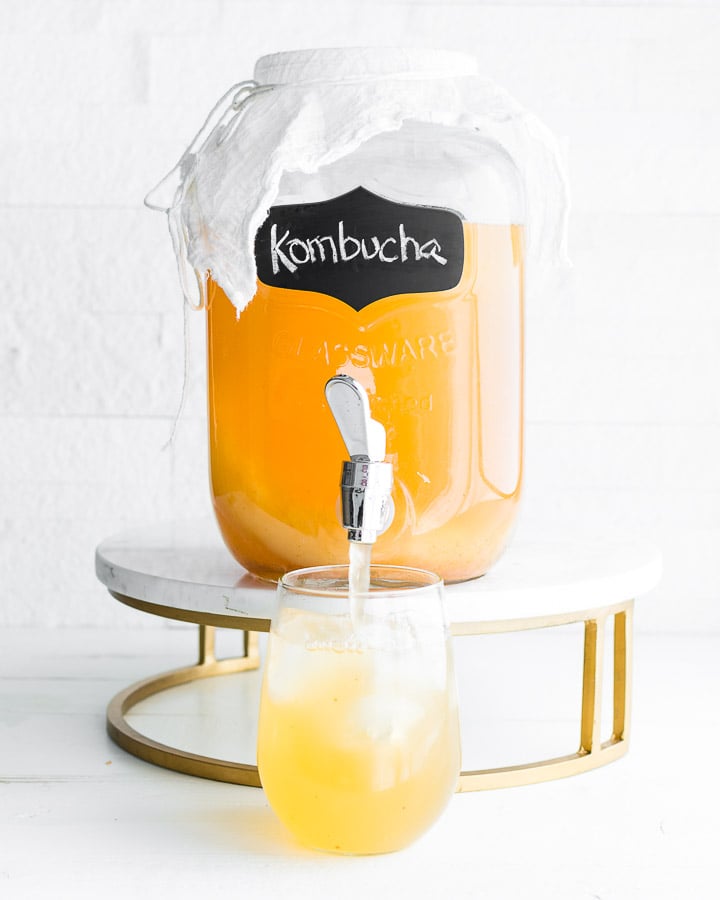
What is continuous brew kombucha?
Continuous brew kombucha is a brewing technique that allows you to have a constant supply of kombucha. Unlike batch brewing, which is done in jars, continuous brewing uses a larger vessel equipped with a spigot. This method allows you to draw off finished kombucha when you like rather than all at once.
Since you only draw off up a little kombucha at a time, continuous brew tends to ferment faster and more efficiently. Further, this technique also significantly reduces the amount of time it takes to brew kombucha, including clean-up.
Most commercial kombucha producers use the continuous brew technique because of its ease and efficiency. However, it's also well-suited to the home brewer who may only need a gallon or two a month.
How does it work?
Continuous brewing is a simple process and tends to be easier and less time-consuming than brewing single batches. You start by making a large volume of kombucha. Most homebrewers find that 2 gallons are sufficient, but others make more.
When the kombucha finishes its first brewing cycle, by producing a baby SCOBY and acquiring a pleasant sour-sweet flavor, you can draw off about ⅓ of the finished kombucha. Next, you replace that volume with fresh sweet tea, continuing this cycle indefinitely.
And just as you can use this method with kombucha, you can also use it to brew jun as well.
Benefits of Continuous Brew Kombucha
The continuous brew method is an easy, efficient, and low-maintenance approach to making kombucha at home. Both continuous brew and batch brewed kombucha will taste pleasant with that distinct sour-sweet flavor, and will offer the same nutritional benefits, there are some distinct practical advantages to continuous brew.
- Continuous brew ferments faster, so if you drink kombucha regularly, it's a great option.
- You can brew a large volume, so if you're brewing for a family (or drink a lot yourself), you'll save a lot of time.
- It's more nutritionally diverse. Beneficial acids are produced late in the kombucha brewing cycle but may make the brew too acidic to enjoy. Because a continuous brew vessel contains both young and aged kombucha, you'll get those acids paired with a lighter flavor (1).
- There's a lower risk of contamination. Since you handle the SCOBY less often with this method, there's less opportunity for contamination by mold or other microbes.
Ingredients for Making Kombucha
There are three primary ingredients you need to make kombucha, whether you make it in batches or in a continuous brew container. You'll need a kombucha mother or SCOBY, tea, and sugar.
- A kombucha mother or SCOBY is the culture that ferments your sweetened black tea and turns it into bubbly kombucha.
- You'll also need tea. Kombucha brews best with black tea; however, you can train your kombucha mother to green, oolong, or other teas.
- You'll need sugar, too. Sugar feeds the beneficial bacteria and yeasts in the SCOBY that turn your tea into kombucha.
Choosing a Continuous Brew Container
Choose a continuous brew container that can hold at least 2 gallons and up to 5 gallons of liquid. Since you'll need to draw off tea as it brews, your brewer should also feature a spigot. Plastic, wooden, or high-quality stainless steel spigots work best, as kombucha's high acidity may cause spigots made from poorer quality metals to leach.
Kombucha contains a wide variety of bacteria and yeast. And as the tea brews, the heavier yeast tends to sink to the bottom of the brewer while lighter bacteria tend to float. So, for an optimal brewing experience and for the greatest microbial diversity in your kombucha, you'll want a mix of both.
Accordingly, consider purchasing a continuous brew container that features the spigot in the center of the brewer rather than at the bottom.
If you can't find one, remember to stir your kombucha before pouring a bottle from the continuous brewer.
Maintaining Continuous Brew Kombucha
Maintaining a continuous brew system is fairly straight forward once you've established your first batch. It takes a little forethought and small amount of periodic maintenance.
- Give your kombucha time to get settled in the brewer. Your kombucha will need up to 1 week in the continuous brewer to develop a new SCOBY before you begin continuous brew maintenance.
- Stir the kombucha for optimal microbial balance. Before removing any kombucha, lift the SCOBY up slightly. Then, stir the kombucha with a wooden spoon to distribute the yeast and bacteria.
- Keep at least 20% of the kombucha in the brewer. That way there's plenty of bacteria and yeast to ferment any sweet tea you add.
- Always replace what you draw off. If you pour off a quart of kombucha, replace it with a quart of sweet tea. If you draw off a cup, replace it with a cup of sweet tea.
- Separate the SCOBY's layers. Kombucha SCOBYs will continue to grow in your continuous brewer, and you'll need to separate them from time. You can give extras to friends, or compost them.
- Clean your spigot if it clogs. Occasionally yeast will clog the spigot, or a new SCOBY may form in the spigot. Drain the kombucha, remove the scoby, and clean the spigot with pipe cleaners or a small bottle brush until water runs through it freely. Then return the kombucha and SCOBY to the brewer.
Get the skinny on kombucha.
Kombucha is a traditional fermented drink made from black tea and honey. While its origins are a mystery, researchers believe the brew got its start in ancient China. It's also popular in eastern European countries, like Russia, and is increasingly popular in the United States where you can find it on many grocery store shelves.
Fortunately, it's also super easy to make. And if you want to get more from home-brewed kombucha, check out these posts.
Troubleshoot your brew, and make sure you're not making any of these big-time kombucha brewing mistakes.
Give these fermented drinks a try next

References
- Crum, H. & LaGory, A. (2016) The Big Book of Kombucha. Storey Publishing.


Kurty says
I'm confused about this, too. It's probably going to take a while for 2 quart of boiling water to cool to room temp. Most tea steeps in 3-5 minutes.
Maybe it's okay to make it so strong, because we are diluting it with 6 qt water later?
Torrey says
Is there a trick to keeping the spigot free flowing and not congested of SCOBY strings?
Jenny says
Periodically you'll need to run a pipe cleaner through the spigot, or use a CB brewer with the spigot toward the middle of the brewer rather than at the bottom.
Margaret says
I recently made my first batch of Kombucha following the instructions from your cookbook. It turned out great but I wanted to flavour it and create some of the fizz that I love from the brands that I buy from the store. I bottled the finished kombucha in a flip top bottle and let it sit on the counter as suggested in the book but when I was ready to refrigerate, I notice what appeared to be several small dots of dark mould on the surface. I put it in the fridge, disappointed and afraid to drink it. What would have caused this to happen so it doesn't repeat with my next batch...was it indeed mould from my description? I haven't been able to find much info on mould during the second ferment.
Amanda says
Does it matter what size of flip top bottle you use for your second fermentation? I have 64 ounce ones I bought from hobby lobby. I left them in the pantry to do the second fermentation with fruit in them for 5 days checking them every 2 days and they never got fizzy. Yet again my house is 61-65 degrees. Do you think it's the temp of my house or the large bottles that causes no fizz?
Marie says
Woah! Once a week? I pour off 1/4 of it every day on my 2 gal continuous brew jug. If I wait longer than a day or two it gets way too much like vinegar. If it goes longer than 3-4 days I usually dump it and restart. Is it cold in your house? Maybe it's because it's summer and gets close to 90 in here quite frequently.
mindy novesky says
How do I get my kombucha to "fuzz" more....?
P Kaufman says
Writing to ask if using parchment paper to keep out insects breathes enough for the Scoby? This is 100% Unbleached from the brand "if You Care" I don't have coffee filters, and wonder about bleached white paper towels..... A friend gave me a scoby last week, and so far it seems to be doing well! She recommended that I use filtered water, that she found chlorine is not good for scobies. Thanks for your article
Sara says
Oh boy. I am good at following recipes, but I sure misread this one! I got a quarter of a large mother scoby from someone and started my first brew today. I added way too much sugar- as I misread your recipe as one quart water to one cup sugar (missing the added three quarts after steeping the tea). So, my kombucha has three cups sugar with three quarts liquid (plus about a cup of mother tea). Should I just start over or increase the liquid ratio with water? I have a 2.5 gallon crock. Thanks for your help in advance, Jenny.
Wanda Feltman says
Could I use organic coconut sugar instead of white sugar?
Jenny says
Yep, that should work!
Sarah says
Are there any fruit juices that cannot be used - for instance citrus etc.. Thanks:-)
Dani says
Not sure if someone has already asked this, but if it isn't safe to use a plastic container to brew kombucha due to the plastic leeching into the kombucha.. why is it all right to use a container with a plastic spigot? Won’t the chemicals from the plastic spigot leech into the kombucha that way also? Thanks
Cathy Earp says
I have a question, I had a nice thick scoby stored in the refrigerator for several weeks in a closed glass jar in sweet tea. (I hadn't realized I should keep replenishing the sugar every few weeks) Recently I took it out and I am trying to restart it. I have it in the sweet tea with 1 cup of finished kombucha on the counter top. My tea smells and tastes like it is fermenting. Can the tea ferment just from the one cup of finished kombucha I added to the sweet tea or can I be pretty sure my scoby is coming out of "hibernation"? How do I know? Should I try fermenting some tea without any starter next to test it? Any ideas on this would be appreciated! Thank you.
Jenny says
You need to get a new scoby. It should never be refrigerated.
Traci says
Can you please explain why the SCOBYs should not be refrigerated? 20 years ago when my mother was making kombucha, she made it only in the refrigerator. My own experience is that SCOBYs are much hardier than most people give them credit. I've had success with them hoteled in the refrigerator, hoteled in my pantry where I apparently neglected them because I didn't know I was supposed to be adding sugar tea every few weeks. They went without new sugar for six months and then after a slow start, produced the best batch I've made to date.
Jenny says
Traci - You just expressed in a different comment that you have issues with mold forming. Mold *is* rare with a properly handled and well cared for scoby. If you're having issues with mold, it's probably because you've refrigerated your SCOBYs.
Anita says
Jenny,
I have read that it must brew in darker conditions and that's why containers that are not glass are good...is this not true? Does your glass container work just fine in the open? Or do you cover the whole thing with a cloth to keep it darker? Or is it in a dark place always? Please reply as I'd like to order something soon but need to know if glass is fine. Thanks, anita
Jenny says
Nope! Not true! One of the many, many myths of kombucha. Glass works fine.
the panorama sg says
Please don't plagiarize the effort of original authors. You'll find an excellent spot to curl up in the sun aand dash in the waves,
with few distractions or other tourists. Whenever you think of Vegas, what comes to mind?
Dallas Mold Inspection says
This implies yoou are never vulnerable to your fuel running out before a distribution is created.
Treating your problem will help you regain confidence thwt you thought you lost forever.
A number of people aleo provide white-colored streaks.
amanda says
Hi Jenny, Im not sure if this question was already answered in previous comments, i was wandering once u add some of the tea to the flip top bottles with the added juice, how long do u ferment that before you and your family drink it?
Mrs. Mills says
My mother and I bought a mother twice from our local health food store. It came with the cup of kombucha tea, but both times our tea developed mold. We followed all instructions both times. We're so frustrated. Has anybody experienced this? The store tried to tell us that it was because we stored the package in the refrigerator while we prepared the sweet tea, but that's where they had it stored. ????
Jenny says
Mothers shouldn't be stored in the refrigerator, and I recommend strongly purchasing from a trusted *online* retailer who specializes in kombucha.
Traci says
I read often that mold is rare, but I have also had issues with mold forming. Make sure it is truly mold (green fuzzy circles) and not bubbles that have formed in the bottom side of the baby/new mother. I believe my mold issues are the result of organisms in our house throwing the SCOBY out of balance growing much more yeast that it seems should be there. The more you ferment, the better you get at ascertaining what's happening. When I see it getting too yeasty, I do a longer ferment (two to three weeks for me, more "vinegary") which seems to get the yeast-bacteria/ph balance where it belongs. Also every once in a while I let it ferment for a couple of months essentially producing kombucha vinegar which we then bottle up and use in place of other vinegars, and also put in our chickens' water supply to increase their intestinal health and inhibit worms, etc. When I start a new batch after a longer ferment, the ferment goes faster and is fabulous.
Carrie says
I have a large continuous brew container. Just started 2 weeks ago with a gallon batch. I am drawing off 25% of that today and replacing it with the same amount of sweet tea as prescribed. How do I grow my batch to 3 gallons without compromising my SCOBY? Not sure about the ratio of sweet tea to Kombucha I can safely add to increase my batch. Thanks!!
Suzie says
I was making and enjoying kombucha, but recently had concerns about candida overgrowth in the body and am trying to follow a diet to prevent that. I wondered if anyone could advise on the use of Kombucha and it's effect on Candida overgrowth
jennifer says
I've been following for so long for wellness and recipes, and wondering why I've waited so long to get into making my own kombucha. This is one of the best blog posts I've seen and the comments are [mostly] very informative. Thanks, as always, for posting, Jenny.
Trinity: Thank you so much for your input!! I'm finding it super helpful 🙂
Marjorie says
Great post. I was checking continuously this weblog
and I am inspired! Extremely useful information specially the ultimate section 🙂 I maintain such info a lot.
I used to be seeking this certain information for a long time.
Thanks and good luck.
http://www.youtube.com/watch?v=thJYV2BU0cg says
You need to take part in a contest for one of the most useful websites online.
I'm going to highly recommend this blog!
Rachel Wolf says
You convinced me. And after mulling over what large glass container to buy to ferment in I found a one gallon spigot jar (for sun tea) at the thrift store and picked it up. Now I'm back and see that you suggest 2 - 5 gal. Ack! Any reason a 1 gal won't work if we don't tap off too often? Thanks for any advice.
Beppy White says
When I bottle my kombucha I place a small piece of candied ginger in the bottle for flavoring. I usually leave the bottles on the counter for a day or two before putting in the frig. I love the ginger taste.
Alton Brice says
What should I get to Offer Warmth for Outdoor dining?
Trinity says
Answers to some questions as I read the previous comments:
1. I made my own starter SCOBY earlier this year using plain-flavored GT kombucha. I actually put the tea, sugar, and kombucha together and then forgot about it for a while, and when I went back (a month or two later), I had a really nice, big SCOBY.. So those who are saying it can't be done this way anymore are mistaken. It MIGHT take two bottles of GT kombucha instead of one (I think I used two just for "insurance"), but it certainly can be done.
2. I use Lipton decaffeinated tea bags (my husband and son get headaches from caffeine). It works just as well as caffeinated tea.
3. I quit making kombucha for a little while because I simply don't have the refrigerator space for all the bottles needed for the batch-brew method. In the mean time, I kept my SCOBY in a gallon jar with a few cups of sweet tea and covered the jar with a piece of cheesecloth. I put it up on top of my refrigerator for a couple of months, and it survived just fine. Now it's in a brand-new 2-gallon batch of continuous-brew, along with all of the kombucha that was in the jar.
4. A washed piece of unbleached muslin (from the fabric/craft store) makes a great kombucha jar cover. I tie mine on with a piece of kitchen string. I might decide to get fancy with it later and add some elastic.
5. I bought my 2-gallon glass continuous-brew container at Target. They had several choices there, ranging from 1.5 gallons to 2 gallons. I chose the Anchor-Hocking one, even though it was a little more costly (about $30). because I trust the quality of that particular brand. I have also seen them at HEB (Texas grocery store chain), and I've heard that Bed, Bath, and Beyond and Wal-Mart carry them, as well.
6. Look for the EZ-Top swing-cap bottles (like in the photo at the top) at your local home-brewing supply store. I think I paid just under $30 per dozen for 16-oz bottles.
7. It's perfectly normal for the SCOBY to sink to the bottom, float on top, or anywhere in between. And the film that develops on top (as long as it's not fuzzy) could very well be a new, baby SCOBY forming.
Traci says
Regarding 7., I whole heartedly agree. My SCOBYs are sometimes on the bottom, floating in the middle or hanging out on the surface. I ALWAYS get a new baby forming on the surface, with every batch. It starts out as a very thin membrane which becomes milky and patchy looking until it gets thick enough that it is completely opaque. Babies form on the surface of the liquid.
William Motley says
Hi Jenny,
I noticed that the swing top bottles keep the kombucha's fizz intact. If I just put it in a normal container and let it go flat will that affect the probiotics or only the taste?
Mikey F says
Hi, This looks like a great way of making kombucha, and im really thinking of trying. My question is, I couldnt see anywhere about adding extra sugar after each drain off? is it necessary?
thanks in advance
Trinity says
When you draw off some of the kombucha to bottle it, you add that amount of sweet tea to the kombucha brewing container. Use the same recipe (above) for the sweet tea that you used to make the kombucha to start with. If you draw off 16 oz of kombucha, add 16 oz of sweet tea to your brewing container to replace it.
jill says
How do you all sterilize your large jar and flip top bottles? I read that serilizing all of your equipment is essential to prevent contamination and I'm not sure how to properly sterilize this huge jar that I bought that doesn't really fit in my dishwasher (sanitization cycle). I have a scoby sitting in my fridge because I'm too nervous to start my batch without sterilizing it. How about the tea you add- need to always sterilize your tea kettle before brewing more tea or is this not really a huge issue. I don't see any instructions about sterilizing here.
Jenny says
I don't sterilize, because I don't think it's necessary.
Cathy Earp says
Once my larger containers and utensils have been scrubbed with soap and hot water then rinsed extra good, I fill the large containers with boiling water to the top and overflowing and let it sit a few minutes. I don't have a dish washer and this is the way I sanitize.
http://www.chinasingels.com/LeandraFr says
Moreover, meal replacement products are usually high in protein.
Use skim milk or fat-free yogurt that contain about 80 calories per serving.
You can also use a calorie guide to determine how many
calories are in certain foods or dishes that do not have labels.
Marian Gall says
I had a kombucha going quite a few years ago when we lived in the motor home. It rode beside the copilot seat and really did well. Since my husband would absolutely not drink that stuff, it was just me and it got away from me. I am alone now and was thinking about this the other day and was wondering what it was good for. I am 78 and need all the help I can get. Any information would be appreciated also where to buy a starter kit.
Rose says
What kind of fruit juice do you add to make it more fizzy? I'm hoping to create a taste similar to GT's citrus kombucha. Is it ok to add lemonade
Audrey M says
I live in San Juan Capistrano CA. Where is the best place to get the continuous container. thanks
Rose Marie says
I just bought my 2 gallon at Target.and someone else said they found one at Walmart.
Stefan says
Has anyone seen any actual evidence that Kombucha needs to use caffeinated tea from a real tea plant? I am really interested to know if this is necessary. I would be suprised if the caffeine was necessary for the bacterial or yeast growth. I personally have been using twig tea which are the small branches from a tea plant. It has insignificant levels of caffeine (ie much lower than green tea). So far my colony has been going great (mind you, I have only had it going for about three months).
Mirian says
I react badly to caffeine. Does kombucha have caffeine? Can I do half tea and half Tulsa tea?
msrudy says
good morning~ I just started my brew almost 48 hours ago and I started with 1 gallon of sweet tea as that was the only size vessel I had ( I thought I could scurry up a 2 gallon jar) Meanwhile, I made the initial 2 gallons of sweet tea. Can I successfully, combine the 2 tea's into a different jar now- to continue with the ferment? I would hate to waste the gallon of sweet tea that is sitting in my fridge as I don't drink sweet tea. Any and all advice is welcomed. Thank you~
Brixie says
I'm sorry if this question has already been asked or silly. I received a kombucha mother last week and have gone through steps 1 and 2. Now I'm ready to draw off 25% of the kombucha, but I'm unsure of the sweet tea recipe that I use to replace the 1 quart that I'm planning to draw off. Is it the recipe above (1 qt water, 2 T tea, 1 cup sugar) or do I need to consider the 3 quarts of water that was added in step 1 making the sweet tea recipe (1 qt water, 1/2 T tea, 1/4 cup sugar)? Thank you 🙂
Paula M says
Hi Jenny,
A friend gave me a scobby a few months ago and I started making Kombucha using your continuous method. Now, my problem is that we don't consume that much Kombucha at all at home. Sometimes I forget that I have a bottle in the fridge. Is this an issue? How long can the mother go before I should take some of the Kombucha tea and replace it with new sweet tea? Thanks
Celeste says
My first brew is over a week old. The scoby has been floating near the bottom of my jar the whole time, and now there is a white icky looking film on the top. Since my kombucha kit sat in the refrigerator, I'm wondering if it was any good. How do I tell a healthy brew from one that's gone bad?
Jenny says
Celeste, I think the issue is that you refrigerated your kombucha kit. Kombucha is very temperature-sensitive and is not well suited to refrigeration. I would throw it out and start over.
Dee says
I took a break refrigerating my scobys for months. ..then gave away my good ones. Decided to try again but realized all i had was cut up refrigerated scraps i planned to compost. I used these and i was successful in growing a nice round scoby and lovely brew.
Dee says
If the top film is smooth and off white or beige
and not fuzzy and other colors it is your new scoby. I had my scoby in the fridge for months and worked fine.
Dee says
It should smell slightly vinegary and not rotten smelling.
Kerri says
Do you ever check the pH of your brew to see if it is in the "safe-to-drink" range? By the time mine reaches a 3.0 pH, it is reeeaaaaallllly tart. Should I just not worry and drink it at will?
Celeste says
Hi! I just started my first batch of kombucha. However, I read in Nourishing Traditions that I shouldn't have used non-organic tea because it's high in flouride. I didn't have any organic tea so I'm wondering if that will be bad for my brew.....I don't have a problem with flouride, and I'll eventually buy organic tea when I make more, so that the flouride will eventually be gone...In the meantime, I'm wondering if I've wasted a scoby.....any thoughts?
Jenny says
I think nonorganic tea is fine. I'm a big fan of doing the best you can with what you have. No worries.
Amy says
I bought a glass container very similar to yours. I see in the picture you have that the cover is on. Do you always use the cover or do you instead use a coffee filter or similar thing in place of the cover? My cover is not a tight seal and I wondered if that would give it enough air flow. Thanks for all of the info!
Brianne says
I use a jar with a lid similar to the one in the picture and I've never had any problems! It doesn't create a tight seal so it still works.
Annie says
Hi Jenny and all.
I have been given a scoby and am excited to start making my first brew.
Since I am a Mormon, i'm not sure about which tea to use as we dont use black or green tea. so i'm going to use all Roibus tea.
Has anyone had success with this?
Thanks for all the great information.
I adore fermented foods.
Jenny says
If you cannot use caffeinated tea because of religious reasons, I recommend you find a different tonic, as kombucha needs to be made with the tea plant.
Erinn says
Im wondering what kind of tea to use to start my first batch?
Brittney @ Sound in Wind and Limb says
My mom makes this tea but I I have yet to try it. I am not a fan of cold tea but I know fermented foods is really good for you. I like that you can flavor it to make it more tasty. I may try it with flavor! 🙂
Charlie says
Thank you!
Charlie
Charlie says
I have a problem here.
I'm allowed nothing with even a hint of caffeine in it.
That includes green, white and decaffeinated.
Any suggestions what I could use as a base?
Have a Joyful Day :~D
Charlie
Jenny says
In that case, I'd recommend you look into other fermented tonics like water kefir and beet kvass, avoiding kombucha.
Kate Sanford says
Could I just ask whether I could use normal, decaffeinated black tea?
Jenny says
Absolutely! That should work.
Cathy Earp says
I have a friend who uses rooibos, said to have no caffeine and her scoby is healthy. She uses the continuous method.
Misty says
I rec's a scoby from a friend. It sat in about 1 cup K-tea for 24hrs. until I could get to it. When I placed it into the sweetened tea it sank to the bottom of the gallon jar. Not flat on the bottom of the jar, kind of on it's side. Did I kill it?
Tara says
Can I use a SCOBY from my homemade apple cider vinegar jars to make the kombucha with?
Jenny says
No. You need a kombucha mother.
sydney says
I just started brewing kombucha using your instructions, this is my first batch. However, I when adding my replacement tea, I accidentally added it cold and not room temperature. How do you think this will affect my continuous kombucha? THanks.
Jenny says
It shouldn't affect it at all. Take care.
Pamela says
A question from a novice. I was given a Scoby mother in some tea so that I could start making kombucha but I just didn't get around to it. Anyways, I have kept the scoby and tea in a mason jar with the lid slightly ajar for air. And I have kept it in my pantry cupboard so there is no dust. It still smells fine to me and there are no funny growths or molds. Do you think it is still safe to start up a batch of kombucha with this existing scoby or should I get a new one? Thanks for your help and advice.
Kathryn says
I have a question. I have difficulties with yeast--it makes my asthma act up. So, . . . I'm not sure if I should even try Kombucha. Does anyone have any thoughts?
Jeanmarie says
Before you go to the trouble of making your own, you should try a little from the store, plain flavored. That said, I don't think the type of yeast is closely related to candida, for instance. I had candida problems for years and kombucha doesn't cause problems. The only way to know is to try, starting with just a little and working up gradually.
Pamela says
Jenny, you do not mention anything about the issue of the spigot plugging. Don't you have that problem?
I went back to my old standard way I've been brewing for over 4 + years. After around 5 -6 months of continuous brew I had it with the spigot plugging up every 2 weeks. I had to empty and clean / remove the spigot and with tweezers and an air compressor
blow out the tiny little scoby's that grew inside the spigot.
Jenny says
Nope - I've never had that problem, though I've heard it *CAN* be a problem. Sometimes the spigot starts to run slow, so I stick a pipe cleaner in it to clear it out a bit.
Pamela says
Pipe cleaner never worked for me, probably the style of the spigot.
I have come across several that do continuous brew in a larger jar with out a spigot.
And just dip in using a ladle. So that is an option for anyone that doesn't have a container with a spigot.
Sara says
I got a great kit from Kombucha Brooklyn to get started with. I'm on my 3rd brew since the end of december. It comes with a gallon jar, tea, sugar, flavorings, and a really powerful scoby. It's not continuous but makes a big enough batch that I am only brewing every 10 days
Vanessa says
This is a great post. My mother has been making Kombucha for a while now. I've always wanted to make it but never have, but she came for a visit recently and brought up some of her SCOBY, for me to make my own. It's funny how excited I was. My first batch is on the second fermentation for the flavor. I can't wait to try it. I plan making the contunous brew too, it just seems to make more sense.
Brooke says
Hello,
I started a brew last week of 1/2 gallon's worth of Kombucha. I started with such a small amount because my scoby seemed so small in my continuous brew container. Is it possible now once Ive started to increase my brew by another 1/2 gallon or gallon? If so, how much should I remove and how much sweet tea mixture should I add back in? Im nervous I will mix up the proportions
Thanks!!
Peggy says
I confess to being one of those who drinks a pint at a time! Now that GT's is "enlightened" (read: watered down) it is easy to drink 16 ounces of it in one sitting. when I was home-brewing, I could only drink about 4 ounces diluted with an equal amount of water and sometimes 2 ounces of fruit juice added per 16 ounces of kombucha as well. I can heartily recommend the mother cultures from Cultures for Health. The first several batches I make from their mother are wonderful, like tea with lemonade! Soon, though, yeasts tend to take over and the flavor changes for the worse. It could be that a continuous brew would prevent that problem. I use filtered water and organic, unbleached "white" sugar.
Oh, and the compost pile LOVES old mothers. Heats it up very efficiently!
Aliyanna says
I have an odd question...how do you keep your kombachu from bothering your other ferments? I have had a terrible time with it and my kefir. Do you think lidding it loosly would do the trick?
Brooke says
Aliyanna,
I have read its important to keep your kefir and other ferments away from eachother.. at least a few feet but across the kitchen or even another room is preferable
Nancy Lee says
I like the thought of having continuous brew kombucha available! It sounds easier than what I'm doing. Initially, I started by growing my own mother (or SCOBY) using two cups of kombucha with some strands in it, which I got from a friend. It took over two months. It never produced a baby, and eventually the brew tasted very yeasty. I consulted Hanna Krum, Kombucha Mama to ask why, and this is what she said (taken from the Kombucha Kamp FB page):
"Thanks for your kind words and Merry Christmas to you and your Mom. Sadly, I don't think you're gonna like what i have to say. Growing a SCOBY is no longer recommended (and takes 12 weeks! what a waste of time!): http://www.picklesnhoney.com/2012/06/15/homemade-kombucha-giveaway/
Also, since it's not reproducing, it's not even making Kombucha, just a yeast drink. http://www.kombuchakamp.com/2012/04/top-5-signs-of-a-healthy-kombucha-brew.html
Commercial brands are weak and watered down for the most part; good to drink but not as starter for real Kombucha. We believe that just like anything it's critical to start with the best ingredients. That means full size, full strength, genuine Kombucha cultures. A heater is important for the best flavor but no amount of heat will make a weak culture into a strong one. http://store.kombuchakamp.com/Kombucha-Mushroom-Cultures/"
I bought a new starter SCOBY and a warming strip (it's chilly here). Ten days later, I had kombucha, and a baby! It was perfect. I'm on my second brew with the new SCOBY, and I'm glad I invested in it.
I do keep my crock in the corner on the kitchen counter, with a cotton kitchen towel covering it. The towel is secured with a large (clean!) hair band. You could also use a rubber band if it's big enough. I have a small painting propped in front of the crock. It's pretty, and it keeps strong light away from the crock. I have a warming unit that I keep very loosely wrapped around the outside of the container. I have a temperature strip on the side of the crock that stays about 82 degrees all the time. I'll leave the strip plugged in in the colder months.
I hope everyone tries this wonderful, healthy beverage. I'm such a convert! And thanks for sharing the recipe, Jenny!
Basia says
About 5 weeks ago, I tried starting a SCOBY from GT's store-bought unflavored kombucha. 4 weeks later (it takes a long time in upstate NY in WINTER!) I took my SCOBY and started a batch of kombucha. It's been 7 days, the SCOBY is brewing away, making a baby, and having a fine time. In the meantime, since I just couldn't wait - I bought more kombucha. When I opened one of the bottles, a tiny SCOBY floated up to the top and said hello! So, I got out my quart jar and started another batch in order to have a back-up SCOBY. The 2nd time, I used the kombucha from my original starter jar. It had become very sour. The newest SCOBY is taking off like a rocket! It really loves my homebrew! I would say not to give up on trying to start a SCOBY from purchased kombucha. It took 4 weeks, not 12, and we're all having a lot of fun with this experiment! (PS - that heat wrap? It's heat tape used for reptile enclosures, and sells for ~$2.00 per foot online. I've been using my dehydrator as a heat source. Thinking of getting some heat tape instead.)
Lena says
I've read that kombucha needs to be kept at a minimum of 75 degrees while brewing in order to foster the development of the beneficial bacteria, and actually found that when I tried keeping it at a lower temperature, my scoby grew mold. How do you keep yours warm enough? I live in the Pacific Northwest, and my kitchen rarely gets above 65 degrees. I've even tried keeping it on my water heater, but it's still not warm enough.
Janice Homan says
I bought a seed germinating mat that I set mine on and it works great. Its a plastic mat, and is safe if anything drips on it. I also use it for raising bread in winter months when our kitchen is cold.
P R says
Is this correct? I have mine in basement back room to keep from light. Sooo I need to have it warmer? Do I need to dump what I have "brewing"?
Cat @ NeoHomesteading.com says
I love the boocha! This is such a great post. I do so many ferments but kombucha is one I never succeeded with. I read you can make it with a bottle of kombucha as starter... you can't. Atleast mine didn't work. I want to buy a shroom, for now I just make quick ferment "sodas." The water kefir was not a huge hit. (Raw milk kefir is always around but sometimes you just don't want milky stuff.)
jenny says
Food Renegade talked about that recently - she indicated that, in recent years, kombucha manufacturers have added something that might prevent culturing a new mother from raw kombucha? See here: http://www.foodrenegade.com/kombucha-scoby-experiment/
Riley says
A little over a month ago I grew a SCOBY from two bottle s of KT I picked up at the store, so at least in done cases it's totally doable...
P R says
I would be happy to send you a mushroom - send me a PM
Stephanie says
Just last January I was able to grow a scoby from a bottle of kombucha. It took about 3-4 weeks though.
Sharon says
Does it matter whether you use regular tap water, reverse osmosis or spring water to make kombucha?
Siobhan says
I really love Kombucha. My family did it for maybe over a year. However we stopped after I had my third baby b/c it got overwhelming for my husband during that time. Now that the baby is almost six months we are feeling like we are missing it now and feel like we can get back into it. 🙂 Well our question is do we really need to use sugar. How is that self-sustainable? Did the primitive cultures who did this really have all that sugar to give to the Kombucha mother? 😉 What about honey. Honey can be must more easily self grown then sugar. So can you replace the sugar with honey? I wonder Jenny if you have thought of this and or if you know anything about this.
One tip I gained from doing our Kombucha was letting the Kombucha age for a second week in their capped bottles in a very warm place. We had the best Kombucha when it "aged" on our cast iron heaters. The heat really help it get fizzy. Like Soda.
Well happy Kombucha making. Enjoy!!
Rachel says
We've been doing continuous brew kombucha for about a year now, and this post was still very informative to me! After all that time, our SCOBY is huge! It's probably almost 2 inches thick and more than 6 inches in diameter. I've heard that some people will separate off layers of these larger SCOBYs to have as back-ups or to give to friends. I haven't been able to find that much information about whether it is beneficial or not to do that or to just let it grow. Do you have any thoughts on this? Do you just let yours get as big as it wants? 🙂
jenny says
I let mine get up to 6 inches thick, then I separate it out. Mostly I compost the babies, but my kiddo is after my to make kombucha scoby candy. I'll post a tutorial on that soon.
Jeanmarie says
An alternative to composting your extra scobies is to cut them up and feed them to chickens or other livestock. My chickens love it! It's a protein boost and infusion of beneficial microbes all in one.
Wendy says
Hi, so can the scoobies be consumed in ways other than candy? Say, in a stir fry or salad?
Thank you
Jodie says
wow, tysm for the info. I never thought about feeding them to livestock before, and we used to have a small farm years ago. Too bad I didn't know about Kombucha then.
Sherri says
I have been doing continuous brew for a few months now and will never go back to the jars. But I find the tea to strong/vinager taste when I leave the scoby get to big. I like it much better when I separate them and not have it to thick. It is hard to separate them sometimes without ripping them. Is that ok?
BTW I love all your posts and read them and pass them on to family and friends! Thank you!
Jeanmarie says
It doesn't really matter if they rip a bit, they'll just grow back.
Chiazor says
I posted a question to my fans on Konbucha just yesterday wondering what the benefits are and how their experinces have gone attempting their own. Would you mind if I share on facebook so they can benefit from this great article as well?
cecelia says
Another question: Do you keep it in the dark or is it alright to have it in a kitchen full of natural light from lots of windows? Does direct sunlight need to be avoided?
Bebe says
Yes, avoid direct sun hitting your kombucha jars, unless they are opaque, like a crock.
Basia says
Ultraviolet light sterilizes. Natural sunlight, even coming through your windows, contains UVA & UVB unless your windows are coated. Since you're growing bacteria & yeast, avoid allowing your kombucha to come into contact with anything that sterilizes.
Bebe says
Thanks for this lovely tutorial on continuous brewing. I have finally figured out how to keep mine rolling along, after way too long ago acquiring the equipment! I think the amount of time it takes for each batch to finish depends on several factors: temperature, volume of kombucha left in the container and size of scoby. Mine is done in a day or two if I just take and replace a couple quarts out of a 2.5 gallons. If I take a gallon it might take 5 days, if I take 2 gallons it might take over a week.
I bought a warmer from Hannah at Kombucha Kamp that wraps around the crock and keeps my booch cozy in the winter months.
I also think that the volume of kombucha a person consumes has much to do with the state of their gut and their personal need for probiotics. That is, sometimes I CRAVE kombucha intensely and will chug down a pint without batting an eyelash! Most of the time I drink it in more moderate amounts. My 13yo son does the same with sauerkraut and kimchee. He is the guy with the most compromised system in our family: type 1 diabetic and ADD. (He's also the youngest of seven and was born just 14 months after his older brother... there's the seed of a whole new topic about child spacing and maternal health at conception! If I knew then what I know now...) I figure if he's craving it, he needs it. I am sure GAPS would be wonderful for him but there's the sticky little matter of agreement, both from him AND his dad. In lieu of that I just make everything with bone broth and good fats and let him devour whatever amount of ferments he needs.
Dina-Marie @ Cultured Palate says
Hi Jenny,
I have used the continuous brew method for quite a while now and love it! We have a large family so I keep 8+ gallons going at once. I am glad to know that you can use other teas - I thought it had to be black tea but would like to try different ones. I have had flavored kombucha and really like it but have not yet tried to make it yet. I do use sugar because I read that honey could potentially harm the scoby and like you said, it is consumed anyway. Thanks for the info.
Leigh says
I'm wondering what your thoughts are on the spigot. I know you mentioned not using metal, but I had been told not to use plastic either because the acidic nature of the kombucha can cause it to leach toxins. For that reason I am thinking of starting batch not continuous. Even though it will be more work.
Lori Legge says
If a spigot is not optimal ...how about a syphon?
Alexandra @ Creative Simple Life says
If you're interested in learning how to grow your own kombucha mother from scratch using a bottle of raw kombucha, I recently posted about this: http://www.creativesimplelife.com/grow-your-own-kombucha-scoby/
Jennifer Easterbrooks says
I just wanted to add a comment that there is a cheap resource for a SCOBY that I read about and tried that works beautifully. Buy a bottle of Kombucha that has some of the slimy goodies in it. K.T. is a great brand or if you are in Austin, TX Buda's Brew is a wonderful local brand. Pour your Kombucha into a mason jar, cover with a t-towel with a rubberband around the opening. Leave in the jar for 10-15 days until a SCOBY forms. You can use the tea as the starter for your first batch. It works beautifully and is very economical.
Ashlie says
I was also able to successfully grow a SCOBY from a bottle of plain GT's kombucha. I looked for a bottle with lots of "floaters" at the bottom, poured it into a mason jar covered with a paper towel, and in about a week it was obvious that a SCOBY was forming. After a couple more weeks it seemed large enough to try making a batch of kombucha, and it worked beautifully! I've been making kombucha for close to a year now and have so many babies growing that I frequently have to put some out into the compost.
nancy says
I have been wanting to try it; however, the 2-5 gallons sitting on my very small counter in my very small kitchen is a bit overwhelming especially added to the fact that I live alone and am the only one who will be partaking. Is there a way to make a smaller batch without affecting the balance within the formula? Having no experience with it, I don't want to try to alter the recipe. A nice quart or so would be sufficient to have on hand, as it seems that drinking small amounts are adequate for health benefits.
Jeanmarie says
Sally Fallon's kombucha recipe from Nourishing Traditions is smaller, and what I still use after many years: 3 quarts of filtered water, 1 c. organic white sugar, 4 tea bags (I use 2 black, 2 green, a tip I got from KT's), plus the mother SCOBY and at least 1/2 cup of kombucha, which is necessary to get enough acidity to keep pathogenic organisms at bay. Works for either batch or continuous. Just double it if you want more. You can increase or decrease the sugar a bit to your own personal taste. I used to throw in some flavored teas but stopped just in case something in them could interfere with the fermentation. I add flavoring in the secondary fermentation with fruit juice, sometimes a little dried fruit.
cecelia says
when you say "cover loosely", what do you mean? With a cloth, or with a cover left partially off or unscrewed? I'm worried about contamination.
Bebe says
Cloth cover, with something to secure it (like a rubber band) because in the summer months, or all the time in temperate climates, you will have an infestation of fruit flies! Fruit flies are not only obnoxious to have around, they will spoil your kombucha and possibly your mother as well.
As an aside, a little kombucha in a bowl with a single drop of dish soap makes a great fruit fly trap!
Elizabeth Kegans says
You can also cover with a paper towel (which is what I do) or a coffee filter secured with a large rubber band. I have recently started making kombucha, and I have noticed that if some of the sticky sweetened tea gets on the top where I put the paper towel, it sticks to it, ripping a little to get it to come off. So maybe cloth is best, because you can wash them, instead of using up more paper towels or filters. But this does give you more options.
Shelley says
I have kombucha brewing in a half gallon jar right now. I would like to try this continuous method, but where do you find such a large glass container? My biggest jars are one gallon. Any way I can modify the recipe for a one gallon jar?
Thanks,
Shelley
Bebe says
I ordered mine from Hannah at Kombucha Kamp and she is an excellent resource for starters, equipment and know how. You can also just find one of these online: http://www.amazon.com/Products-Ceramic-Dispenser-900114-Refrigerators/dp/B002GK2EOM/ref=sr_1_12?s=home-garden&ie=UTF8&qid=1358547715&sr=1-12&keywords=water+crock
Christina says
Doesn't the plastic spigot get 'eaten away' over time due to the acidity?
sandra says
I bought an Anchor Hocking, made in the U.S.A 2 gallon glass jar with lid at Walmart. I keep a folded flour sack type towel
over the top of it with a rubber band.
Shannan says
What about temperature? Is there a range the kombucha should be kept at while brewing?
jenny says
I don't worry about temperature: whatever is comfortable in your home 68 - 80F?
Gigi Rusk says
I am just starting also. And in reading and checking on line i found that some use a wrap around heater. I feel so much better after reading here to findout I may not. But in the other sites it did say witbout tbe heaters we are leaving the door open to mold. I am so confused and would like to start my brew ASAP what should I do? HEAT OR NO HEAT ? MOLD OR NO MOLD, THAT IS MY QUESTION. THANK YOU SO MUCH FOR HELPING ME NOT TO KILL MYSELF WITH THE MOLD. LOL
Christine says
You want your brew to optimally be at aprox 75 F. If you need to heat, it is best not to heat from the bottom as this over stimulates yeast which can then take over and starve out the beneficial bacteria. Heat from above is considered the best or just "ambient heat" like a heat source in a cabinet that raises the air temp around the vessel which will then raise the brew the ambient temp in the cabinet.
Kerryn says
We tried using honey with our continuous kombucha feeling that we didn't want to use sugar. Many said it couldn't be done, but we gave it a go. While it didn't kill our kombucha mother (we boiled our raw honey for 5 minutes & cooled before adding), it seemed to create a very alcoholic result. We have since thought that doing it this way perhaps cultured it all too quickly & favoured the production of alcohol (which we would rather avoid) rather than the beneficial qualities (which is what we want). Do you know anything about this? We have since gone back to using rapadura after having a few bad experiences.
jenny says
I don't think there's anything inherently wrong with plain, white sugar because it's almost all consumed by the microorganisms. But, I also think it's myth that you MUST use black tea and MUST use white sugar: any tea from an actual tea plant should work and any caloric sweetener should work. That said, there's potentially many things in more natural caloric sweeteners that might inhibit the microorganisms in a kombucha brew. It's interesting that that brew seemed alcoholic. For me, I'd just use white sugar or rapadura and ferment it longer.
Christine says
Actually you have to use real sugar as kombucha requires glucose. Table sugar (any type, whatever process) is a di-saccharide meaning it is 2 single sugars combined (bonded) to make a more complex sugar. In this case it is fructose and the critical glucose in equal amounts. The breaking of the bond provides energy and the glucose is where the more beneficial acids in KT come from. Honey does not contain glucose, it has dextrose instead. If you want honey, I would stick to using it as a flavoring agent when bottling.
Leslie says
I would like to start making kombucha, but I am confused about one part of your recipe. Where am I to get "1 C kombucha tea from a previous batch" when I don't have any previous batches? Thanks!
jenny says
You get it when you order a mother culture - they'll usually send the kombucha mother packed with about 1 cup of the tea or so.
Anne says
I was lucky to have made raw apple cider vinager, so I used that instead of starter from a different kombucha batch.. that worked a treat! One cup in a gallon, and i added one more a week later to be sure it was low enough ph. Read it is possible to use white vinager too!
Christine says
Do NOT use raw vinegar!! Raw vinegar has it's own culture called a mother and it will change your kombucha culture. You will be making a mother of vinegar instead of a scoby (a kombuch mother is called this). If you want to use a raw vinegar, boil it first to kill the living culture in it. All you want it for is the acidity so plain distilled white vinegar is used if you do not have properly soured kombucha from a previous brew. To "Ann" Sorry, but you need to re-start your kombucha if you haven't already 😉
Tamara Cooper says
I don't drink tea for religious purposes. Is there any way to make water kefir continuous, like this, as well?
jenny says
Yes- it's done more or less the same way, but many people keep the water kefir grains in a muslin bag because they have a tendency to clog the spigot.
Alicia says
Good post, and our family loves kombucha. I'm curious why you said it should be consumed in small, infrequent amounts?
jenny says
Kombucha is a medicinal tonic, not a replacement for water - small frequent amounts, coupled with an equal amount of water is optimal. Too many people exchange overconsumption of sodas and caloric beverages for kombucha, and while kombucha is probably better, I don't recommend consuming large amounts of any particular food/drink. But, it all depends on how your body reacts and how it works for you.
Jodie says
Jenny, is this your column? If so, I have a couple of questions and an observation or two. First the questions. You told Alicia that she was right about small amounts, but what is a small amount? I used to make Kombucha many years ago iin 1 gal. glass jars. I usually had two going at once, as my family would drink about 8oz. each a day. Since moving into this house and we've been here 13 yrs. I haven't been able to keep a mother alive. Granted I switched to a water crock used for filtered water with a plastic spigot that we used to use for filtered water, but I have washed it out many times using straight white vinegar to remove any mold and the tea keeps molding. I am assuming that it is from mold in the house. I also haven't a good place to brew but in the dining room which adjoins the kitchen which is only about 4 ft. from my garbage can in the kitchen. This brings me to my second question, should I switch containers completely and where did you get your glass container of such size? I prefer glass as you can see what is going on in it, but have never seen an as you describe with a lid and spigot. I have been buying my kombucha since I haven't been able to make my own, but I can't buy it on a regular basis, it is too expensive. We have been buying GT's kombucha as it is what is available in the big city, and I usually drink 1/2 to 1 of his 1/2 liter bottles a day. I have had no healing crisis from this, but like I say I only get it when we go to the big city and I only buy a few bottles at a time. Is 1/2 liter a day too much? I have been thinking of moving the kombucha farther away from the kitchen and garbage can, say upstairs in the guest room, would that work better do you think. It is darker in there as the curtains are closed, it would be away from most smells etc. and there are no electrical items . I had thought about getting an ionizer for the dining room but didn't know how that would affect the mother either. If you could respond by email or tag my email when you respond I can get the message. tysm for your help. Kombucha has been a part of my life for over 20 yrs and would like to be able to make my own again.
Joy A Pickens says
I always boil ALL the water. I am thinking that the added three quarts are not sterile and may add contaminants. Every once in a while I get a batch that tastes a little off, maybe one out of twenty but we drink it anyway and since I always have several going at t time, I just get a mushroom off of a different one for the next batch. i don't usually take the mushroom off when we start drinking one batch, just drink on it until it starts to taste to vinegary, then add that to the next batch; sort of a modified continuous brew.
Shirley says
Jodie, I was having trouble with my kombucha molding, too. I used to have it out on the kitchen counter and never had a problem, but when we moved to a house with limited kitchen counter space, I started putting it in an unused bathroom cupboard to keep it out of direct sunlight. There was a small garbage can a few feet away, just like you. I couldn't get an un-moldy batch, ever. It turns out the combination of too little airflow and bacteria from the garbage, even though it was mostly things like paper towels, was/were the culprit.
I've since moved it from the cupboard to the counter, in the same room, and have now made several successful batches. Getting your brew away from the garbage may be the answer for you, too. Good luck. 🙂