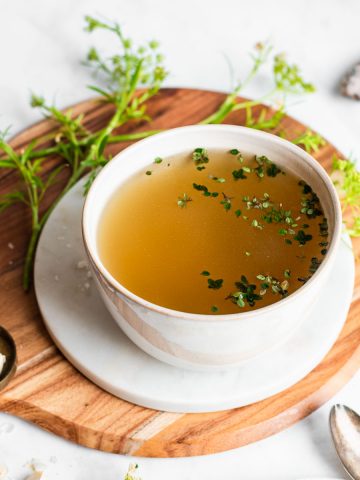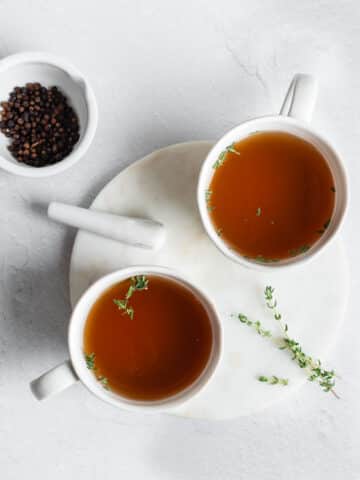

Bone broth is a staple of my family’s diet. As with healthy fats, heirloom vegetables, grass-fed meats and a good old-fashioned fermented cod liver oil, we consume a lot of bone broths – usually aiming for one quart per person per day, at the recommendation of our nutritionist. Broth, you see, is a nutritional powerhouse. It is extraordinarily rich in easy-to-assimilate minerals, amino acids and goodies like glucosamine chondroitin. Its gelatin helps to heal the gut, which is why it plays such an integral role in the GAPS diet, and it provides powerful medicine – particularly in combating colds and flus.
And, you did read that right: we do aim for one quart per adult per day (the little one of the household gets at least a pint). That’s a lot of broth. Let me do the math for you. That’s between two and three quarts per day, averaging to about four and a half gallons of broth each week for our family. Yes, as you might imagine, soups and stews are a big part of our day, more so in the winter than in the summer. When I serve breakfast, I serve it with a mug of broth and another mug of broth sits at my desk as I work.
It’s a beautiful thing, really, and I credit good broth, fermented cod liver oil and of fermented foods with the resilient immunity my family enjoys each flu season. We also use these unconventional techniques to fight the flu and build immunity.
So how do we make enough broth?
So if you’re wondering just how I manage working at home full time, homeschooling our 6-year old with making four and a half gallons of bone broth each week, I’ll tell you. I slow cook it. I call it perpetual soup. You see, my six-quart slowcooker (kinda like this one) is my cauldron. That is, it is always on – bubbling away and ready to nourish my family with the bounty of the bones that stew away every hours of every day.
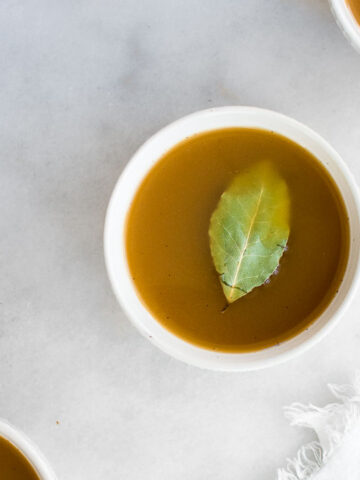
Once a week, I place the frame of a roast chicken into the slow cooker, cover it with filtered water (We use a Berkey to filter our water, and you can find them online.), toss in a few bay leaves, black peppercorns and vegetable scraps, turn it on and call it good. As I pull broth from the slow cooker, I filter it through a reusable coffee filter which helps to strain out any floating herbs, chicken skin or pieces of bone and results in a beautiful clear broth. As I remove broth, I add water and continue the process throughout the week – ensuring that by the end of the week every bit of goodness has been pulled from that chicken frame.
And, in case you’re worried about the cost of keeping your slow cooker on twenty-four hours a day, every day of the week, the estimated cost of running your slow cooker is about $0.01 to $0.03 per hour – for a total cost of $1.68 to $5.04 for the week. Undoubtedly worth it. Learn more about energy-wise cooking here.
Perpetual Soup or Bone Broth the Easy Way
chicken bones, sweet bay, peppercorns, vegetable scraps
ingredients
- 1 whole chicken or the frame of a roasted chicken
- 2 sweet bay leaves
- 1 tablespoon black peppercorns
- any vegetable scraps you have on hand (see note for recommended vegetables)
- filtered water (see sources for a good filter)
equipment:
- 6-quart slow cooker (like this one)
- fine-mesh sieve or reusable coffee filter (like this one)
method:
- Place one whole chicken or the frame of a roasted chicken into your slow cooker with sweet bay, black peppercorns and any vegetable scraps you have on hand. Cover with filtered water and cook on low for one week.
- After twenty-four hours, you may begin using the broth. As you need broth or stock, simply dip a ladle or measuring cup into the slow cooker to remove the amount of stock you need. Pour it through a fine-mesh sieve or, preferably, a reusable coffee filter which will help to clarify the broth. Replace the broth you remove from the slow cooker with an equivalent amount of filtered water (see sources for a good filter). If you’re using a whole, fresh chicken, you may also remove chicken meat from the slow cooker as desired for stir-fries, in soups or in recipes like Asian-style lettuce wraps.
- At the end of the week, strain off any remaining broth and discard or compost the bones. The bones from your chicken should crumble when pressed between your thumb and forefinger. Their softness is an indication that much of the nourishment from the bones – minerals, amino acids – have leached from the bones and into the broth you’ve enjoyed all week long. Wash the insert of your slow cooker and start again.
YIELD: As much or as little broth as you want, my family consumes about 2 to 3 quarts of broth each day. | TIME: Perpetual.
NOTE: Vegetable scraps are not necessary for perpetual soup; however, if you’d like to use them, take care to use the ones recommended as prolonged cooking with certain vegetables may yield a bad flavor to your broth. I recommend using parsley and parsley trimmings, onion, garlic, celery and celery leaves. Do not use carrot scraps (it makes the broth too sweet) or beets, broccoli, turnips or any other brassicas which introduce a bitter aftertaste to your broth.


Thank you for this practical method! I see that you add no salt to the broth. Have you simply grown to enjoy it without? This baffles me!
I add no salt to the broth, because I prefer to season it when we use it. So I’ll take a cup of broth for breakfast, sprinkle chopped parsley, a little garlic and salt into it and it’s wonderful!
I was wondering about the flavor of the broth. I have done this before and have found that if I leave it all too long in the slow cooker, it gets a rancid taste.
Any ideas?
I have not found that to be the case at all. I wonder if it’s cooking too hot?
Hi all! I have been thinking about a crook pot because it is probably cheaper than my method of broth making, but this “rancidity” question is one I was just discussing with my sister. She uses her crock pot for many things but noticed that a stew or soup made on the gas stove, kept better than one made in the crock pot. First there are many kinds of crock pots, and the one I see here is a pretty nice one, and pricey. That is worth it for the use it gets, but in my experience,most people are not using the higher quality ones like this one. So the cooking times and temps vary. MY theory is that with some of the crock pots the middle of the stock or stew stays cooler than the other edges, never getting above the “danger zone” for long when cooking. Especially if it is not stirred frequently. When getting food ready to store, it is also important to stir food while cooling and cool below 40 degrees as quickly as possible. Check your temperatures in the “Perpetual pot” with a reliable food thermometer several times a day and every day to see if it is keeping above 140 degrees at all times. Keeping it going at about180 should keep down bacteria growth and still not be too hot ( 210 is boiling). Hope that helps!
I hope this helps. I have heard it is the chicken fat that can give a rancid flavor to long & slow cooked bone broth. Skimming the fat off the top of the broth in the crock pot after it has all rendered out of the chicken & the chicken skin is supposed to help with that. Beef broth does not usually have that problem but you can skim the fat off it too if you like.
The fat is one of the most vital parts to homemade broth. Skim the foam, leave the fat.
why skim the foam? is it bad for you or is skimming it just for appearance’s sake?
ps new to this site and dig it!
Hey Jenny and Alexis,
I’ve had the same experience. In my crockpot, beef stock (bones roated or not), chicken bone stock (roasted or not) and chicken feet stock all end up smelling (and tasting) like rancid oil. The temp is definitely high enough that it’s not a bacteria issue…when it’s on “low”, I see small bubbles indicative of a “simmer”. But for whatever reason, it just doesn’t work. Maybe the simmer is too hot? Interestingly, it’s even “rancid” after a short(ish) period of time like 12-24 ours.
My solution: bring the stock up to temp on the stove, then place in the oven at 190. It requires less watchfullness and maintains a steady temp better than the stovetop. I typically leave it in for 3 days but have left it in for as long as 5.
Hey Jenny and Alexis,
I’ve had the same experience. In my crockpot, beef stock (bones roated or not), chicken bone stock (roasted or not) and chicken feet stock all end up smelling (and tasting) like rancid oil. The temp is definitely high enough that it’s not a bacteria issue…when it’s on “low”, I see small bubbles indicative of a “simmer”. But for whatever reason, it just doesn’t work. Maybe the simmer is too hot? Interestingly, it’s even “rancid” after a short(ish) period of time like 12-24 hours.
My solution: bring the stock up to temp on the stove, then place in the oven at 190. It requires less watchfullness and maintains a steady temp better than the stovetop. I typically leave it in for 3 days but have left it in for as long as 5.
Jenny, I have a couple of questions. Do you add vinegar to your bone broths or do you soak the bones in it first? Do you brown/roast your beef bones, ham bones and the like before you make broth? Do you put your spices into a mesh bag and then add them to the broth? I hate straining stuff through a coffee filter – it seems easy enough but it never works for me, and always turns out to be a very very very slow process. I could use some of my butter muslin I guess, but I hate to do that.
Now, about that slow cooker – I have tried four different brands in the past year and am sorely disappointed in all of them. They are not cheap ones, either. But they get SOOOO hot on the outside of the cooker (if a child reached up and touched it, they would definitely burn their hands). Does this KitchenAid cooker stay cool on the outside? My DH has about had it with me because every time he thinks he’s gotten me a good quality slow cooker, it ends up to be a lemon. Thanks for any input you can give.
Lastly, the link to the embedded thingy about unconventional ways to treat cold and flu is not functioning. Could you please just post the link itself? Actually, for all the embedded links, just post the whole, real link (or a tinyurl or something).
D. –
I don’t typically add vinegar to my chicken bones, but I add them to my beef bones. I find that the chicken bones don’t really need it.
I don’t brown my chicken bones – I either use a whole fresh chicken or an already roasted chicken frame. I do brown all other bones though (beef, lamb, pork) otherwise the stock tastes weird and acrid.
Have you used a reuseable coffee filter? It seems to be super fast for me, but I’m only straining a cup or two at a time, not the whole batch. You might also try a fine-mesh sieve.
I’ve been happy with KitchenAid and Hamilton Beach, too – we have two slow cookers. One for perpetual broth and one for actual meals.
All the links seem to be functioning correctly. What browser are you using? Perhaps its some sort of setting you have?
The link seems to be working now. Previously I got some message which said something about Apache somethingoranother not working – whatever that means.
One of the previous slow cookers I have is a Hamilton Beach, but I’m telling you the outside of that thing gets soooooo hot it’s just not useable. Maybe I just got a bad one. That wouldn’t surprise me at all, it’s just the kind of luck I seem to have. One is an actual Crock Pot brand, one is a Cuisinart and one is an Emerson or something like that. I literally threw that one outside because it got so hot is burned my pot holder that was laying on the counter beside it. Luckily, no damage to my counter because I set it on a wooden cutting board.
If your KitchenAid doesn’t get burning hot on the outside I may give that one a shot. If that doesn’t work out, I’m done with slow cookers. I wish they made them nice and simple – like they used to be before all this digitalmania.
Thanks for the info about the vinegar.
When you say a “reuseable” filter – are you talking about the basket thingy??
Neither of my slow cookers gets really hot on the outside – warm, yes, not hot – so I’d hate to recommend something to you and have it not work.
YES! I LOVE my reusable coffee filter. It’s intended for coffee, but I use it primarily for broth and it picks up solids that are left by the fine-mesh sieve.
the fact that all your cookers seem to “run hot” makes me wonder if your electrical current may be a little strong? you might try putting a surge-protector between the wall socket and the appliances….
My Rival SmartPot slow cooker was ‘running hot’ until I took the fat off. I did this two days in a row and then she calms right down afterward. Keeps a good even temperature on ‘warm’. We’re on Day Five of a beef broth!
I’m confused about the vinegar. In your roast chicken stock recipe (http://nourishedkitchen.com/roast-chicken-stock/ and also in the How to Cook Real Food class), you say to use cider vinegar. I thought it helped leach minerals from the bones? Do you leave it out in this case because you are cooking the bones for so long?
Yes. I leave it out in this case because it’s cooked for so long, the vinegar is unnecessary.
Jenny, thank you, you just totally blew my mind! I have been troubling over how to provide our milk free family with enough bone broth. I usually do my chicken bones for 24 hours and call it good; a pot typically lasts us less than a day. This method is absolutely what I’ve been looking for!!!
You will love it! It makes taking bone broth SO EASY!
My gramma used to have an old-fashioned stove with a soup well in the back (at least that’s what we called it) and she had bones and water and every vegetable from her garden in that thing year round. It was kept at a low enough heat that the smell was very pleasant, if you noticed it at all. I noticed it the most upon entering the house, but then I couldn’t smell it much after that unless I was over there stirring. It didn’t make our clothes smell, and it didn’t make the furniture smell, but then her kitchen was not anywhere near her parlor, either.
This is great, although I now feel like I have wasted many a chicken frames by not using them to their full potential! Never too late to change things up. Thanks for the insight.
I know, right? We’re on a budget (who isn’t?), so using every single bit helps.
is there still nutrition in the broth by the end of the week if you keep adding water? Just wondering – I have done mine for a few days, and by the third day it is at least losing flavor, unless I add more seasonings. So I guess the secondary question is does the last cup taste as good as the first?
Thank you
I would also like to know how it tastes as well as the nutritional value. After 24 hours in my crockpot, the chicken bonescrush easily when I strain the broth. When the bones disinigrate I assume the minerals, etc are extracted as much as can be. I often add more water to this before pouring into containers to freeze, since it has boiled down and the broth is in a concentrated form. Reboiling the bones seems pointless to me, practically and nutritionally but maybe I am totally off base and incorrect. What do you think, Jenny?
Your blog is an inspiratin and blessing to me. Thank you for all your generosity in sharing your wisdom & experience.
I don’t have the means to have it tested for mineral content or other nutrients, but flavor is reliable indicator of the presence of nutrients. The flavor is lightest on day one, peaks on day 5 and is slightly lighter on day 7. There’s a lot to be had from bones, and this method seems to be sufficient for nourishment.
most chicken broths are done in a short period of time so long cooking isn’t necessarily, convenient but not necessary . I just make a large batch on hold it in smaller containers in my fridge.
Thanks for this great post, Jenny! I’ll definitely pass it along to the handful of people who have asked me recently about bone broth and how to make it.
Do you and your family drink that much broth all year long? I find it easy to sip on mugs of broth throughout the day in the cold months, but it’s difficult for me to do so in the summer because it’s just so hot. I was wondering if you consumed so much to build up your immunity for the cold/flu season or if you continued on your quart/day regimen all year long.
Thanks in advance!
Amazing! So much less work than trying to strain the whole thing at once and then freeze the whole batch of broth. Thank you so much for the recipe
In the summer, it’s harder to do so much broth. Winter is easier because I want to constantly have something warm in my hands, and the mug of broth helps with that. Also, having the slowcooker on all the time helps keep the house warm so we don’t turn on the heat quite as high. It’s our nutritionists recommendation we do 1 quart a day – so we weren’t doing it this summer.
In the summer, though, I do gazpachos and summer borscht with broth and braise all our veggies in it,
I can’t believe there is much left after cooking a day let alone all week. Does it taste just as favorable as the first day? Is there still goodness left after adding water all week? I hope so I am going to try it have a chicken in the fridge now.
Short of having the mineral content tested on day 1 and day 7, I can’t make a guarantee, but in terms of *flavor* it’s lightest on day #1, peaks around day 5 and is slightly lighter in flavor on day #7. Flavor is usually a good indicator of nourishment. There’s much to be extracted from bones particularly after prolonged cooking. The bones at the end literally fall apart, an indicator that most of the good stuff is in the broth you’ve drunk all week long.
Can you refer me to a brand of slow-cooke that is lead-free? I’d love to do this, but I limit use of my current slow-cooker because I can’t confirm that it’s lead-free. Have you researched either of yours? I can’t imagine how much lead could potentially be in a broth that’s been stewing for a week and will go out and buy your brands today if you’ve looked into it.
I don’t believe that lead is a serious concern for slow cookers. It could possibly have been an issue in older slow cookers, but there will be no measurable amount of lead in modern slow cookers. Besides, ceramic products manufactured in and sold in the US are not permitted to have lead.
Cheeseslave has a post about this, of course now I can’t find it, but her conclusion was Hamilton Beach.
FYI, most new slow cookers have a low levels of lead in the glaze (US companies are only require to be below the recommended FDA level, but most companies will admit that there is still residue levels of lead if ask directly. And I think I would be concerned if ones is consuming something in significant amounts everyday (like bone broth) that has been cook for a long time in a slow cooker. FDA levels are based on intermediate exposure not regular exposure and long term accumulation. I probably would be especially careful if you have young children…
FWIW, I use my crock pot A LOT and was concerned about the same thing. This past summer I had both my kids’ lead levels tested and they were at the lowest level that can be registered. This was actually a significant decrease from where my 5 y/o’s level had been when he was 12 months and my 2 y/o’s level went down only slightly. And my Crock Pot use significanly increased during the past two years. I’ll probably have them rechecked every year or so but at this point I’m convinced the Crock Pot is safe.
You can get lead-testing kits on Amazon or a hardware store. This has a higher potential for user-error than having a university test it or a professional coming to your home, but it may be something to look into to put your mind at ease.
I just can’t take a big corporations word for it; I like outside verification from a trusted third party. Mistakes happen whether intentional or not. I understand your concerns, pmtexas.
this was my question also. thanks!
also, whenever i’ve tried to add water to currently brewing broth it seems to cloud up on me- does this happen to you in the crock pot?
It does and then it settles down and becomes clear again.
Great post, Jenny. Have been making stock recently but have not yet done perpetual broth. I have a hamilton beach slow cooker which I bought based on recommendations saying it was lead free.
Yes, Hamilton Beach is a good company.
I never would have thought of leaving the chicken broth going all week! We used to laugh at my Dad because he was always making turkey or chicken broth in the winter, but it’s nice to have something warm to drink available that isn’t sweet. I’m definitely going to do this!
Thanks, Jenny!
You’ll love it!
Brilliant! I’m going to make it now!
So to clarify – do you do perpetual beef broths too (other broths besides chicken)?
And do you just “deal with” the smell of simmering broth all of the time or do you have a trick for minimizing this? Even doing a 24 hour simmer my whole house gets to smelling of broth and after awhile it just isn’t pleasant. Perhaps you’ve been doing so much that you’re used to it?
Also, does your crockpot broth gel? Sometimes what I absolutely know should be a good gelatinous broth, does not gel.
Thanks for considering these questions.
Heather –
I haven’t yet done a perpetual beef broth yet – just chicken.
I LOVE the smell of simmering broth, so it’s not an issue in our house.
The broth doesn’t gel. But there’s still plenty of goodness in there. With prolonged cooking, the gelatin just breaks down. The broth is still good though.
Thank you for this post! When I was doing overnight simmers I would get a great gel, even without feet. Now with a pound of feet per batch and a 36 hour simmer it no longer gels. I was worried maybe I wasn’t getting as much gelatin somehow. I think I will try this method as there will soon be 3 adults in the household on GAPS intro!
Hi Jenny,
Would you also do this if you were making a broth with chicken feet? Sometimes I use just the walkies/talkies (heads and feet). Wondering if they would last a week……
Thanks!
Gretchen
I like to make straight chicken foot broth. It’s my favorite. I do that on the stovetop.
so…would it be a good or not-so-good idea to add a foot to a crockpot that already has a whole chicken in it? Jenny
+1 for “walkie/talkie” soup! LOL
I have to try this, I saw something like this on one of those adventure travel-cooking shows, I can’t remember the animal, somewhere in Asia, but the broth pot hadn’t been emptied or taken off the fire for something like 25 years.

The only problem is we’re in a small bungalow and not fond of cooking smells going 24/7, after a week I think all our furniture would absorb the cooking odors. Particularly bothers my husband, since he is primarily vegetarian.
That is so cool, Diane! I got the idea, originally, after reading information about how traditional peoples often left the cauldron on a low simmer all the time, just adding and taking away from time to time. I figured, why can’t I do this with a slow cooker?
Thank you so very much. I usually make a batch of stock after my inside freezer is so full of bones that I have to make room. I just got through making 3 gallons of turkey broth from two turkey carcasses. It was cooking on my electric stove top for 2 days. Plus my freezer is so full of jars of broth I don’t have room for much else. I never thought to use a crock pot for this and to leave it on all the time. Is the taste thinned out by the end of the week? Plus, it’s time for us to start consuming more of it!
The taste actually peaks at about day 5, and is lightest on day 1.
A tip to store broth in less space: boil it down quite a bit and freeze it into ice cubes. I had 1/2-tbsp. broth cubes that would each flavour about 1/4 c. of water, and they were great for many things. At that size, they melt pretty quickly when adding them to just about anything.
Actually, Hamilton-Beach doesn’t claim to be lead-free, just ‘within acceptable limits.’ I just can’t trust federal agencies on what those ‘acceptable limits’ are. To me, there’s a big difference between that and lead-free.
It used to be 2 PPM was acceptable in products according to FDA standards. Seems like I heard this may have been lowered to 1 PPM in recent years. You’d have to look it up. Either way I agree with you. A little lead in a lot of stuff equals a lot of lead exposure. Lead cheapens the manufacturing process of a lot of goods. Makes it popular in other countries where standards are more lax or nonexistent, at least in terms of enforcement.
Darn, I just gave the bone bits after a 36 hour cook to the animals…now I’ll save the next batchfor a week long soak ;o)
We love broth and use it for so many soups and starters, I’ll be sure and ad this to the other goodies on my counter.
I have a q about browning other types of bones- do you brown them on top of the stove or in the oven and how long? The smell has been mentioned and that is my hubby’s only complaint, especially for beef…usually the pot gets put in the garage, but I hate wasting the heating potential…any ideas for pleasing aroma?
Thanks for the great tip!
to your health, Nancy
See – the smell doesn’t bother us at all. I think a tight-fitting lid on the slow cooker also helps to keep the smell minimized.
Whoa! I didn’t know it was possible to do this! I usually make broth once per week and don’t even cook it near long enough. I don’t have a slow cooker at all so I think I know what I want for Christmas! I can’t wait to taste broth that’s been cooking for days. My DH will likely think I’m strange but I bet after he tastes it he won’t. He unfortunately likes to make cubed broth to drink but he’s always up for soup, so this sounds like something I need to do. You can really cook it all week? I’ll have to cite you on that, as DH freaks out about not refrigerating things right away.
It’s kept at a hot enough temperature that it doesn’t need refrigeration. It’s like a slow simmer all week long.
Hi Jenny – I am so going to try this!! I do have a few very basic questions, that perhaps should be obvious to me, but wanted to double check
1) when using a whole chicken, do you put in a raw chicken or cooked?
2) if raw, can you put it in straight from freezer? If so, can you still start using after 24 hours, or do you need to give it longer?
3) when the week is over, do you just freeze the remaining broth for use in recipes?
thanks so much! Jenny
1. I put the chicken in raw.
2. I thaw the chicken in the fridge first.
3. We pretty much use it up that day. I have too many livers and hearts and other meaty things in my freezer to store broth!
thanks Jenny…can’t wait to try this! Jenny
Whoa! I didn’t know it was possible to do this! I usually make broth once per week and don’t even cook it near long enough. I don’t have a slow cooker at all so I think I know what I want for Christmas! I can’t wait to taste broth that’s been cooking for days. My DH will likely think I’m strange but I bet after he tastes it he won’t. He unfortunately likes to make cubed broth to drink but he’s always up for soup, so this sounds like something I need to do. I can imagine scooping some hot broth over rice or whatever whenever I want to–mmm. You can really cook it all week? I’ll have to cite you on that, as DH freaks out about not refrigerating things right away.
Are you concerned about maintaining a certain temperature to prevent spoilage?
My slow cooker and crockpot do not have a temp setting just high or low.
No. A good slowcooker should maintain a fairly constant temperature and slow simmer. I use the low setting.
This is pure genius! What a wonderful way to get more broth into our diets. I am so excited to try this. Two questions:
1. Do you ever wash out your slow cooker? If not, does it get all crusty and gross inside over time, or does the addition of more water each time keep that from happening?
2. Do you add any fat to the stock as the week goes on? It seems like there would be plenty of fat in it initially, but by the end of the week maybe there would be none at all. I always leave the fat in my stock and really enjoy drinking it that way.
1. Yes. Once a week, I strain the remaining broth, compost the bones and wash the insert.
2. No, I don’t add any fat throughout the week, but you can melt some into whatever you’re cooking.
Thank you SO MUCH, Jenny!! What a fantastic idea! I have been getting tired of having to thaw and/or warm up broth for my DD every day, and I rarely ate/drank it myself. I’m going to try this and see if I can get more broth in!
I’m currently simmering some turkey stock on the stove and was going to start chicken stock tomorrow – now I can start it today and have it all week! YAY!
You’ll love this method, Heather!
I did try it last week, but the broth was WAY too peppery and did not have a good taste for what we like. I’m going to try it again starting today or tomorrow without the pepper, just with some celery and parsley and see how we do.
Thanks again!
I just cleaned the pot out last night- I used my cast iron dutch oven…. the final fill tasted like metal (I also didn’t take from the pot for over 24 hours, so it stewed for a bit)….. hmmm. time to find the elusive orange crock pot…..
what temp should i have it at? my (candy) thermometer read 165.
I recommend using an electric slow cooker with a ceramic insert and setting it to “low.”
Here I sit with 3 # of beef bones our beef farmer just delivered and no crockpot! Guess I will roast the bones with some olive oil and salt and pepper, add them to filtered water in my cast iron enameled stock pot with some carrots, onions and celery and sit it on the woodstove until the smell drives us out. Then add herbs and filter.
I make a lot of stock as we really like soups and stews with homemade rolls. We have them a couple times a week or more depending what’s in the fridge, but if I cook the broth for a long time, especially poultry, they taste old or rancid. Any ideas why? I use the whole bird including any meat left on it which may be the problem.
It could be that a long-cooked broth isn’t being fully cooked or kept at a uniform temperature.
Sounds wonderful. We would drink so much more broth if it took little energy to keep it going! My concern is about leaving the crockpot going at night…do you think the manufacturer would consider this a fire hazard? I also wonder if there is such a thing as a commercial slow cooker that might give you more cooking time before it dies. How many years has your slow cooker lasted using this method?
The information out there is confusing and it appears that most if not all conventional slow cookers do contain a small amount of lead, but they do meet the FDA’s standards (which I personally don’t trust) for lead levels. I know that Vitaclay slow cookers and others made from Zisha clay don’t contain lead, but I don’t know how the material would hold up to perpetual cooking. Anyone concerned about a slow cooker they already own could purchase a lead test online to get their own results.
Here is one blogger who did the search for a totally lead-free slow cooker: http://pepperpaints.com/2011/01/14/thursdays-recipe-fail-fridays-kitchen-gadget-update/
I will have to look into this some more!
Yeah – I don’t think it’s necessarily a big issue, but a lead test couldn’t hurt. I’m with you – I’m not sure how the clay would hold up to perpetual cooking.
One more question Jenny. What temp do you use low or high?
I use low.
I had a lead test kit here (just was testing my dishes last night) & have tested my crock pot, which came up negative. i’ll post a reply with the brand of test & model of cooker in a moment
Thank you, Jenny, for this fantastic post! I struggle with making enough broth to keep up with our family’s needs, so this might be just the ticket.
Thank you, thank you, thank you!
hope posting these links is allowed! if not, sorry!
i tested both the bottom and handle of the crock & both came back negative.
the kit also comes with a control to verify negative results, which came back positive. so we know the tester was accurate!
test kit: http://www.amazon.com/gp/product/B004XJKXJ2/ref=oh_o04_s00_i00_details
crock pot: http://www.amazon.com/Crock-Pot-SCVC609SS-6-Quart-Programmable-Stainless/dp/B0024XKV6E/ref=sr_1_31?s=appliances&ie=UTF8&qid=1323296622&sr=1-31
Hi Jenny–
Thanks for the post! Another person brought up the question of the broth spoiling. I am curious about that as well. What temp does the broth need to stay at to prevent the broth from becoming a home to bacteria we don’t want to consume? usually when I make broth I simmer it for 12 hours and the put it in the fridge or freezer. However, it usually gets very gelatinous and becomes sort of a pain to reheat properly. I like the idea of having broth constantly available, but worry about it spoiling. Thanks for sharing!
It just needs to be kept at a slow simmer.
I also make lots of bone broth, but I always add kelp or dulse. But i don’t add seasoning. After it is cooked I add my veggies and seasoning and whatever. Really good. We buy lots of organic dried veggie mix and whatever we can find for winter veggies….like rutabagas and cabbage….yum!
I love dulse soup.
I was wondering about using one of the electric roaster ovens I saw for sale before Thanksgiving as a slow cooker for a larger amount of bone broth. Has anyone tried this?
Hi, Jan,
I am doing broth in my big roaster right now- second time, and it is turning out great! I just enjoyed my first cup. So much healthier than my nightly cup of hot chocolate I am trying the perpetual soup this time, but it is taking up a lot of space in my kitchen, so I can’t imagine doing it this way all of the time. I think I came away with 6 or 7 quarts last time. I researched somewhere online what the general temps are for slow cookers, and it said that Low is around 170-175 deg. F, and High is around 190-195 deg. F. So I set mine at 175, and just make sure it’s simmering but not boiling at all. Hope this helps!
I do use a roaster oven (we call it a turkey roaster) for a lot of cooking because in the summer we use it outdoors rather than heat up the house. It’s just like using an oven. Thing is, when I use the roaster for things like broths and soups, I actually use a different pot (like a granitware bean pot) and set it INSIDE the turkey roaster, rather than having to wash out that whole big lift-outable insert every time I cook something in it. (Does that make sense? It’s kinda hard to explain.) Think of it as putting a cake into a regular oven – you don’t put the cake batter right into the oven, you put the cake batter into a 9 X 13 pan and set that inside the oven. That’s how I use my roaster oven.
It sure would be a lot easier to control the temperature with the roaster oven than with a crock pot (or four) which seem to be totally unreliable temperature-wise. I have noticed that my crock pots click a lot and that is the temperature setting changing all the time. I’m just not comfortable with that.
Thanks so much for reminding me about the turkey roaster oven thingys! What a great idea. Don’t know why I didn’t think of it sooner myself, since I use it for myriad other things anyhow. Guess I’m on tilt these days.
This is very interesting. However, I’m not sure hubby will let the crockpot go 24/7. Can you stick it in the fridge at night and put in back on in the morning?
If you are thinking of taking the crock back and forth from cooker to fridge and back again each day: DON’T! This is a recipe for bacteria soup as the large quantity of hot soup sllooowwllyy cools in the fridge, hanging about in the danger zone for hours (and raising fridge temp and putting other foods at risk). And then the cold crock and cold liquid travelling slowly through to danger zone again. Youd need to remove it, to several small containers to cool quickly, and next day reheat on the stove to get it to safe temp before moving it to crock pot. Or you might make the stock regular way (using vinegar) and put a days worth in a smaller slow cooker each day. Same easy access but milder odor or lower fire risk or whatever makes your spouse nervous. After a while he may adjust.
I fully agree with KL. The LAST thing you want to do is move it to and from the fridge like that. That is definitely where spoilage can occur. In order to do this, you really need to have a very reliable slow cooker and follow the directions exactly. Also, it’s not good for your insert either.
I read about crock-pot broth somewhere else a month or so ago and tried it. I was really disappointed when the broth boiled on the low setting. The lid rattled and steam/liquid escaped. The crockpot does have a warm setting, I wonder if that would be warm enough. Or maybe if I used less liquid? I’ll have to try again. With our cold weather in south Texas broth sounds so good!
It sounds like you need a better slow cooker – your lid shouldn’t rattle.
Get a plug-in dimmer to slow down your crockpot. Also get a thermometer (yogourmet is a good one) to help you find the dimmer setting that will keep the middle of the pot around 180F.
Oddlycrunch, thanks for the suggestion. I will try that.
Jenny, it may well be that I need another one, but I don’t think I’ll irritate my husband by buying another just yet. It cooks other things just fine. The lid only rattles when the contents are boiling briskly.
You must have the Crock Pot brand, no? 7 quart? That’s my slow cooker. I did a lot of research before buying one, and I got it anyway, because I can’t imagine cooking in anything smaller. Actually, as of 1998, because of federal law, ALL slow cookers must cook at a much higher temp. than the ones before that date. I was fortunate enough to buy my first one before that date, and it was soooo nice and s-l-o-w! It finally went kaput, and got the new one. I was sorely disappointed when it cooked a few chicken breasts in about an HOUR on Low.
So I have read all of the suggestions. The best one was to make a Crock-O-Stat, although I haven’t done this yet. You can read about it here: http://www.delcollo.us/icp/crockostat.html. Also, I just fill it up to about an inch from the rim every time, and it’s usually not an issue. Also, since I read about the law change, I have searched high and low for old Crock Pots at garage sales, etc. If you look on Craigslist, they are out there, usually for $3- $5, since nobody knows the value of them! But I don’t know about the lead content, as somebody earlier mentioned. Hope this helps!
My crocks are all 2000 or later. (I have 4.) None of them rattle or burn my meat. Mine cook boneless chicken breasts in about 4 hours on low – less time for fewer breasts in my small pot.
It sounds like a problem with the particular slow cooker, not all slow cookers in general. You might want to try another one. I have been very pleased with my Hamilton Beach cookers, and a simple one is fairly inexpensive.
My crockpot’s manual says you should NOT use “warm” to cook w/- that it doesn’t get hot enough to keep food out of the danger zone… not sure how it would work once it reached a high enough temp & THEN you turned it down… I guess you’d need to check the internal temp. while testing this theory…
Jenny,
This is a great idea, but tough to implement for the larger family as roaster oven type slow cookers are not as safe as the ceramics.
Here’s my recipe: Send a couple of boys outside to catch a rooster just fat enough and ready for the soup pot (we pasture about 100 per year). Process the rooster and after a couple of hours chill time, add him to a 5 gallon pot (feet and all) with a few cloves, some onion, garlic, celery, a carrot and a dollop of cider vinegar. After about 24 hours on medium, strain the whole thing through a cheese cloth, give the veggie leavings to the future pot roosters and make chicken salad from the pickings. Put as much as you can into a 2 gallon pot to leave on the stove for 3-4 days on low and serve or cook with that broth, then refrigerate the rest for the next 3-4 day supply (and a harvest of fat if you need it). Use whats simmering 24/7 in the pot (adding water when it condenses) and take out the refrigerated batch for the rest of the week when the first broth is gone. 1 rooster, 1 week; and never turn off the stove; a GE profile with sabbath settings making it very energy efficient to keep on low for days.
Tina in TX…25 years of homeschooling and farmsteading; just added GAPS (with excellent results) 8 months ago.
Thank you! This is brilliant. I’ve just started back to work part-time and have been wracking my brain for things to take for lunch/snacks and also to send with my 1st grader in his thermos. I have a bunch of beef long bones that I will roast tomorrow and then place in my slow cooker for some delicious beef broth. Lovely!
I have a question. I’ve been under the impression that it’s far preferable, from a nutritional standpoint, to make broth from a raw, uncooked chicken than from the frame of a roasted chicken. But from the wording of your recipe, it sounds like you use them interchangeably. Can you speak to this? Thanks!
I do use them interchangeably. A fresh chicken yields more gelatin, but I think we need to worry less about how we cook and eat and just resolve to eat real food. When we want roast chicken, I’ll use the bones – and when we’re strapped for time I’ll use a whole fresh chicken.
1) We have eight children and I never think ahead. So I throw frozen chickens and bone-in roasts straight into the crock pot or large roaster oven all the time! With water and seasonings, they’ll be cooked by suppertime. (Usually start the roaster at about 350 and then reduce to 250-300, depending on how fast I need some of the meat.) Can also do in a large stockpot on the stove. Just be sure to watch that pot tops fit tightly or your liquid will boil away and the bones will burn. (Ask me how I know!) Then get off the meat you want and keep the rest going.
2) I leave our roaster oven with bones (and tons of free-range eggshells for added calcium and something like 27 minerals they contain) going for up to 72 hours with the same bones. But I’m afraid I’ve given the dogs and cats bones sooner than I needed to, having now read this excellent article. Thank you so much for posting!
We go through so many eggs here and I always feel bad throwing away all those shells! I wonder if I did this method of cooking broth, could I perpetually throw our used egg shells in there too? Added minerals and a place for our egg shells?
Do you use organic chicken? Are you concerned about hormones in regular store bought chicken?
Thank you.
Federal law disallows the use of hormones in chicken, so even conventionally raised chicken is raised without added hormones. I typically use pasture-raised birds, but will use an organic, free-range bird in a pinch if I can’t get a pastured one.
I was just wondering the same thing, Jenny. However, I was remembering an article I read recently (I think on mercola.com?) where Tyson Foods got in trouble a few years back for appearing to follow federal law, but finding loopholes in sneaking hormones into their chickens. They were injecting the eggs, I think, with hormones, and technically, they were not adding hormones to the chickens at all (just the eggs, pre-hatch). Now, wasn’t that smart of them. So I don’t necessarily trust any label on my food, especially when the chicken breasts are four times the size that they were when I was a kid. Do you know of any other way those chicken breasts get THAT big? My sister and I discuss this all the time, and we are so baffled, except that they are just plain lying to us and finding more loopholes. With that said, we are on such a tight budget, that we have to get conventional Foster Farms chicken from Costco. So any information would be really helpful!
Also, I guess I haven’t researched this thoroughly enough, but will homemade broth help remineralize teeth for dental health? I just got my ingredients to make remineralizing toothpaste from http://wellnessmama.com/2500/homemade-remineralizing-toothpaste-recipe/, and I’m hoping it will keep cavities at bay, considering that my husband is self-employed, and we don’t have dental insurance! Thanks for your help!
My brother-in-law raised commercial fryers. No way will I eat a non-organic chicken!! If you knew what I do about the chicken raising industry, you wouldn’t either. That said I still have some chickens I need to butcher in my perpetual chicken pasture. Thanks for this great idea to keep my broth perpetual. I’ll set it up near my perpetual kombucha. Perpetually yours…………
Sandy can you tell me about your chickens? I am really interested in raising my own since I live in an area where Organic or Pastured chicken is hard to find, and VERY expensive. The question is how. I dont want to leave my e-mail here but maybe you can get me on fiberartchic.etsy.com and send me a convo? Or maybe you have a blog or website?
Genius! That is exactly how I make broth, but I have only made it on occasion. I LOVE this perpetual soup idea, and I could drink it easily every day and the children would too. Do you always use chicken? And I suppose this would make a good organic chicken really worth your money. Thanks for the great idea.
I’ve only ever made it with chicken, but I bet you could use other bones, too.
What a beautfiul and clear broth. Great information. Broth especially chicken broth has medicinal value. I’ve never heard of having it daily for your health but it makes perfect sense. Such incredible lessons your child must be learning at home. Kudos to you. Homeschooling is hard enough on it’s own let alone running a full time business at home as well. I’m impressed!
Hi Jenny — You are absolutely brilliant! I want to drink broth everyday, but before I was just too lazy to pull it out of the fridge/freezer and heat it up in a little pot (dirtying another pot) to just the right temperature for drinking. This method makes drinking broth so easy! I’ve pulled out my crock pot and just got it going! I’m waking up to breakfast broth! For an experiment, I added some kombu and some beef liver for extra nutrients. This is perfect for the kids too! My two year old loves drinking broth out of a mug with a straw!
How do you find the beef liver does in broth? I’ve been hesitant to add it because I think a lot of the vitamins (not minerals) would be destroyed by such prolonged cooking and I’ve wondered at the flavor. Tell me more!
Excellent post! Thank you so much! I cannot wait to do this one week thing because it was tiring to do every other day on stovetop it gets very hot! I love love love your ideas! Nursing a baby who is on Gaps, that will be excellent help to me. I don’t have a water filter and searching for one. Would you recommend Berkey? We drink Poland Spring but since I started using it in evertthing it gets very expensive. And the plastic leaching is a big problem too. My husband cannot drink any water other than Poland Spring. Do you say it makes water taste like Poland Spring? I can’t stand tap water taste. Does that improve after filtering? And where you place it? It doesn’t look very decorative:) Thanks in advance.
I like our Berkey. The flavor is clean. I’ve never had Poland Spring, so I can’t compare it at all. We tend to have pretty good water straight out of the tap, though.
I have been making broth with 2 chicken heads, 6 wings, onions, celery, carrots, salt, and vinegar for 24 hrs on the gas range’s smallest burner. At the end it is VERY dark almost darker than beef broth and taste burnt. Do you think its getting too much heat and is burning????? I hate the broth I make!
Also forgot to mention i use 4 chicken feet
AND i keep it on the lowest setting!
Hi Christina,
Try just making your broth with meat/bones & vinegar first. I thought I made crappy broth too until I found out that I didn’t like the taste parsley imparted on the broth at all. Now I think I make good broth. So try just the basics 1st and see if you like it and just keep adding things one at a time from there.
Are you actually checked the temp it’s cooking at? Low on the stove is way higher than a slow cooker! How heavy is your pot? A temperature diffuser might help. You can buy one or just put the stock pot on a large enough cast iron skillet or griddle.
If you think the heat is still too high on the lowest setting, you can also use a heat diffuser that is more typically used for gently heating of delicate sauces.
Thanks for the great post! I have been making perpetual Thanksgiving turkey broth the last couple weeks…. YUM!! We had a 17 pound local bird, and it had a LOT of bones!! In fact, I still have a bag of bones in the freezer waiting for its turn in the crockpot! I also have some local goat and venison bones that I want to use for broth, but I have only made chicken and turkey broths up to this point. I’d be very interested to read more about your method for other bones!
Its great you venison bones! They will have the most minerals. Wild animal have more minerals in them.
I roast my elk bones (350 for 45 min or so till nice and browned) in a pan then put them in a big pot, add water bring to a boil on the stovetop then simmer for days and days on our wood stove. (Althought it cools off by morning, it reboils in the morning and I have never had any spoilage issues). I take out stock as needed and add water back.
For beef bones, I roast lightly salted beef bones the same way. I cut away the roasted fat and save it (or eat it standing there) and pull out any marrow if they are marrow bones and try to save that for hubby but usually I can’t resist eating it. after a few days of simmering I put the pot it in the fridge to cool off so the fat will surface then I skim it, refidgerate it and use it for other uses (add it to the pan when cooking ground elk or venison), then I put it back on the stove reboil for 3 mintues then back on the wood stove to simmer for days. I do this cause the fattyness of the beef bone we get is too much for me.
Valerie, are the bones you roast picked clean of meat? I have a large venison bone that was already cooked as a pot roast with potatoes and carrots. Does it need to be completely cleaned before roasting? Or should I skip the roasting and just go ahead and use it for broth?
Thanks for your help.
Ronna- do you find that the turkey broth tends to be more gelatinous than chicken broth? i ask because mine does. i raised heritage turkey last year- the broth was amazing- thick & beautiful! this year i raised cornish X rocks (a fast growing hybrid) & the broth is very thin- even if it runs for a week, which i did a few weeks back– the broth seemed almost rancid at the end & the chickens ended up eating it! wondering if the lowest heat on my burner is too low? (it’s a heartland- gas- with the tiny low burner in the center of the larger element) all i could think of was don quixote & the blue soup!
just heard about this method so last night i put our christmas turkey carcass in my slow cooker and cooked it almost 24 hours. went to make soup just awhile ago and the broth is terrible! very dark color and tastes like oil and has that slimy oily texture. now what to do about dinner tonite? i’m so disappointed-what did i do wrong?
Brilliant! Thank you for this helpful tip. I will definitely be implementing your “perpetual” method. I passed it on to all my family and friends with a link to your article on my blog!
I just read through the comments before posting here and I realized that you are typically using a whole chicken. Is that right? Do you remove and eat the meat as it is cooked? Or do you simply let it dissolve back into the broth? IF so, that probably makes a huge difference in the flavor vs just a carcass, right? I’ve been making my own stock for ages, but without a whole lot of salt and such, I’m just not that impressed with it. I am going to try your method though. I’d LOVE for it to work for us.
Sometimes I use a whole chicken, sometimes not. I typically remove the meat after day one of cooking otherwise its flavor deteriorates and it gets mushy.
Hi Jenny.
I’m making my first batch of Perpetual Broth right now! When you say you remove the meat after Day 1 do you mean after 12 hours or 24 hours?
Thanks for all of your ideas!
Lorena
You do use the lid on the slow cooker, right?
Yes. Definitely.
Anyone have an idea about what i posted earlier?
I love this idea! I want to try it with the ox tail I bought. thanks! deb
Wow looks delicious. I love how the meat just falls off the bone when making bone broths!
I know for sure my family is getting all the great minerals & such when I press the bones and they fall to pieces with light pressure between my fingers. Also thanks for confirming my experiences in the Note section re veggies to use & not!
OK, now that looks easy and doable. . .I’ve been making broth off and on for my family and it is SOOOOOO GOOOOD, but I hadn’t found a system for keeping it made up regularly. This is a must try.
Thanks for this idea. Im actually making my first batch of turkey stock today.I love the crockpot idea. So simple. I stay at home and homeschool our three children, so life is so hectic.
I have all the beef materials ready for a batch of beef stock tomorrow. Question…..at what point during the week do you remove the meat off the chicken? Do you follow these same guidelines if making beef stock? Thank you! Meg
I typically pull the meat off after day 1, and I haven’t tried this method with beef bones but I imagine it will work.
What a great idea! I love using the crockpot, and you are so right, it is the modern cauldron.
We had a lot of soup based on bone broth as kids and my family was quite healthy and very resilient. We had to eat soup out of necessity but it seems like we were getting what we needed to give us a healthy start in life. I read somewhere that eating soup 5 nights a week adds an extra 10 years on a mans life (who knows about women, this survey was aimed at men apparently) and that would be enough reason for me (if I was a man that is
) to eat more soup. Thankyou for giving us this great information to allow us to make more informed choices about our health and how to heal ourselves by diet, rather than by shoving handfulls of pills down our throats.
THANK YOU. This is going to be a lifesaver!
This came at a great time….I had been fantasizing about this lately thinking back to the Stone Soup Festival in Vancouver, BC where they had this pot of soup going all day -adding more to it and serving people from it all day! I was envisioning doing the same in my crock-pot (so that there would always be something to eat without starting from scratch!) but was nervous about the idea of the stock going bad…thanks for sharing your experience, I feel courageous now!!
This is GENIOUS! Why did I not think of doing this! I prefer chicken broth, using the entire chicken then eating the meat after 48 hours in the slow roaster (used as a super huge crock pot). I do get tired of eating so much chicken. This solves that problem! THANK YOU!
we roasted a chicken last night and i stripped the meat and started the broth. it smells heavenly. here’s my question: how to use the broth? from reading the posts, here’s what i gleaned:
–drink a mug during the day instead of tea or something else (i’ll try this one now before i’m off to morning yoga)
–use it to braise vegies
–of course, soup…
what else? i don’t see myself dipping in as part of my normal cooking, but i’d love some ideas for how to make this a more natural part of my cooking.
thanks, everyone, katy
Anytime you are making a savory recipe that says to use water? Use broth. Some recipes that use milk for liquid: use broth. If anything seems a bit dry, add broth. Cook your grains in it.
thank you! i’m really enjoying drinking it when i need a hit of something warm and nourishing, and i’ll try these suggestions as well.
I cook all my grains in stock! I soak 2 c. of grains (quinoa, millet, or long grain brown rice) for 24 hours in acidulated water (water with 1/4 c. whey or kefir), then cook in about a quart & a half of stock with a big bunch of kale, a half a daikon radish, an onion, a small burdock root, a handful of freshly-ground rosemary, & sea salt. Then I put it in a big glass tupperware to eat for lunches thruout the week. We eat 3/4 c. each at a meal, usually with the chicken we plucked off the bones, & a homemade dressing. When reheating, I always add a little of the stock too, instead of water, so it doesn’t scorch the pan. Simple & nutritious.
Thanks to your post i am now ready to be a bone broth Jedi! I was making broth in batches but it’s a pain to store etc. Your post is brilliant! Love it.
I’ve slow cooked chicken bone broth for many days before, but probably not for an entire week, but I don’t see why, with reasonable precautions, that a week isn’t a good idea. As you say, it’s very much like the cauldron in the hearth or pot on the back of an old fashioned wood or coal burning stove in older times. In college I worked in a Chinese restaurant and they had a huge cauldron of chicken broth like this behind the wok burners.
Electric slow cookers generally have a very good fire safety record, especially compared to other appliances (like automatic dishwashers, for example), so I feel very comfortable letting one simmer overnight, for days at at time, & while away for home for a few hours (within reason of course, not while gone overnight on vacation, LOL). Of course, with pets & other potential interferences, this issue will vary for many situations.
The only issue I’ve had with recent Rival Crock Pot brand slow cookers (in varying sizes) is that the plastic handles, lid knobs, and heat setting knobs have fractured and broken off after just a few years’ use, perhaps becoming brittle from repeated long simmering times. I have two larger CrockPots that I bought specifically for cooking roasts and bone broths; both now have lids that are hard to manage due to broken plastic fittings. My oldest Crockpot (almost 25 years old) is an upright format and smaller in capacity (3.5 qt) – very ugly but holding up very well. From reading slow cooker reviews and comments online, it seems that the newer models run at higher temps (often overcooking food and even burning it), probably to make sure the pathogenic bacteria that is common in the contaminated CAFO foods is killed by heat (we’ve never had food poisoning with our older, lower temp Crockpot, though). Lids knobs can be replaced (shipping costs are ridiculous for a cheap plastic knob but I’m going to try a hardware store cabinet knob instead), but the handles are a more difficult issue. I found an All Clad slow cooker on sale but haven’t unpacked it yet; anyone have any experience with one of those?
I usually put cork mats and a large metal baking sheet pan under my slow cooker to protect the countertop (or else place the sheet pan under the slow cooker and across two stove burners – the burners stay off, of course). I also adjust the electrical cord (or anything else that could be damaged, melted, or ignited by heat) so it can’t touch the hot exterior of the appliance. It’s not a bad idea to post a warning that the appliance is hot, though family members usually figure this out fairly quickly. Of course if small children or other vulnerable people or pets are an issue, then as with any hazard, other precautionary measures should be considered.
Regarding the continual chicken soup aroma, I find it pleasant, but when first entering the home it is definitely apparent, but not very noticeable after a while (guests will definitely notice, and others’ reactions vary a lot). As an aside, I have a theory (but no proof) that cooking aromas are really good for digestion, working up an appetite and priming the pump so to speak, for the nourishment that will come. Sitting down to a meal that magically appears out of nowhere or from a few minutes in a microwave might not adequately cue the brain and digestive system to prepare for food. Just a theory, though.
A garage location is a good way to keep the aroma out of the house if the aroma is bothersome. In the summer, putting the slow cooker outside the house in a protected location (from rain, being knocked over, animal interference (lock the cooker appliance in a wire pet kennel?), etc., effectively dealing with the aroma, counter space issues, and heating up the house in hot weather). Be sure to plug into a GFI protected outlet or use a GFI adaptor.
Fantastic idea! We are battling colds and flu in our house this week and throwing in the HUGE thanksgiving turkey bones that were in the freezer for just an occasion such as this was perfect. Thank you for the great suggestion!
There is no mention of “scum”. Does this method produce a layer of “scum”? When I make broth on the stove it does develop a foamy layer. Thanks.
This doesn’t produce a lot of scum – and if it does, it’s usually only in the first day or so. There’s some evidence that you really don’t need to skim the scum as it’s a good source of amino acids.
Do you drink the broth with the fat? I am not a fan of fat in my broth but don’t how to skim it out when it is hot.
I usually refridgerate my broth in order to separate the fat and discard it. That would likely defeat the purpose of this method.
No. I don’t like the fat that comes from the first day using a whole chicken – so I use that mostly in braising vegetables. After the first day, there’s very little fat.
So how do you get the fat out of the broth after the first day? I am about 24 hours into my first bone broth. Just got the meat off of the whole chicken and threw the bones back in.
Thanks.
i am into my first 24 hours also, with our christmas turkey. the fat is terrible!!! the slimy feel of it is making me want to throw the whole thing out. how can you de-fat it without putting the pot in the fridge?
Can I do BEEF broth instead of the chicken? And have similar benefits? Whats best part of beef to use? Just beef soup bones from butcher?
When do you think it is the optimal time to remove the meat from the bones for eating/cold storage for later? Please reply via email. Thank you.
I pick off the meat after 24 hours.
How do you use so much broth for your family?? I need ideas for using this good stuff more!
Thanks so much for your helpful ideas!! Also, my children complain that my broth stinks up the whole house. Any suggestions for how to make it smell lovely??
Wendy
Love this, Jenny! I asked for another crockpot this Christmas in hopes that I can get one of my stoveburners back . . . there is ALWAYS a stock pot there!
I add chicken feet to my broth. Would it be ok to cook those for a week? Also, do the same veggies cook all week?
Yes, “brilliant” is so aptly used to describe your culinary ability and ideas, Jenny!
Have you used spent bones as bone meal? I just read about a gent who blends up the bones with a little stock, freezes them into cubes and then adds them to soups and stocks. This speaks to my desire to use the entire animal and add more nutrition, if indeed there is something left.
Many thanks, again! I’ll be passing this post along.
Michelle
This is a fantastic post Jenny! I love this idea. I have been doing big batches then freezing. I end up only using it for soup and not having it on a daily basis. I would love to change this.
My question is: Do you use organic chickens?
I buy mine from local farmers to stay away from soy in the feed, etc. Each bird is from $15-$20. At that price I only cook one maybe two birds a month. I would love to try your idea but could not afford $60-$80 a month for broth!
Any thoughts?
I’m wondering how to do this with beef? Can you use various bones from beef and just do the same thing?
My crockpot lid rattles sometimes. To solve this problem, I put a dish cloth on the lid to weight it down. It also provides some insulation. I fold the dish cloth so that it only touches the lid. It solved that problem. On one of my older crockpots the lid is long gone, but I used an heavy lid to one of my sauce pots. It is great and does not rattle. By the way, my Grandmother was one of the last pioneer women in Kansas and she always had a pot going on the stove. She called Pottage. I found out recently that this is an ancient custom and the word comes from Middle English. Each house always had a pot of broth on the fire.
If your lid is missing or chipped (like mine) you can check at Goodwill or Salvation Army for a replacement.
I was wondering the same thing. Carol and Kristen beat me to it. How about beef bones after roasting them? Add cider vinegar? Thanks, Jenny!
Well, I tried this with a whole chicken. This was a “mature chicken” with relatively less fat on it than regular chickens. Today, day 5, I had to throw it all away. It looked and tasted burned and had a thick layer of fat on it. My crockpot keeps a temperature of 180F on “Warm”, which is where it has been since day 1. This morning we woke up to an unpleasant burnt smell, the broth was very dark, and tasted burnt. What went wrong? Was it because we haven’t developed a habit of drinking several cups of broth a day and just left it slowly simmering for all those hours?
I also did some research (Google research) and there is a difference between bone broth and meat stock. Dr. NCM recommends just a few hours of simmering for the meat stock. So did my bone broth turn bad because I used a whole chicken and not bones?
Last question: I received a flyer for a supplement that uses eggshell membrane as a source of glucosamine, chondroitin and collagen. Anyone know how to use eggshells to extract those goodies from the membrane? Could (free-range) eggshells be dropped in a broth or stock for example? My mother says during WWII in her country people would crush eggshells to a fine flour to add to children’s food, for the calcium.
I just tried this for the first time, and the same thing happened to me. I didn’t use a whole chicken (just the bones from one I had roasted), but the broth was very dark, tasted bad, and was VERY fatty. So much so that I’m going to have to throw it out. I bought a brand new crockpot (the Hamilton Beach one that Jenny recommends) just to try this out (I still think it’s a great idea), and I had the setting on low. What did I do wrong? I’m a new cook, so if anyone has any suggestions or advice, I’m all ears.
I actually think the better option would be to make the stock in a regular pot and put it in the fridge. Take it out skim off the fat and then put it in the crock pot. I found when I skimmed the fat off the broth no longer smelled or tasted rancid. It must be the PUFAs in the chicken fat that do it. It will be darker and a different flavor. I just did the bones And let it sit on low for a few days , for every two or three cups of broth I took out I added half of that amount of water back in. No veggies or salt either. I added an egg yolk in my cup and some of the chicken that I removed from the bones previously. That seemed to work well. It was pretty much spent in 4 days.
I have tried this several times and I keep having the problem that after about 24 hours the stuff on the top gets burnt and the broth turns very dark and tastes burnt and terrible. I cook on low in my crock pot. I don’t think it cooks hotter than any other crock pot. I have tried leaving the veggies out at I usually add the end of the onions, celery, etc. I have cut off throughout the week. But if I go too long it still burns. It only burns where they bones, etc. stick up out of the water. Do your bones float a little? Does it all stay submerged? Do you do anything to keep it under? I do usually put the bones in frozen (as I collect them in the freezer all week). Any thoughts or advice? Thanks so much!
Now I want to go to the meat market and buy chicken for stock! lol. I try my best to get more bone broth in but don’t always succeed because I always forget to take one of my jars to work. I’ve been making huge batches in my massive stockpot, but this seems so much easier! Plus, it will be much more convenient to fill a mug from the crockpot as opposed to pulling out a jar and heating it that way.
I just emptied the crock pot after trying this method for 6 days. It really was fascinating to see how the bones crumble after long cooking. It made me wonder, though, if there would be a benefit to crumbling the bones on day 5 or so, then returning them to the slow cooker to let the marrow cook into the broth?
I would have kept it going a whole week, except I have to keep resetting my Crock Pot “Smart Pot” because it automatically switches to “warm” after 10 hours. I finally missed out-smarting it once and it spent a few hours during the night on warm instead of low. My next crock pot will have simple on/off controls, not digital!
This is SUCH a great idea! I’ve been wanting to make my own chicken broth for quite some time, but have felt a bit overwhelmed by the whole process. This is so simple and easy–I can’t not do it now!
How do you incorporate the broth into a toddlers diet? Unfortunately, even my “good” eater will not drink it.
Loving this slowcooker method for broth. It made my hot and sour soup so tasty!
http://parttimepotter.blogspot.com/2011/12/potters-hot-and-sour-soup.html
Cynthia: I have a Smart Pot too, and I tested the Warm setting with a yogurt thermometer (after it had been on Warm for several hours). The temperature was 180F, which is hot enough to keep broth quite safe. I actually switch my pot to Warm after the first couple of hours for broth. Otherwise it actually gets too hot, boils and makes the lid dance.
Jenny,
When I cook any kind of beans or lentils, I really like to drink the broth (potlicker) all day long. I am continually adding water to make more of the tasty juice. Does anyone else do this. It must be healthy for you.
I’m fairly certain that your my hero.
Jenny:
Thanks for the additional tips about the bone broth
I was not aware that you coud reuse the bone frame for a week!
I woiuld like to print out these recipes but do not want to print out
all the comments
On Vital Choice website when they post a recipe there is a printable version so you
do not get all the other things on the page or website
I’m wondering if you could do that?
thanks
Nanette
Regarding Berkey filter systems. There are DIY videos on youtube for clear units.
Are they made in America, or just a ton of distributorships here?
This would be my first choice if purchasing one today. Berkey. Not sure about the do it yourself version, but thought it had great merit!
LOVE that you can clean the main filters, and that there are fluoride filters available!
When you’re ready to take this to the next level, get a steam juicer. They’re basically a double boiler with an inverted bundt pan. You just throw the whole chicken in and “juice” it. This nets you a gallon of clear broth and most of the fat. Then it’s very easy to pick the meat off, skim the fat off, and then put the carcass in the crock pot for your perpetual broth.
This solves a couple of problems. Most of the fat comes out in this step. (I save the fat to fry potatoes in.) Then when I crockpot the chicken I don’t get near as much fat floating on the top. Also, after “juicing” the chicken it’s fairly dry and not greasy, which makes it a lot nicer to pick the meat off. I used to hate lifting the hot, dripping, greasy chicken out of the hot crockpot to pick off the meat.
Typically I thaw out the chicken and take the breast meat off for dinner that night. I run the whole chicken (minus breastmeat) through the steam juicer which takes about an hour. Then I pick off all the meat to use throughout the week. We’ll eat that in soups, casseroles, pot pie, and chicken & rice. Then I crockpot it and start simmering.
When I’m rushed for time in the morning it makes a fast lunch. Just ladle some hot broth out of the crockpot into a thermos and go. You can also add a handful of tiny star pasta shapes (uncooked) to the thermos and a little salt and onion powder or Bell’s seasoning, and by lunch you’ve got a nice hot lunch of chicken n stars soup.
The steam juicer just makes the process easier and nicer. Here’s a typical steam juicer: http://www.amazon.com/Cook-Home-2-Quart-Stainless-Steel-Steamer/dp/B001KB9KCW/ref=sr_1_1?ie=UTF8&qid=1324237880&sr=8-1 It’s also great for making juice, lol.
Vicki-this is such a great idea. How long do you steam the chicken? What size bird fits in the juicer/steamer? What else do you use the steamer for?
Hi Jenny,
I did the perpetual broth for the week. Is it normal for it to turn a ruddy brown by say day 3? I figured this was probably the marrow coming out of the bones. Does yours do this? It didn’t look too appetizing only because that’s not what I’m used to seeing. Let me know.
Thanks!
Gretchen
Ruddy brown? Usually mine is a golden brown. It’ll get darker if you’re not removing much liquid. Does it taste okay?
It tasted okay. I wasn’t drinking it every day though so that is probably why. When I went to dump the bones, they were but dust. I also think my crock might run a little hot.
Hi Jenny,
Thank you for this great idea! When I make broth on the stove top, I normally add ginger. Would that work for such a long cooking time?
I also have the same questions several other folks mentioned, about chicken feet. Can you leave the feet in for the whole week?
What are your thoughts on putting egg shells in?
hi Jenny,
so I made the stock with a pastured chicken I regularly get from my PA cert. organic Amish farmer, but the stock is a shade of deep pumpkin! I make chicken stock all the time on the range and am puzzled about this. It tastes different too, the stock that is, not the meat.
I put the mostly dethawed bird in the slow cooker as directed, and by the next day the stock was appearing kind of orange-y. It also had a different smell to it than the usual stock.
Any ideas?
Thanks, love your site.
Elizabeth
Can you clarify how it was different other than that it was orange? Slow cooking can heighten the colors of stocks and meats.
We’ve been using our perpetual broth to make egg drop soup for breakfast. Egg drop soup is stupid easy, basically you whisk a few eggs together, then pour into your broth. It’s quick & easy on a hectic morning, and so delicious with some buttered toast for breakfast. Or put it in a mug and take with you. It feels good to send my kiddo off with something hot and nutritious in her tummy even when there’s no time to make a “real” breakfast.
That’s wild! That is one of our favorite breakfasts/lunches because it is so easy and so nourishing and so quick. Glad to know we’re not the only ones.
How long do you wait before the egg is cooked?
Jenny,
Can you use the bones from a SMOKED chicken or turkey for the broth?
Absolutely! I do from time to time. Be prepared for a slight change in flavor.
any suggestions for crockpots that switch off automatically?
Mine turns off every 14 hours, so I just turn it off and back on before bed and again in the morning so it can reset.
This is brilliant! I am going to try doing chicken for a week, and pulling it out and storing it if we don’t use it each day. Then next week beef broth. Then maybe fish stock … has anyone much experience with that one? Then I can rotate back to chicken.
you wouldn’t want to cook bone broth for that long… not more than a few hours. It will break down the omega-3′s.
Hi Jenny, wow! This is a really useful post, I’m a newcomer to the site and saw this in your ‘best of 2011′.
I Just had one question (and I noticed a few others did too): Could you go into a bit more detail as to why it’s safe (from bacteria) to leave it cooking all week. I live in Australia, where it’s pretty hot already and people freak out about leaving things out of the fridge. I’m really inexperienced at cooking and when I asked relatives for advice about bone broth they were wary of me leaving it in the slowcooker overnight let alone a week.
Hi there! Love you blog! I have a question and I apologize if it’s already been asked. I am not sure if I’m doing this correctly: I get a whole chicken and cook it in the crockpot (with no water). After it has finished cooking I remove the meat to use for a meal, and then I fill it up with water and cook the bones (a small amount of meat left on the bones) for about 18-24 hours. The broth is a light golden color and sometimes cloudy. I don’t ever find it needs to be skimmed, but after the broth has cooled I remove the fat that settles on the top. Is this correct or could it be improved on? Thanks!
I leave a crockpot of broth going quite often but not endlessly. We had to do a lot of broth on GAPS. If I don’t have time to make a meal, I just add a couple tablespoons of butter and some s. salt to a cup of broth and call it a meal. But I do get conerned about the lead issue every now and again. I’d pay a reasonable amount for a certified lead free crockpot.
Is it not necessary to first bring the stock to boil and skim the foam? I cannot get organic chicken here where I live so I think it may be better if I skimmed off any impurities. Could I do that when cooking in slow cooker?
No, the slowcooker keeps the stock at a safe temperature (a slow simmer) so you don’t need to boil it. As for skimming off “impurities,” the impurities you find in the scum on top of chicken broth is comprised mostly of proteins (specifically, albumin). Skimming a stock will in no way help to make up for not using an organic/pastured bird (those kinds of impurities – the residual soy/corn proteins from feed and antibiotics – aren’t going to rise to the top to be skimmed), but if a conventional bird is all you have access to, use it – it’ll still be a good source of minerals and gelatin.
Great post! Also a very good idea to strain with a coffeefilter. My only concern is BPA, do you know if this filter is BPA-free?
Thanks!
Excited to try this broth. Have you ever made broth with venison bones? My husband hunts and I saved the bones for broth. I’m thinking of roasting them as per your beef broth. Would you then be able to use that for the perpetual broth?
Thanks!
I love venison but I haven’t tried the bones. What I have heard is that they are VERY gamey and most people don’t like the taste. I would think that the long cooking would make the flavor even stronger, so maybe not the best choice for perpetual broth…. I don’t know! But let us know if you try!!
I did my first batch and it’s too fatty for me (perhaps I should have just put the bones in instead of the whole roasted chicken carcass including the skin etc). I can’t skim the fat off while it’s in the slow cooker either. How do you deal with this? Do you put the first batch it in the fridge and skim it off?
I know, right? I hate that chicken fat taste and have never liked it. My Mom made homemade chicken noodle soup from her broth and it never had that flavor, but our neighbor lady made homemade chicken soup and I always nearly gagged because it tasted like straight chicken fat. Ewww. I discovered, sorta by accident, that using a piece of bread will sometimes soak up the extra, non-hardened fatty stuff and improves the taste even more. I made sourdough bread, which is quite heavy and dense so it absorbs a lot!
Yes, I put mine in the fridge and skim the hardened fat off the next morning. I don’t throw it out, though. I do use it for other things like adding it to our homemade bird suet or giving it to our dog in a bowl (he is normally on an all raw diet, but I love to let him have fats and poultry skin. I also open an acidophilus capsule over his fresh meaty bone every morning, and we add just a touch of sea salt to his water dish. Healthiest dog I ever saw – perfect teeth, beautiful coat (he’s a nutmeg colored cocker spaniel, registered AKC). He LOVES coconut oil and soured raw milk. Just goes wild.
So skim it if you wish, but don’t throw it out.
I just finished a huge batch of chicken broth and a smaller batch of turkey broth. The bags are cooling as we speak and then they will go into the freezer in a bit. My next try will be Jenny’s perpetual broth recipe, although I still haven’t located a decent crock pot for this, as they all get too hot even on the “low” setting, and the instructions say not to “cook” food using the “warm” setting. Grrrrrr. I’m about at my wits end, but I have no desire to keep my gas stove burners going night and day for a week. My DH would have my hide if I tried that.
Thanks for the reply D. Haha chicken fat makes me gag too! About your slowcooker problems … maybe you could roast it first? Just an idea, I’m still a newbie at all of this.
The turkey was the carcass left from our late Christmas dinner on the 30th of Dec. (We had two Christmas’s this year!). I started the broth on Monday the 1st of Jan and just finished it up last night. So that was precooked meat/carcass. It turned out just lovely.
When I started the fresh chicken, I let it roast in the crock pot without adding extra water (and leaving the cover slightly ajar) for about 6 hours (on low) because the inside of the bird was still just a little bit frozen. The skin browned just a little which is the way I like to start our broth no matter what kind of broth I’m making, but it wasn’t truly “roasted”, i.e. not fully cooked. I’m not positive what my Mom used to do, but I suspect she took the major part of the skin off the breast before she added the water, maybe even took the skin off the legs, too. I wish I had paid closer attention to what she did because her broths and soups were delicious, not fatty tasting at all. But I know there was fat left in there because you could see it at the top.
For those that end up with too much fat: I use a gravy or fat separator. That way I don’t have to wait for the broth to cool and can just take a single serving.
Regarding “low” on a crockpot cooking too hot: after 24 hours on my crockpot low behaves more like high and I can switch it to warm. I have a little hole in the lid (designed for a temp probe) where I stick in a thermometer so I can monitor the temperature. That’s probably not necessary if one can see that it is simmering gently, but it helps me to learn what temperature is a gentle simmer, versus a rolling boil. Always learning!
Thanks! I never would have thought of that.
This is brilliant! I never would have thought to do this. I do have stock simmering in my crockpot right now and was trying to figure out where I was going to store it when it was done since my freezer is full. Now I have my answer…just eat some, add more water to the pot and keep it cooking.
This popped up on my yahoo homepage this morning. I didn’t scour the recipes to see if the ingredients are ALL healthy (but that would sorta depend on how you eat – for instance, my family eats noodles, homemade) but some of the title ideas sounded do-able.
The only part of the article that might be questionable is the suggestion to remove the fat from the chicken before starting the broth. As I said earlier, I leave the skin on but I’m thinking if I remove it after a certain amount of cooking time, I might like the taste better, because I do not like the chicken fat flavor. But that’s just me.
http://shine.yahoo.com/shine-food/7-chicken-soups-soothe-winter-soul-225900481.html
Doesn’t the broth get watery or less flavorful when you keep taking out broth and putting in water?
How much water do you start with. I will be using a stock pot. Do you use 4 qts for a whole chicken?
Thanks for the info!
Thought this perpetual soup would be great till after 3 days my husband said, “I am tired of the chicken smell.”
So, I may just have to stick with once a week broth making. I think my crock pot may run hot also. The 1st day when it was just starting the kitchen smelled wonderful! The 2nd day not as great. Is it better to strain it off within 12 hours and then add more water?
Okay, been doing this all week and love it! I think one thing some commenters are missing is that you have to pull all the broth out each day, and refill, so as not to overcook, or break down the good fats and collagen. I now have 3 large mason jars of broth in the freezer, and 1 in the fridge. Today my bones were all nice and crumbly, so I crunched them up and filled up my final batch for tomorrow. Some notes from the week: I started with a roasted hen carcass flavored with salt, garlic powder, and thyme, and the flavor is perfect. We eat the meat and skin off the hen, so my broth isn’t fatty at all, although the first day had more fat than any others. The smell was strong the first day, but almost unnoticeable after that. I start each day on Low for about 2 hours, then switch to Warm. Even on warm my crockpot still has a slight simmer. I checked the temp and it was 190 after several hours on warm. Thanks Jenny- this is a life changing idea for me!
This may be what my issue is. I’ve done several chicken and beef broths this way but *usually* have emptied the crockpot every 2-3 days. My broth at the end of this time sometimes has that rancid taste previous posters have mentioned. I’ve never had an issue with “too much fat” making it taste burnt. However, I’ve questioned whether I should have removed the skin, meat, etc. earlier in the process. Anyway, I have another batch started so will definitely take to emptying it every day to see if that makes the difference by the end of the week. Thanks!
This sounds fantastic! Just one question: is there a reason for filtered water? Would plain tap water suffice?
I hope my questions haven’t already been answered . . . I am wondering about vegetables that will work in the broth.
Will–
potatoe skins?
collard stems?
sweet potato skins?
Thanks!
Does anyone know a good slow cooker for minimizing the smell? Is the Hamilton Beach 6-Quart Slow cooker a good one in this respect? I noticed it has a rubber ring around the lid, whereas the one I have at the moment just has a simple glass lid.
The ones that have the rubber ring plus the locks on the side so you can travel with it and not spill definitely minimize the smell. Huge difference.
Cheers Patricia.
The locks on the side of the Hamiltom Beach cooker are for travel only and are not to be used during cooking per the manual. If locked during cooking, the pressure could increase to dangerous levels.
A great post! Thank you Jenny for the information and the wonderful website! I came across your page via Sarah Wilson here in Australia. I have had a slow cooker for about 3 years and love using it – even in summertime! It’s 30 degrees celcius here now and I have the cooker on with 2 chicken frames, peppercorns, onion, garlic and celery tops. I bought 6 chicken frames from my local organic butcher. Unfortunately he had no beef bones so no beef broth for us. Apparently it doesn’t sell in summer. Such a shame! For Australian readers, I have a Breville Avance slow cooker and it has been very reliable. Cooks everything from curries to lamb shanks, and now broth.
I am making my own chicken bone broth for the first time ever tonight… my mother says i should skim off the gel that rises to the top after refrigeration… but, you never mention doing that… is that the good stuff that i should actually be keeping or do you agree with the idea of skimming (others have recommended it as well).
So, I’m a rookie in the kitchen. Last week I tried to make this with the carcass of a roasted chicken that we got from our neighborhood local, organic, delicious food store, but after day 2 i found the broth to just be too herb-y and didn’t have a good taste at all (also, just realized I shouldn’t have used carrots). Yesterday I went out and got a fresh chicken and am attempting a version with a whole, uncooked chicken. My question is, would it be beneficial to use the gizzards/innards (whatever you call them) in the broth? They came inside the chicken in a separate baggie and i’ve transferred them into a “baggie” i made using cheesecloth… does that sound right? or just toss them? i figure they’re probably full of nutrients so why not throw them in there? Thanks so much! love you site!
I tried this the other day. I got an organic chicken (which is over $20 here) Day one made beautiful broth. I pulled the meat out but left in the veggies. Day 2 the whole house smelled like burned rancid nastiness. I had the crock pot on low.
1. Do you take out the veggies too? I was wondering if the sugars in the onion carmelize and burn or something.
2. The fat layer was nasty. Do you cool the broth after day one to get the fat layer off or spoon it off or what?
3. could it be that my crockpot just runs too hot?
Thanks
It is my observation that crock pots are no longer made the way they were originally designed. They also don’t work the way they were originally designed to work. They get entirely too hot (even on warm). As I mentioned here earlier, mine gets hot enough to brown the chicken skin before I add the water to make broth.
I tried roasting a small batch of walnuts in mine the other day, just because I didn’t want my gas oven running for 24 hours. Within about 4 hours, it burned them. I was right here!! I was watching them and stirring them and paying attention. They went from not quite fully roasted to burned in a matter of about 15 minutes.
I’m going to throw my crock pot off the back deck and hope no one gets hurt.
I’m amazed how well this works! It’s like having a magic pot. Every morning I refill with plain water and the next day – poof- it’s turned into lovely, fragrant, nutritious broth. I can’t believe how much nutrition we were wasting before. I pour it through a gravy separator the first few days because our home grown chickens have a lot of fat. We love having a hot mug of broth for breakfast.
My Hamilton Beach 3 in 1 crockpot holds at a gentle simmer when the pot is filled. I tried the Zisha brand crockpot and it boiled hard even on a low setting. I’m going to make a Crock o Stat for it so I can have a crockpot going for beef stock too. We just butchered a grassfed steer so I tried this with beef bones. We didn’t like the beef stock to drink plain but it’s wonderful for soups and cooking rice in. And it gels wonderfully. All week while the crockpot was tied up with beef we were sorely missing our chicken broth, lol.
Seems like people have problems when their pots run too hot or they’re adding other ingredients besides plain bones. Please keep trying till you find a method that works for you. It sure works great for us. Thanks so much Jenny!
One thing I discovered with my crockpot is that if it’s less than half full or has mostly dry ingredients, it runs hot. If it’s nearly full with liquid it holds a nice, slow simmer.
Finally got some beef bones (2) & am following the recipe in my Hamilton Beach Meal Maker Slow Cooker, using Keep Warm setting. I can’t wait to see it tomorrow evening! Thanks so much & I’ll keep updating with progress . . . of course hoping there’s no rancid smell { just a beautiful garlic pepper aroma }
Jenny – It could also cost you nothing at all
How?
Well, if you have a solar oven you could leave that simmering away all day / every day – forever. You would simply remove it from the solar oven every afternoon when the temperature inside the solar oven drops below 100oC (212oF) , allow it to cool, and place in the fridge overnight. First thing the next morning, return it to the solar oven, and let the sun do it’s thing
And add a new carcass and veggies every week.
Solar cooking is the way of the future. Simple, no hassle, no burning – food which is basically cooked in its own juices. You, seriously, cannot get more nutritious than that.
Dani
I have had the same problem using a whole chicken, the fat is stinky and the broth smells awful. I just started the perpetual soup on my stovetop in a stainless steel Americraft stockpot (I don’t want to worry about anything that can leach). I used chicken feet, wings, & legs after all of the reviews I read. I also added a splash of applecider vinegar, some ginger and fluer de sels salt. I has made a beautiful clear sweet broth that is easy to drink and easy to get my kids to drink. Today is day 3, I replenish water at night before bed. I also added a few organic free range egg shells this morning for calcium. We are doing the Gaps diet and are excited about this soup. My stove is a flat top LG and I keep it on 1.2 setting to keep the soup and the soup stays at 178-180 degrees. I pour the broth into my For Life Tea pot to strain out the bits. It has a stainless mesh filter that easily washes out. It works great. I will have this going all the time. I do have to turn my stove off and on every 8 hours because it has an automatic turn off feature, but no biggie.
Thanks so much for the broth idea. Just adding onion and parsley has given it a wonderful taste. I’ve been draining off the first batch of broth, freeze, and then add water to the same bones to make another batch. Next time, I’ll do it your way and just replace with water what I scoop out. My chickens are from a local farmer and so tasty.
This is wonderful! We’re certainly going to start in on this method of broth-making next week (right after I buy a chicken). It’s easy, offers LOADS of nutrition and economical.
Thank you for your post!
We’ve been doing this for a couple months now, but rarely clean out the pot, unless we maybe forget to fill it and it gets a ring of burnt stuff on the top. Another tip is to throw in hearts and livers and necks from the gizzard bag if you aren’t going to eat them as is. I know they’re good for me but they gross me out, so into the pot they go! I also keep a bag of “bits” in the freezer and anytime we have meat on the bone or some pork chop gristle it goes in there or right in the pot if it’s time to be refreshed. Love the idea of the reusable coffee strainer though, I’ve just been dealing with “not so clear” stock
Made a chicken in the slow cooker this morning and was wondering if I needed to dump out the natural juices made during the cooking process before putting the chicken carcass back in the pot to make broth. Can someone comment? Thank you. I just love my slow cooker!
Not at all! You may want to refresh any herbs or veggies that have totally run their course, but other than that keep the flavor! When I roast a chicken in the oven I deglaze the pan and then scrape the juices into the crockpot (unless they are going to be gravy)
I finally got the Hamilton Beach 6-Quart Slow cooker and put it on overnight on low, by the time I got up today all the water had boiled off and there was burnt chicken smell throughout the house, and the plastic on the handles had started melting! Does everyone else use ‘low’ setting? It seemed to be boiling like crazy on that setting.
Sounds like you have a defective slow cooker. Overnight on low should in no way cook that hot.
ITA. I have a HB and while it does run too hot to make stock, it doesn’t boil the liquid away over night. Even when I accidentally left the lid off. O_o
I’ll add to the chorus, but that’s definitely a defective slowcooker. My HB slowcooker is on 24/7 except for a 4 hour break on Sunday to wash the insert and get a new batch of broth going. I’ve left it on high overnight and never had the issue you experienced.
Thank you so much…..the process of spooning out my own broth to put in my soup feels so healthful and nurturing, I couldn’t be happier.
On the 5th day, my broth suddenly went clear, almost completely clear. I did not put vinegar in on the first day, but I did add a splash on the 4th day. Did that have anything to do with it? And, is the clear broth (I mean clear) still filled with nutrients or was the process “done.” Thanks, any enlightenment would be good.