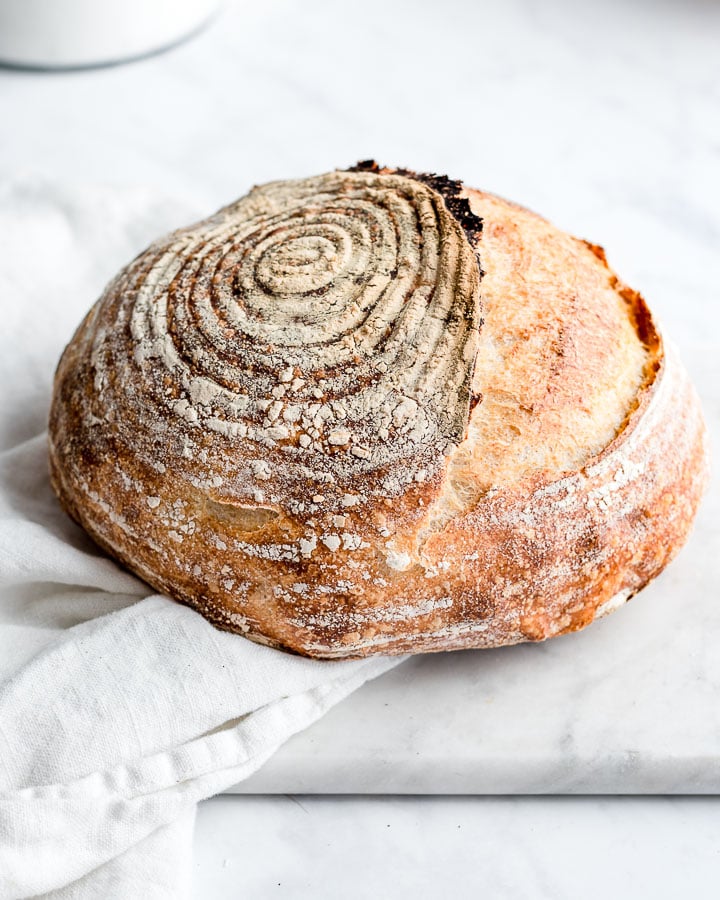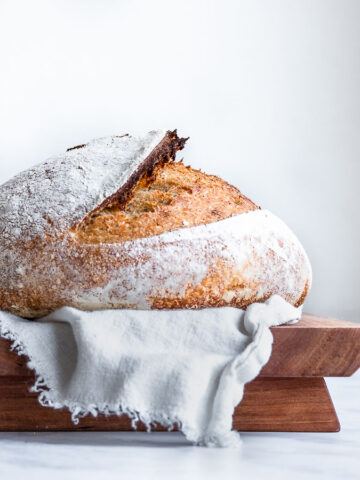

No-knead sourdough bread, with crisp crust and its ballooning airy pockets in the crumb, is our favorite bread. And, recently, I’ve taken the time to return to the kitchen and my roots within traditional foods by embracing the pleasure breads, grains and pulses bring to the kitchen table in addition to all those lovely fats, heirloom vegetables, raw dairy, wild-caught fish and grass-fed meats.
Traditional sourdough baking is a slow process, but there’s lessons to be learned in that, too: the lesson of delayed gratification, the lesson of patience and anticipation of good things to come.
Of course, there’s a bit of a learning curve to preparing wholesome sourdough breads at home, which is why this no-knead sourdough bread has become our favorite. So many sourdoughs can turn out dense and even brick-like from too much flour, too much handling.
No-knead Sourdough Baking Tips
Recently, I attended a class on bread baking taught by a friend and local artisan baker. While I always had moderate success with sourdoughs (like my sourdough focaccia with grapes and rosemary and sourdough challah), learning from Chris proved immeasurably helpful and now, I can pass on what I learned to you. Chris bakes exclusively with sourdoughs, and primarily with freshly ground local wheat.
Use good quality well-sifted flour
The quality of flour greatly impacts the quality of the bread. Nutrients and food enzymes begin to break down once you grind grain into flour. The longer the flour sits, the fewer vitamins (and food enzymes) it offers. Using freshly ground flour enhances not only the flavor of your bread, but also its nutrients as well. I use a Nutrimill grain grinder (you can find them online) at home.
If you don’t have access to freshly milled flour or don’t have a grain grinder yet, consider purchasing sprouted flour (get it here) which is richer in vitamins than plain whole wheat flours; however, both plain whole wheat and even unbleached bread flour will work for this recipe.
Lastly, take the time to sift your flour. Sifting helps to lighten the flour, removing stray bits of excessive bran that can be a source of the antinutrient phytic acid which is reduced during fermentation. Sifting the flour also helps to produce a lightened loaf, with larger air pockets and this traditional method of sifting flour prior to souring was widely used by traditional bread bakers in Europe and in central Asia.
Allow for a long, slow rise
A long, slow rise effects three goals: flavor, texture and nutrition. As is the case with all fermented foods, time brings flavor. This no-knead sourdough bread is allowed to rest and rise and rise again for a total of about 16 to 20 hours, during which it develops that rich and varied flavor characteristic of artisan-quality breads.
A long, slow rise also improves the texture of your no-knead sourdough bread; that is, during this period of 16 to 20 hours, gluten is developed on its own, without kneading which tightens grain’s protein structure. A result of a slow rise is that, with very little active effort, your bread will produce large and airy holes
Lastly, a slow rise activates food enzymes still remaining in your flour like phytase which reduces the naturally-occurring antinutrient phytic acid. Phytic acid binds minerals in the grain, preventing their full absorption; however, with a long and slow rise, the enzyme phytase has the chance to do its work – deactivating phytic acid and rendering the grain’s full array of minerals available to your body. Further, the process of fermentation by sourdough starter enhances the B vitamin content of your bread – particularly folate, while also reducing the bread’s glycemic load.
Handle the dough as little as possible
A long slow rise also eliminates the need for kneading your sourdough bread. In essence, you allow time and the wild yeasts and bacteria in your sourdough starter to do the work for you. The more you handle the dough by kneading or shaping the bread too roughly, the more likely the bread’s protein structure is to contract. Less handling and more gently handling results in a lighter and airier loaf.
Bake hot and allow for steam
Lastly, creating steam in the oven gives the crust of the bread a chance to crisp and flake. Some home bakers create steam by baking in a Dutch oven; however, I like to shape my own loaves and bake them on a preheated baking stone (like this). I create steam in my oven by filling a preheated cast iron pan
No-knead Sourdough Bread

By Published: May 1, 2012
- Yield: 1 loaf (16 Servings)
- Prep: 16 hrs 10 mins
- Cook: 45 mins
- Ready In: 16 hrs 55 mins
Our (almost) daily bread is this simple, whole-grain no-knead sourdough bread. Its a long process, from start to finish, but that's where flavor and texture are born. If you're wondering about hydration levels of starter, check out my tutorial on how to make a sourdough starter.
Ingredients
- 1 cup sourdough starter (proofed and bubbly)
- 3 1/2 cups whole grain or sprouted flour (double sifted)
- 2 teaspoons unrefined sea salt
- semolina or corn meal (for dusting the baking stone)
Instructions
- Pour sourdough starter into a bowl with flour, salt and 1/2 cup filtered water. Mix with your hands to produce a shaggy dough. Cover the mixing bowl with plastic wrap and set it in a warm spot in your kitchen for twelve hours.
- After twelve hours, scoop the dough from the bottom of the bowl and fold it over on itself twice. Allow it to continue to rise for a further two to four hours, or until doubled in bulk.
- Flour your hands and your counter top. Plop the dough onto your floured working surface and gently shape it into a boule or a torpedo as it suits you. Keep in mind that the less you handle your dough, the better your loaf will be. Allow the dough to rise until doubled in bulk, about two hours.
- Set as cast iron pan onto the bottom level of your oven and a baking stone on the middle level of your oven. Preheat the oven to 450 F.
- Once the oven is preheated, bring one cup water to boil on the stove.
- Sprinkle the preheated baking stone with semolina or corn meal. Gently place your bread on the baking stone. Pour boiling water in the cast iron pan on the bottom wrack. Shut the door to the oven fast and bake for 45 minutes.
- Allow the bread to cool completely before slicing and serving.


Hi – I think adding the flour is missing in step 1.
This may be a silly question, but it doesn’t say in the instruction, do I add all of the flour at the get go with the salt, starter and water?
Your blog is not loading right. I thought it was me, but other blogs, etc., are loading fine.
The recipe looks great! I just have to get a sourdough starter started.
I don’t understand what you mean. If it’s not loading, how were you able to comment? I’m confused.
This probably is related to whatever browser Lori is using. Older browsers and Internet Explorer tend to mess up pages that aren’t impeccably coded. Things are loading fine for me with the newest Chrome. Lori – what browser are you using?
I third this; it looks like the flour should be included in step one. Can’t imagine where else it would go in.
Recipe’s all fixed: flour goes in on step #1.
Pour boiling water in the cast iron pan on the bottom wrack.*
*rack
)
(wrack means destruction or wreckage, but I am amazed at how you knew the bottom of my oven is filthy
I’ve been waiting a long time for a recipe like this! Can’t wait to try it! Thanks!
Thanks – I’ve been watching for this one after you told me it was coming a couple of weeks ago!
1) Can you clarify, do you measure the flour before or after sifting? (And/or alternatively do you ever measure it in grams/ounces?)
2) Do you use a peel to get the bread from the counter to the oven/baking stone? Or what is your most reliable method for that?
3) Is this recipe also suitable for spelt flour?
4)For those such as I who are limited right now to purchasing commercially ground organic flour, do you have a favorite/recommended brand (apart from purchasing the sprouted flours)?
1. If the instruction is listed after the ingredient, that means the action is performed after the measurement. (i.e. 3 1/2 cups flour (double sifted) means you sift twice after measuring). Otherwise it’d be listed as part of the ingredient (i.e. 3 1/2 cups double-sifted flour). I will probably follow up this recipe with oz/grams.
2. No. I just lift gently and place. I should probably get a peel, but try to keep kitchen equipment minimal because my kitchen is teeny tiny.
3. Yes. Spelt will work.
4. No. No favorite brand. Try to buy a local grain if you can or from a local mill. My baker recommends King Arthur if you can’t find local/organic.
Thanks for your time with this.
– Breadtopia has some good videos but it seems overall you work the dough even less than he does.
I would love the oz/gram version and the shaping video!
Thanks again!
I work the dough *very* little in shaping. I used to overwork it. It wasn’t until after seeing Chris (our baker friend) shape, that I finally got it. It’s a beautifully gentle process.
I have been trying OH so hard to make sourdough work with a boule, but mine always spreads (“rises”?) out flat instead of up. Do you ever have that problem?
I did before I learned how to shape the loaf. I should try to do a video on shaping. But very gentle shaping helps to make the boule from spreading quite so much.
Is there no water in this recipe? I make nearly the same recipe all the time with only 1/4 cup starter but I need 1.5 cups of water to form the dough.
Yes. There’s water. It’s listed in step #1.
Sorry
I see it now. Just skimmed the ingredients and didn’t see it there! I’m going to try this version to see if there are any differences.
Of course, it all depends on the hydration level of your starter, too – so it might be good to eye it and see?
If you could weigh your ingredients next time you make this (and it turns out normally) & include those measurements I WOULD LOVE YOU FOREVER!
Will do! Next time I bake, that is.
Thank you for posting this! I am newly married and my husband likes bread in the mornings (I am not a big bread eater). Also, thanks for sharing how you use your pizza stone and a cast iron skillet vs a dutchy. I have a minimalist equipped kitchen right now and use my skillet for just about everything.
I REALLY like the baking stone/cast iron skillet method. Works really well for me.
Love, love this method! I was first introduced to it with Jim Laheys book “The No Knead Method”. After adopting the technique I have also used it with sourdough with much success. The flavor in combination with the harder outer shell from the duct oven and the large air bubbles give it the perfect consistency. If only it lasted longer around my house :0
Thanks for sharing!
I haven’t actually read his book. It’s on my list! I used his method when I first started baking and really fell in love with the results. Gorgeous stuff.
When you sift it, you are not actually removing any of the bran, correct? Just running it through the sifter?
Double sifting will usually remove up to 25% of the bran.
You refer to sifting as being practiced traditionally by Asian and European bakers–Nagel suggests that up to 95% of the bran was removed during sifting. Where have you read that 25% was removed? Or is this estimate based on your own sifting?
Thanks.
How to quit the Nourished kitchen ? I don’t find the information. I don’t understand english very well, so it not very interesting for me. Thank you
Hello Jenny, Just wondering how you keep the dough from spreading after shaping?
When I shape the dough into a battard, it then seems to spread out sideways, so I end up with a flat bread. Any hints on how to keep the right shape?
Many thanks
Terrie
Thank you for this recipe! I can’t wait to try it.
Hi! I’m actually going to try this recipe. Haven’t baked bread in many, many years and want to get a better quality food product than anything I can buy. But I’m stumped at the first ingredient and have cut and pasted the line here:
1 cup uses for sourdough starter (proofed and bubbly)
what does 1 cup uses for… mean? Just a typo? Thanks for this recipe! Wish me luck!
Yeah … just a weird glitch with my recipe plugin.
I haven’t done anything grain in years, since I follow the Specific Carbohydrate Diet. However, one of the things which was discussed shortly before Elaine Gottschall’s passing, was that a really long fermented sourdough might be a good candidate for a reintroduction of grains, if one wished to try it. Since I use my pizza stone for all SCD foods, I was wondering if one could prepare the loaf on parchment and slide it onto the stone on the parchment so as to keep my stone uncontaminated if the sourdough doesn’t work for me.
I think that with GAPS (which is similar to SCD) they start off on a very long-fermented buckwheat bread before reintroducing true cereal grains. It might work with the parchment.
Hello,
Has anyone at Nourished Kitchen succeeded in making Gluten-Free Sourdough or in using Rejuvalac in place of yeast?
Shelley
We talk about gluten-free sourdoughs and rejuvelac extensively in this online cooking class: http://nourishedkitchen.com/ecourse/ferment-anything/.
Hello – is it possible to cook this bread in a bread maker???
No, it hasn’t been tested for a bread maker. You could try and let us know.
What is shaggy dough? I just mixed this up and it is dryish. Should it hold together at all? Would love a picture of how it’s supposed to look at that point. Should I add more water?
This is shaggy dough: http://nourishedkitchen.com/no-knead-sourdough-bread/shaggydough/ it should be wet. If it’s dry, your starter is not at the right hydration level and you need to add more water or follow my method for sourdough starter (upon which this recipe is based): http://nourishedkitchen.com/how-to-make-a-sourdough-starter/
Rats! I wish I would have read the comments before venturing to make this bread. When you said shaggy dough, I looked at my dough which looked like a shaggy carpet but not pulled together. I started the dough last night and now I have a dry mess. I added more water but I fear this bread is a bust. I will let it ferment a bit longer but it looks like it’s headed to the compost. Have any suggestions on what I can do with it instead of composting it?
Did you ever receive an answer to your question? I too have a very dry dough. Can I add water after my initial 12 hours? Or do I need to count this one up as a loss?
Any help would be appreciated.
Something similar happened to me today. Based on the picture Jenny has posted of her “shaggy dough”, I think mine was too dry (i.e. too much flour).
Because this was my first time making this particular bread (as well as my first time using my home-made starter to bake bread), the shape and overall consistency of the finished product ended up less than desirable. However, it still tastes great and is a pleasure to eat with some melted butter or honey (try the honey; it’s amazing!)
Anyways, what I mean to say is: just try cooking it anyways! You might be pleasantly surprised by what comes out. Also, knowing just how your bread turns out in the end based on the consistency of the dough, etc., is invaluable experience in becoming better! Failure paves the way to success!
Thank you for this! FAIL was my first attempt too, but I am still baking it and giving it a try!
I went ahead and added more water today and then ended up kneading the dough and letting it rise again and the bread is okay. I would go with the Breadtopia recipe, that came out really well with my starter (like I said, pancake like consistency, so I don’t see how a 1/2 cup water would be enough with all that flour – maybe I did something really wrong.)
Yeah, I tried this with the 1/2 cup water last night and it was so dry – but I thought that maybe that’s what “shaggy” meant. I found another recipe today at Breadtopia that calls for the same amount of flour but with 1/4 cup starter and 1.5 cups water and that worked much better for me. My sourdough starter has been working well in other recipes, so I’m not sure what the deal is, it’s about the consistency of pancake batter.
My starter was quite wet, but since I didn’t see the water in the ingredients (I was using my mobile to scroll through while cooking), I added the water too late… after adding way more sourdough starter in order to get it somewhat moist. It would be helpful to change the ingredient list to include the filtered water. I think this one is a bust for me, I’ll have to try it again in proper proportions. My fault, but the ingredient list change would be helpful for those who are using mobile devices and scrolling while baking. Thank you!
I’m new to looking at food as medicine. I think I heard in one of you webinars that sourdough bread was glutin free? Is that correct? I also recall one of your viewers claiming her arthritis improved or cleared up after changing to a glutin free diet. I have arthritis and, thus, I’m interested in anything which might alleviate my condition.
I look forward to hearing from someone regarding this. TY
Arthritis is often caused by a misdirected inflammatory reaction in the body. “Silent” allergens can cause this, and as gluten is a very common allergen in the western world, (probably due to overexposure in combination with or coincidental to gut damage,) removing it completely from your diet may calm your body’s response and thus your arthritis.
A few notes: Eliminating gluten entirely is difficult if you are not already a scratch-cooking real food home. That’s not to discourage you! In fact the concomitant elimination of packaged and processed foods containing gluten in its many guises may be as helpful to you as your main aim. You sound like you’re not sure if gluten is your trigger, so there may be other trigger foods/situations for you and they will have to be rooted out as well. Then, just as removing the thorn from your palm is only the first step, your body will need to be allowed and supported to heal so that the inflammatory response can calm down. There are various protocols for this – GAPS, autoimmune paleo, SCD – to which you will want to commit at least 30 days of strict adherence before you can assess whether you’re on the right track.
There are tests for gluten intolerance but they give a lot of false negatives (say you’re okay with gluten when you’re really not) partly because that’s the best we have, and largely because there are many markers that most doctors do not know to check for. I’ve been told by a senior internist that I’m not gluten intolerant because it does not cause me to have loose stools, when this is absurd and well disproven by the literature. See the gluten-free society for more information on the various markers and tests. The bottom line is, if you feel better not eating gluten, then don’t eat gluten no matter what the doctor says!
Jenny will know best the likely gluten content of her bread, but it’s fair to remember that gluten is what makes baked goods “tearable” rather than crumble into dust. As other comments have shown, long-rise sourdough from freshly milled flour is likely the best bet for reintroducing bread to a damaged body (such as one displaying autoimmune reactions as is yours) BUT that is after a long and careful elimination and healing protocol with bread at the very end of the reintroduction period due to gluten’s potential for reactivity.
It sounds impossible, I know, especially when the alternative is an “easy pill”. Bear in mind that this condition did not develop or manifest over night, and nor will the side effects of the pills, but the damage is slowly accrueing. Taking this cue to focus on what your body needs may resolve a whole lot more than arthritis, and will certainly prevent even more problems down the road. Best of luck to you on your journey.
I couldn’t have said it better.:)
I can’t speak to how sourdough affects arthritis, but I can recommend a delicious beverage that I used to clear up my achy shoulder and my husband uses to clear up his gout. We recommend this to everybody who complains about arthritis, including an old lady whose gnarled up hands are now improving. I wrote an article about “Purple Pectin” for my website where you can read the whole story of how I discovered it, but the bottom line is that you drink 6 oz daily of purple grape juice with a tablespoon of Certo dissolved into it. Simple and tasty!
I so need to try this. I have been making the no-knead bread for a few years now, but could not figure out how to do it with sourdough and all whole wheat flour without it being hard and tough. Thanks so much for posting this.
So what’s the best way to sift flour?
I have questions about sifting. Do you have instructions and useful tools listed somewhere. I’ve never done it and have no idea what it means.
I live in Colorado, about 5400-5500 feet. How do I account for altitude?
Jenny lives at altitude too. Those at sea level are more likely to need to adjust her recipes than those of us up here in the clearer air!
Would love to know what kind of sifter you use? Mine has extremely fine mesh which takes a long time to use and sifts out too much… thanks!
I usually use a sieve, because I don’t want too much equipment in my kitchen.
This seems like a silly question, but why do you need to boil the water before putting in the oven? I have used water in this way, but have never heated it (call it lazy, perhaps). I love all of Nourished Kitchen and this recipe sings to me….so when I not having morning sickness enough to do this, i’d like to do it right (as I’ve never done sourdough before!)
The release of steam is better if the boiling water hits the preheated skillet.
So you say to sift the flour *after* measuring but I sifted a full 1 cup out of my 31/2 of sprouted wheat flour! So I added one cup white to make 31/2 again (I did this b/4 reading comments). My dough is dry and crumbly! Is that what you mean by shaggy? or should it be somewhat moist?
Thanks
The dough should be wet. Follow the recipe above (without increasing flour)
Just made the dough… but added a little more starter and probably an extra 1/2 cup of water because mine was soooo dry. Hopefully that works!
It sounds like your starter isn’t at the right hydration level. Are you following my starter method?
Mine is dry too… I see your starter instructions say 1/2 c flour: 1/3 c water, but I do 1/2 c. : 1/2 c. and mine is still drier than what you indicate in the recipe. I had to add an extra 1 cup of water to make my dough “shaggy.” I have noticed my starters acting differently based on what type of flour I use. For example, with a white flour starter I used less water than I do with my whole white wheat flour. What kind of flour do you use in yours? Perhaps this has something to do with why some of us have such dry dough to start?
On second thought, mine is likely more like your measurements. I measure in grams. I don’t know what I was thinking about the 1/2:1/2…
Anyway, I still had an incredibly dry dough and added water to make it shaggy looking. now that I’ve gotten it to the point that I’m shaping it, the dough is really wet. Is it supposed to be? It’s not holding form well…. I’m not even sure it doubled in size and I let it rise for over four hours on my warm stove top. What am I doing wrong?
It sounds like you’re not quite following the recipe, so making adjustments to the dough will definitely affect it’s ability to hold form. You could make ciabatta? It’s got a higher amount of water.
Just made last night and my dough is incredibly dry, too. I left as is because I wasn’t sure just how ‘shaggy’ it should be. This morning, it looked the same. So, I’ve added some water and covered with a wet towel to keep moist. Do you think I have a chance in salvaging this batch? I’m using stone ground flour and my own sourdough starter that I’ve had for a few years. My starter may be thicker than yours, but it nice and bubbly and healthy.
Hoping to have a loaf tonight! Thanks for sharing the recipe and offering support.
If you’re not using my starter recipe, you will need to adjust the hydration levels.
I could use this recipe for pizza dough too, right? I would follow the same basic instructions, but flatten it into a pizza shape (or 2) rather than forming it into a ball?
No, but you can use the sourdough focaccia recipe linked above.
I just made this and it turned out beautiful!! Though I just realized I completely forgot to sift my flour. Will do next time. I went to my local bakery and got enough sourdough starter to start my own starter and to use the rest for 1 loaf of this bread. This will definitely be a regular in our house! Can’t wait to try it with my own starter next week.
There is just something about bread. I love the pic of everyone lined up in front of their ball of dough. Hope you are well Jenny! Beautiful post as usual!
Hello Jenny,
In step three, you say to let the dough rise for two hours, do we do that still in a covered bowl, in a warm spot?
Also, If i don’t have a dutch oven nor a baking stone and I’m on a tight budget right now, but I do have a large cast iron skillet, do you think I could bake it in that instead, and put boiling water in just a regular oven proof pan?
Thanks alot, can’t wait to try it.
I started this recipe last night and not surprisingly, I screwed it up. Its almost been 12 hours and it hasn’t risen, although it seems softer. I know I put in too much flour because I forgot to sift it (I worked until 1030pm and was trying to throw it together before bed). It was pretty dry and I even added extra water. I am the worlds worst bread maker, I’ve learned everything through trial and error because I’ve never had any help from an experienced bread maker. I’m not sure what to do with it at this point. Continue on with the recipe or maybe make a pizza with it? I will definitely try this recipe again and again until I get it right Im not a great bread maker but Im determined.
Hi! Can you tell me which kind of whole grain flour you used for the bread in the photo? I’ve made a similar bread a few times with spelt and whole wheat flour and it’s delicious, but comes out much darker in color and without the nice air pockets you have in the crumb. Thanks!
This was double-sifted einkorn flour.
You mentioned that some bakers use a dutch oven to bake their bread. I don’t have a baking stone anymore, but I do have a dutch oven. How would I go about baking sourdough in it? Thanks =)
I made this bread today but unfortunately didn’t have good results. The dough/loaf seemed quite nice and light when I put it in the oven – it had raised but didn’t double in size. The cast iron pan boiled dry before the 45 minutes baking time was up (that’ll teach me for eye-balling how much 1 cup looks like) so the crust is quite dark and very hard – the crumb isn’t light in texture or colour. I’m using a starter that I bought – have fed it and it’s active and bubbly. I live at sea level – should I be adjusting the time and/or temp? I’m just starting the sourdough baking thing so won’t give up. Keep trying and learning, I guess! I’d appreciate any tips or suggestions!
Did you use my recipe for starter? Hydration levels vary from starter to starter, so if the starter you used differed in hydration from mine, so would your results. Also, the pan is supposed to go dry before the bake time is over, otherwise the crust won’t set properly.
Also, did you double sift your flour?
No I didn’t sift the flour (had the fine-mesh strainer sitting on the counter but I forgot to use it) – and the starter I bought from someone else. I think I get the message – follow the recipe exactly as written and you’re more likely to get the same results. I did grind the flour just before using it – organic hard wheat kernels, not sure what variety. Thanks for responding – I’m not going to give up on this sourdough adventure. And I promise I will re-try this – following your recipe specifically.
You confirmed what I suspected. My best loaf of sour dough was one I started on a Sat. Am before going to work, let rise once, put it in the refrig. and finished Sunday afternoon.
I wish you had it by weight, rather than volume. Any idea what those amounts are in grams? I use a scale for my breadbaking.
Hi,
I have tried sour dough before, but it always gets moldy after a couple of days. I live in eastern, central FL and was told it was very hard to make it here because of everything in the air. Can you let me know how to do this without the mold? Thanks,
I checked some Australian bread baking sites for you; see if you find an answer here:
http://www.sourdoughbaker.com.au/starters/healing-your-starter.html
http://sourdough.com/forum/discarding-part-starter
http://sourdough.com/forum/starter-not-really-starting
It seems to be able how covered vs open, and wet vs dry you keep your starter.
OK, so I read it again and it said for less than 1 day.
Though, how can we culture another batch without having to buy lots of starter?
You need to make your own starter using the tutorial linked above.
This is so beautiful. Thanks for making it look so easy
How do you measure your flour initially? Do you use the spoon and level method?
Hi Jenny,
In step 1 above, do we add the starter, FLOUR, salt and water?
Love your site!
Sorry, got it. The page hadn’t reloaded with everyone’s comments yet. Thanks!
We love this method and the bread is so tasty! However, the top crust is just hard as a rock. Can you help us troubleshoot what we might be doing wrong? We’re following the directions and starter directions to a tee.
A few things could be happening: 1) are you using a convection oven? 2) are you boiling the water before you add it to the preheated skillet? Also, during the rising times, are you making sure it’s covered with plastic wrap or maybe a damp towel?
Hi Jenny, So i’ve done this recipe twice so far. The second time worked better b/c I had the flour to moisture ratio right. I got a real good rise overnight and when I turned it over twice and let it rise again it doubled again. A few hours later, I shaped it into a loaf and it didn’t rise as much as the other 2 times. I cooked it with the steam and all that but the loaf is not as airy as in your picture and more flat and dense.
I was thinking that next time, I would let it sit over night, then shape it into a loaf and bake it after that. Thus skipping the 2 hour rest in the middle step. What do you think? Why do we need to flip it twice and let rest, then shape it and rest again? Is my starter not powerful enough for that third rest? The bread is very tasty, just a bit dense. Thanks in advance.
Please try it and let me know how it works. I’m at about 8500 ft, and while altitude doesn’t usually make a whole lot of difference in sourdoughs, perhaps it does in this recipe? The additional rise times are for flavor development mostly.
Thanks, I’ll try it out and let you know!
Hi Jenny,
I am at 3500ft altitude and have a heck of a time with spelt sourdough ciabatta, I cannot do a second rise, or I get a heavy mass, I have to do one rise then bake……do you have any comments or input?
I have been making my own starter for a year and it sounds to be just like yours.
My spelt I sift and its very light….my started is from organic all purpose….with is very bubbly at about 75% hydration, i feed 1/3 cup to 1/3 filtered water.
Spelt is low gluten(I have issues with gluten- i am not celiac) so I do not over handle the sticky no knead dough as the spelt will bleed as it rises overnight 13 hours.
I have no humidity where i am in western canada….so i cover with plastic in a bag to rise so it will not dry out or get a crust on the top.
I bake in a heated clay baker with a cover.
I would like to get bigger holes, any suggestions.
Will it be possible to make your challah without wheat and using spelt?
many thanks
JO
Hi Jenny, Thanks for this. Does plastic wrap seal the bowl because I have a pyrex with a lid and I’m wondering if I can use that. My first loaf didn’t rise. I had it in a bowl with a towel covering it. Thanks!
Is there anything you can do with a dough that didn’t rise? I am just learning about sourdough and while most of my breads do rise well, I had one or two which didn’t. I know there is no point baking a dough which hasn’t risen properly (the bread would be hard as stone) but is there anything alse I could use it for or a way to save it instead of just tossing it in the bin? Organic grain is not cheap and it hurts me to waste it.
Any suggestions?
For dough that didn’t rise well, you can stretch it and bake it anyway pita style. If tastes good – you can make it into croutons or breadcrumbs.
I just wanted to add here that sometimes your climate needs to be taken into consideration with the amount of flour that you use. Every flour is unique in its moisture content. If you live in a dry climate, you might have to add a little less flour, a humid one, more flour. I have a wonderful bread book that I bought in the early 80′s called “Bread Winners”, put out by Rodale Press. The emphasis is on going by “feel”, to compensate for the differing moisture contents in flour. This might be even more important if we are using different types of flour (which they didn’t do so much in the bread cookbook!) I am going to give this recipe a try today, (95% humidity here!) and let y’all know what I come up with!
For those of us with a grain mill (and only as of recent, so I’m new to this). What specific grains do you typically use for the bread? Also for starter?
I typically use Einkorn find it here for the bread and unbleached bread flour for the starter.
I’m bummed. I’ve tried this recipe three times with slight modifications because the dough is too dry. I have yet to have any success. I always end up with a flat, dense blob of hard bread. Wish I understood more of the baking science behind this process so I better understood what was going wrong.
The Bread Baker’s Apprentice: Mastering the Art of Extraordinary Bread by Peter Reinhart is an absolutely incredible resource for understanding anything having to do with making bread – including sourdough. I currently have a copy from the library, and it’s on my birthday wish list. Right at the top, in bold letters!
My starter is a very different consistency than the recipe states, I think (although it sure seems like runny pancake batter), because I need to use about 1 1/2 C water instead of 1/2 C to get the right consistency. I’m on my fourth batch, and haven’t gotten it just right yet – mine are always just a tad too wet and can’t hold their shape while proofing. But I’m getting there! Try looking at images of “shaggy dough” before adding your flour. That’s what I’m doing, and it’s getting closer every time.
For the rise after shaping does dough need to be in container covered with plastic wrap or damp towel?
Thank you so, so very much for this recipe. I’m playing around with it a lot – such as having use almost 1.5 C water instead of .5 C if I use the entire 3.5 C flour. Also, I’ve added an additional “build” or rising step to the process, or at least I did to half the batch today. I so appreciate finally being able to make sourdough bread, after so many attempts and failures in the past. I’m still working to get my ratios down, but as for now these are the best holes I’ve attained in any of my bread attempts – and there have been countless attempts!
Also wanted to add a link, in case anyone else is having problems. My bread, the last four tries, has flattened to almost nothing. I realize now I was letting it rise too long, thanks to the helpful hints here: http://www.breadtopia.com/sourdough-no-knead-method/
Hey have you tried this recipe with rye yet? It would be interesting to compare it to wheat as far as the rise time and crumb development… I know there isn’t as much gluten in rye, and it might need a shorter rise time. Any speculation?
Wow so many comments. It’s like reading a thesis on bread. Thanks for the recipe. Haven’t quite mastered it yet. My loaf was too dry too, even though I followed the starter you suggested on your site. Not sure what happened so added more water to the dough. Double sifting removed a lot of bran!!! so less water needed. At what temperature should it rise? It’s -6 at night here (Central Australia) so it has been difficult to get it to double in size. It’s very different method to how I’ve been taught before with a sponge/pancake like mix to start. I never got the hang of kneading so thank you all for no need bread! and its so wonderful to see it done with sourdough and not bakers yeast.
thanks again.
A recipe for bread that has “no-knead” in the title and looks as tantalizing as this one does is golden
Okay, I really need to get to the bottom of this. Personally, I don’t have any beef with traditionally prepared bread. But there are a lot of people who are turning away from whole wheat and grains, suggesting that they are no longer traditional foods because of the way they are all grown, even sprouted and organic flours. The blog Deliciously Organic even posted a post about the book, Wheat Belly, and she sites some pretty scary stuff. Which included sprouted flours. I’m dying to know if you’ve researched this, or if you could, and post about it (or just give me your thoughts, please).
I’ve tried this twice now, and both times my bread ends up being way too sour. When I let it raise for only 6 hours the flavor is much more tolerable, more of what I’m used to for store bought sourdough. I’m not using a starter made from your recipe, but I’ve changed the way I maintain it since I’ve read your site. Any tips on what makes the final product more sour?
Jenny,
Can I use any sprouted flour for this recipe? Would spelt, kamut or barley work? Or should I just stick with wheat? thanks!
Any flour should work, but you might need to adjust the hydration levels as needed.
Hi Jenny,
Can the foccacia rise longer? I am a healing gluten intolerant person that can eat long, slow rising sourdough bread? Is the 8 hour rise time long enough for gluten reduction? Thanks. Use ur site daily. Am trying to master the no knead bread. I have 4 starters than I have been rotating for 1.5 years. Getting better at it each loaf. Thanks again.
So, my first stab at making this bread was a flop. My bread didn’t rise at all and was brick-hard. After reading the other comments, it seems that my starter’s hydration levels weren’t right, because my bread was so dry. I’ve added more water to my starter and it seems to be at a better consistency. I’m also using rye flour for my starter like Sally Fallon says she likes to do. Can you describe for me the consistency of your starter? How “soupy” is it and what should I expect mine to be like?
Hi Jenny,
Any tips for those of us with small (microwave size) convection ovens?
Thanks!
Allison
I have a small microwave/convection oven also! Any tips would be appreciated!
Help!! I took my starter from the freezer three days ago, and have fed it once each day. The starter was originally a mix of Bob’s Mills’ rye, whole wheat, and spelt. I’ve been feeding it with kamut. I’ve kept it in the fridge as we live in an apartment with a BAD gnat problem. I put it in a quart-size jar with a piece of plasitc fitted under the canning ring. I poked holes in the plastic with a tiny sewing pin. It’s done nothing!! What am I doing wrong? Is it too cold? I’ve heard it’s okay to keep it in the fridge. Are my pin holes too small? Do I need to feed it longer than 3 days to keep it in the fridge?
Is this bread sour when using the Parisian starter? Thanks:)
Yes.
This recipe seems to use too little water. I added a little over 1/4 cups more (and using white flour only!) and its still too dry – I think wetter dough means better bubbles, lighter loaf. My starter is 100% hydration and active (recipe calls for proofed starter – ??? – proofing is something else I think, active is the right word here)
Another thing with the recipe is that it states use only wholewheat flour but when you look at the images its obviously white flour bread. I wouldn’t advice to use wholewheat only, the loaf is too heavy – maybe 50-50?
1. No. The recipe doesn’t use too little water – you need to actually follow this recipe, the recipe for the starter and the instructions on flour. 2. Proofed starter is the same thing as active starter/recently fed starter. 3. It IS whole grain flour and as described in the ingredient list it is double sifted which removes anywhere from 1/4 to 1/3 of the bulk of the flour (mostly bran), making the hydration levels correct. Please, in using the recipes on the site, follow the instructions and ingredient lists.
ok jen, thanks for answering
maybe measurements in grams or ounces would be helpful and people could follow the recipe more precisely. I usually put a big bowl on my scales and add everything by weight.
btw, regarding the wholewheat flour – whats the point of using it when you “double sift” it anyway?
regarding the picture in the recipe: did you really actually make that bread from wholewheat flour?
IF YOU READ the segment on why you need to sift the flour, you will have the answer. And, yes, the bread pictured is made from double sifted whole wheat flour.
I’m on my third attempt with this recipe, but I have high hopes for this trial because I’ve decided to ignore the recipe and go with how the dough feels. It took slightly less than 2 cups of commercial flour to get a good looking sticky dough. The 3 1/2 cups of flour called for in this recipe is raw wheat, which you then double sift to get about 2 cups of usable flour that goes into the dough (losing all the bran that makes whole wheat whole in the process, which makes it seem like it might have been faster to just use commercial unbleached white flour to start with).
If you’re using a bag of flour from the supermarket like most people, try using 1-1/2 to 2 cups of flour and see if that makes a nice wet looking slightly sticky dough. Using 3 1/2 cups of regular flour in this recipe is going to give you an extremely dry dough that will turn into a brick of bread.
Maybe for this recipe put the amount of flour post sifting?
Robert, YES that is exactly what happened to me! I tried double-sifting 3 1/2 cups commercial sprouted wheat flour I bought from the store but it was already well sifted because no bran whatsoever was left behind in the fine mesh strainer. I couldn’t get it to become a shredded dough and in the end I was left with an unleavened brick. The devil is in the details when it comes to bread making, for sure. I will definitely try your suggestion next time around!
YES Robert! Upon reading your comment, I understand why my dough was not “shaggy.” I had to add another cup of water, and yes, Jenny, my sourdough starter is actually MORE hydrated than yours. I could not understand why it had turned out so dry. It makes sense that one is left with less flour post-sifting, but when you’re using plain ole store-bought, that throws the hydration of the bread off. As someone else commented, I normally use the 1/4 cup starter and 1.5 cup water recipe, but I like my bread more sour and was glad to find this one using more of the starter.
Thanks for the recipe, Jen! Love your site.
I used this recipe with my starter that has been going for about 2 weeks now. Doubling between feelings and seems to prefer a 1:2:2 ratio.
Bread came out super sour (which I love) but also super dense. First rise was great and definitely doubled but deflated the second I took it out of the bowl to form it (also really stuck to the bowl). Didn’t really rise in that second 2 hour rise time. Any suggestions? The taste is perfect but I like my sourdough really airy
Any help would be greatly appreciated.
What is the consistancy of your starter? (wet or tacky) I know with no knead the moisture content is key for the process to work. My starter is quite wet and seems to throw things off.
My starter is pretty wet. Pancake mix and pourable. Should I be adding more flour when I feed it?
So far ivebeen feeding it : 1/4 c starter, 1/2 c water, 1 c flour. I don’t have a scale and know that’s the best way to measure but until I get one I’ve been using cups. It always doubles and gets nice and frothy.
Tried again to make this tonight but no luck. Dense and no air bubbles. Soooo disappointed. I’m also pretty type “A” so am going to keep at this till I get it right!!!
Will not be defeated by the bread!
I recommend using my sourdough starter recipe with this recipe.
Jenny,
do you give private courses?
Help! My dough is like a brick. What did I do wrong? It’s just so heavy and dry…seems like too much flour. Any suggestions?
Refer to Robert’s post a few comments above!
Fabulous! Can you explain the purpose of the plastic wrap? I hate to use disposable plastic every time I make bread. Is it supposed to create a seal (and then could I just use a large sealed container), or would I be better off just putting a dishtowel over the bowl?
You can use a dish cloth IF you live in a humid area. The plastic wrap keeps the top of the dough from hardening during the rising period.
Thank you this was my 4th try with my sourdough starter The best results so far with the least amount of work A1 . This Will become a staple in my recipe files.
Jenny, love your site! I’ve read through the comments and didn’t see this addressed so wanted to ask: How much do you work your dough when you initially mix it all together? I don’t want to overwork it but also want it to be properly mixed. Thanks!
Jenny,
Re: Sour dough bread
Since the recipes is handled so little. Does this recipe fall in the gluten free category. I pray it does.
Thanks,
Deidre
I am on day #5 of making my first starter and I am really excited about the process. A question for Jenny or anyone else who has successfully worked this exact recipe: I have an old commercial Wolf stove with only two oven racks. Top & bottom. What do you think are my best options for situating the bread & the water pan? My first thought was shared space on the bottom rack as the top one is maybe 6″ from the top of the stove.
As I type this a new idea has hit me.. maybe removing the top oven rack, propping my pizza stone on two bricks and then putting the water pan on the bottom rack?
I am open to suggestions!
Hi Jenny!
Thanks for this recipe.
I am wanting to start making my own starter in the next few days and I also JUST started grinding my own flour.
SO I have been experimenting a lot lately. I am a big fan of the “artisan bread in 5 minutes a day” method and I am wondering if there was ANY WAY to incorporate their method with your recipe? Could I make a bigger wetter batch with sourdough starter mixed in (I have no idea about a ratio here) and then let it sit for 12 hours like you do and then just store it in the fridge so that I can just grab some dough when I am ready to bake a small loaf? What do you think?
I will also email them and ask if they ever played with sourdough starters and see what they say but I am curious about your perspective… the methods are very much alike… It’s just have no no proportions to follow.
Well, I just found this:
“A cup of active sourdough starter has about the same rise potential as a package of yeast. So, substitute a cup of starter for each package of yeast and then subtract about 1/2 cup of water and 3/4 cup of flour from the recipe to compensate for the water and flour in the starter. You’ll probably want to play with the ratio between the flour and water, and adjust the amount of riser to get the results you want, but this rule of thumb is a good starting point.”
SO maybe I will make your starter recipe and try to substitute it for the yeast in the ABin5 recipe? Does this sound like a bad idea?
I just made this bread, and followed the recipe EXACTLY, (right hydration of the starter, double sifting the 3 1/2 cups of whole grain flour), but I was left with a dry brick. I wish I had read through to the end of the comments, as that would have provided me with the important information that is missing. There are variables here that will change the amount of flour, after sifting. My flour must have been more finely ground, as the double sifting process only removed about 2 tbsp. of coarser bran in total, leaving me with about 3 3/8 cups of flour including fine bran. As Robert mentioned, a coarser ground flour, after being sifted, might have left only 2 cups of flour. I used a standard flour sifter that I’ve used for years, but perhaps you have a very fine sifter, which would make a big difference as well. Either way, it would be much more helpful to have the flour listed in the recipe as the “post-sifted” amount, so that people using different flours or sifters will be working with the same flour to moisture ratio. From the previous comments, it seems like there were many of us that had way too much flour for the cup of starter and half cup of water. I would like to try this recipe again, if you could provide the updated information, (with weight measurements please).
Hi,
Can I make rolls out of this dough rather than one large loaf? I’m new to baking my own bread so I apologize if this is a silly question. I just finished my first starter. Also, does sourdough freeze well? Thank you!
Hi,
What about adding seeds to the bread – i.e. sesame, poppy, sunflower, flax seeds etc. Would they be added to the mix in the beginning? Would they deter growth? Or does this bread only allow seed-topping before baking?
Hello Jenny, Just wondering how you keep the dough from spreading after shaping? When I shape the dough into a battard, it then seems to spread out sideways, so I end up with a flat bread. Any hints on how to keep the right shape?
Copyright 2013, Nourished Kitchen, LLC. All rights reserved. No part of this content may be republished without express, written consent.
Hi,
I tried making sourdough bread twice and gave up because my bread was way too dense, sour and hard to like for people who are just coming off store-bought wholewheat bread. next i tried making sourdough pizza, this was crumbly and my poor kids ate in strained silence. Your recipe sounds very promising! please post a sourdough pizza recipe too! Thanks a lot!
hi there,
have just started making sourdough, but have yet to try the no knead method…would you be so kind to let me know the ounce/gram measurements, as I live in the UK, and have a feeling that your cup measurements are different in the U.S. Thankyou very much,
Simone.
Jenny I am so excited about this recipe but i have failed 3 times now. I have religiously adhered to your starter recipe but when I use it to make the dough it does not double (or even move), is way to dry like so many others have commented. We are hand-grinding kamut for this bread, maybe my grind is too course? Even when I add extra water to make a “shaggy” dough my dough does not rise. Getting desperate – willing to pay $$ to get your help solving these problems. Any other tutorials you recommend?
I would also like to add to the chorus of voices asking for weight measurements. I live in Germany and it can be very humid here, I have had to learn how to bake bread all over again. Measurments in grams would take a lot of guesswork out of this process for us. Thanks.
Dear Jenny,
I adore your website. I am a busy Ob/Gyn and spend lots of time discussing nutrition and it affects on reproductive health with my patients. That being said, I also have two small children (4&6) who think sourdough starter is neat-o. I have tried to make this bread a few times and was wondering if you might post your flour measurements by weight?
Thanks for your help,
Keri
I am working on my first batch – a friend made your starter and gave me some that was several weeks old. My shaggy dough was crumbly. I saw in one comment that means my starter doesn’t have the proper hydration. How do I remedy this? Thanks!!
Looking forward to trying this recipe out this week. Thank you!
Thanks so much for this recipe. I would love to try it soon. I have been experiencing dense loves of bread. I have just one question though.
What temp do you let the bread rise at?
Thanks for your time!
I have a question a came across a sourdough starter called “Goldrush”, what are your thoughts on them if any?
So I just pulled the bread out of the oven and it is hard as a rock! What could have happened. The only thing I didn’t do according to the directions was sift the flour. Could that have been what I did wrong?
I thought that once you add the salt to the dough, the phytic acid will not be able to break down properly.