
kimchirecipe 3

Hot, Salty & Sour: My Kimchi Recipe

I love kimchi, and I make kimchi at home a few times a year, usually in the autumn when Napa cabbage, hefty daikon radishes, carrots, garlic and chili peppers can all be found at the market in abundance.

I buy them by the case, taking advantage of discounted prices – cabbage for 75 cents a pound, carrots for a dollar. The farmers, who all practice organic methods and grow in mineral-rich soils, cut me a deal not only because I buy so much, but also because they know that when my pot of kimchi has fermented away, I’ll bring a quart to each of them. And my kimchi is good, really good.

A Good Kimchi Recipe

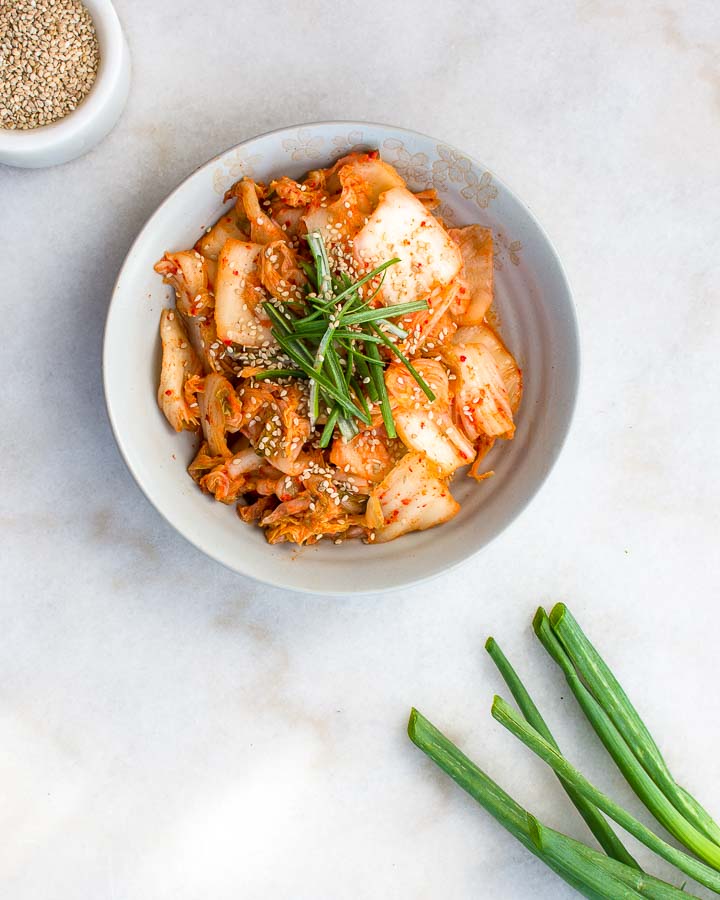
A good kimchi recipe balances texture, flavor and heat. Unlike homemade sauerkraut, where uniformity is the goal, a good kimchi is a dish of variety: chunks of radish and garlic, chili-flecked cabbage leaves and brilliant heat. Indeed, one of the first mistakes newcomers to kimchi make is to simply shred all the ingredients together and pound them away as they would any fermented vegetable dish, but the flavor and textural variety of kimchi rests on different cuts: chunks (not shreds) of cabbage, whole pickled strips of carrot and radish and hunks of good garlic. I typically serve kimchi in condiment-sized (1/4 cup) portions.

Benefits of Kimchi

Like all fermented foods, kimchi is extraordinarily rich in beneficial bacteria – those bacteria that line the gut and help to build our immune system, manufacture and assimilate vitamins. Kimchi is also a rich source of vitamin C and other antioxidants due not only to the ingredients in most kimchi recipes, but also due to the fermentation process itself which typically increases the antioxidants found in foods.

Kimchi, and other fermented foods, may also play a role in the mitigation of risks for metabolic syndrome. Several Korean studies found that those people who consumed the most kimchi (thereby adhering to their traditional diets) were the least likely to suffer from metabolic syndrome – a condition that is on the rise world-wide, but particularly in industrialized nations.

The Right Ingredients for Your Kimchi

I use Napa cabbage, Daikon radish, carrots and garlic in my kimchi recipe, and I season these vegetables with a paste made from fresh chili peppers (though you can use the leftover paste from homemade fermented chili sauce if you like), ginger root, fish sauce (which you can purchase at Asian grocers or online), unrefined sea salt and whole, unrefined cane sugar.

Unrefined cane sugar (which you can purchase at most health foods stores and online) helps to boost the microbial activity of the bacteria, providing them food as the kimchi ferments. It further enhances the flavor, softening the heat of the chilies without detracting from their taste.  Don’t worry about residual sugar, as the beneficial bacteria will consume it; however, if it still concerns you, consider omitting the sugar and adding a shredded apple pear or green apple to the batch.

Unrefined sea salt, rich in minerals, helps to keep pathogenic and opportunistic microorganisms at bay while promoting an environment that keeps beneficial bacteria – those responsible for fermentation – happy and proliferating. You can find unrefined sea salt online (see sources).

The Right Equipment for Your Kimchi

When you begin fermenting foods, like kimchi, mason jars offer a good option; however, they are not ideal. Fermentation is an anaerobic process. That means the vegetables you ferment should not be exposed to air during fermentation as this can cause contamination by stray microbes and molds.

If you plan to ferment foods regularly, invest in a fermentation device equipped with a weight and an airlock (see sources) or a fermentation crock such as the Harsch, Polish or German sauerkraut crocks which you can purchase online (see sources).

These devices are intended for fermentation and their structure as well as the addition of weights (which keep vegetables submerged in the anaerobic environment of brine) and airlocks (which allow carbon dioxide to escape without allowing new air in) help to ensure that fermentation is more reliable in your kitchen and that your fermented foods are less likely to be contaminated by other microorganisms.

Hot, Salty & Sour: My Kimchi Recipe

Prep Time: 30 minutes

Yield: 4 quarts

Hot, Salty & Sour: My Kimchi Recipe

A simple, authentic kimchi recipe, that doesn't involve burying a crock in your back yard. The flavor is bright, hot and pleasantly sour.

Ingredients

  • 1/4 lb ginger (peeled and cut into chunks)
  • 1/4 lb fresh chili peppers (trimmed of stems, seeded if desired)
  • 2 tbsps whole, unrefined cane sugar
  • 2 tbsps fish sauce 1/4 cup unrefined sea salt (divided)
  • 2 large heads Napa cabbage (chopped into large chunks about 2 inches by 2 inches)
  • 1 1/2 lbs carrots (scraped and cut into finger-length sticks 1/4-inch thick)
  • 1 1/2 lbs daikon radish (scraped and cut into finger-length strips 1/4-inch thick)
  • 8 heads garlic (peeled and chopped)

Instructions

  1. Place ginger, chili peppers, sugar, fish sauce and 1 tbsp sea salt into a food processor. Process until you form a smooth paste.
  2. Place chopped cabbage into a large mixing bowl, sprinkle with remaining sea salt and cover with warm (not hot) water. Stir until sea salt dissolves and allow the cabbage to sit for twenty to thirty minutes. Drain the cabbage and pat it dry.
  3. Place the cabbage, carrots, radish and garlic in a large mixing bowl. Spoon in the chili and ginger paste you prepared in step #1 and toss to coat.
  4. Transfer the mixture, cup by cup, into a gallon-sized vegetable fermenter or fermentation crock and pound down with a wooden spoon until the vegetables release their juice. Continue layering and pounding until all the vegetables have been transferred to the crock. Pound again until the vegetables have released all their juice and the level of brine fully covers the vegetables and that the vegetables rest within one inch of the crock's lip.
  5. Weight the vegetables down with your crock's weight or a small sterilized stone, cover and ferment at room temperature for at least one week before trying the kimchi. If you prefer a sourer flavor, ferment longer. Transfer to the refrigerator when the kimchi has reached the desired level of sourness where it will keep for at least six months.
http://nourishedkitchen.com/kimchi-recipe/

Inspired Real Food Recipes Delivered to Your Inbox

facebook twitter pinterest google+

What people are saying

  1. I love kimchi! I had a korean buddy get me authentic salted korean shrimp and korean chili. I’ve made it so many ways, its so easy! I can’t believe I used to pay $5 for that tiny jar.

    Here’s my two recipes- I use sriracha for super fast and yummy kimchi!
    http://neo-homesteading.blogspot.com/2012/01/kimchi-101-two-recipes-for-korean.html?m=1

  2. judith scott says:

    your food makes me weak in the knee’s.

  3. Colleen C says:

    This sounds incredible! I love Kimchi – it is the best part of the meal at Korean Japanese restaurants. I tend to surprise people with how much I will eat in one sitting. It is so yummy! Drooling now…

  4. Susan Garrett says:

    I love your recipes! I am diabetic so putting sugar in anything isn’t an option. Do you think xylitol would work?

    • Definitely not. Xylitol is not a natural sweetener, and since it has not sugar, it won’t feed the beneficial bacteria. Worse yet, there’s evidence that xylitol is antimicrobial, so it might actually inhibit the proliferation of beneficial bacteria to some degree. You could skip the sugar entirely, though – and your kimchi should turn out fine!

      • Xylitol is found in many natural fruit and vegetables and is usually made from Birch tree bark. But it still might not work because of its antimicrobial properties. Can one use unrefined honey in kimchi?

    • one kimchi recipe i use has this instead of sugar: half an apple, half a pear and half a sweet onion pureed with 1 cup of water to provide the sugar needed for the ferment and also a good part of the liquid to submerge the vegetables. i go ahead and add the garlic into this to puree all at once….. yumminesss

      • That sounds like a really good variation.

      • I’m all for anything that omits sugar. Yum! Thanks.

      • sugar isn’t necessary. none of the kimchi recipes i have tried call for sugar and they turned out great. you dont need additional sugar for fermentation, after all, you’re trying to make kimchi, not alcohol, right? my guess is that the sugar jenny adds is merely for flavor which i look forward to trying. the korean markets here have a large variety of kimchi’s – hot & salty, sweet and mild and sometimes fishy. Some entirely daikon, others with napa or one of my favorites, kale kimchi! room temperature is going to be a bigger factor as to how quickly or aggressively your kimchi ferments. one week is a great starting point for a cool 65-70 degree kitchen but if its in the 90′s you’ll find that pot ripening up strong and fragrant in just a couple days

    • I had a Korean lady give me a recipe for her kimchi and she used a little applesauce. I thought it was weird because I had never put sweetener of any kind in my kimchi but since then I’ve seen many traditional recipes that use fruit, including citrus… now it makes sense.

    • TruthisTreason says:

      The sugar is used as part of the fermentation process. Xylitol is a natural sweetener. Lots of disinformation in these replies here.

      • Xylitol is *not* a natural sweetener. It is a heavily processed sugar alcohol sold as “natural.” Just because it’s marketed to natural foods enthusiasts doesn’t make it natural.

        Xylitol is made by processing xylan (usually from a corn source, and unless it’s organic it will be GMO). Then it is processed by acid hydrolyzing and hydrogenization (typically using a catalyst like nickel). It’s then evaporated. Then they stir in ethanol to crystalize it. Then it is centrifuged.
        Sounds natural to you? I don’t think so.

        • elisssabeth says:

          Xylitol can also be made from birch. I know this because my daughter is deathly allergic to corn and this is the only kind of xylitol she can tolerate…you are correct in that MOST xylitol is made from corn. But NOT ALL. For example, Glee Gum Unsweetened is the only gum on the U.S. market, at all, I have found that is completely corn- and corn-derivative-free because their xylitol is derived from birch.

    • Susan, the sugar will be completely consumed by the fermentation process. I’ve made sauerkraut with slices of apple in the jars, and when the kraut was finished fermenting, the apple slices had no trace of sweetness in them.

    • The recipe calls for 2 Tbls sugar and about 10 lbs veg. That’s an insignificant amount per serve, and is consumed by the yeastie beasties,, anyway.

      Curious tho- do you use any kind of refined flour, starch or Irish potato? Much bigger problem than the insignificant portion of sugar here.

  5. I love kimchi and make it very often, coming from an asian background! You actually can just cut out the sugar if you like but still add sweetness by using a grated pear or apple instead, as is often used in traditional kimchi recipes. I have it on my blog too, if you would liek to take a look/share (:
    http://mummyicancook.blogspot.co.uk/2012/01/better-homemade-kimchi.ht

  6. Kelley Ahearn says:

    This is a wonderful fish sauce https://redboatfishsauce.com/index.html !!

  7. Hi Jenny,
    Been interested in starting to experiment with fermented foods. Your kimchi looks simple enough but my family doesn’t eat spicy foods, can we omit the chilies or reduce( pls provide amount) so it’s hardly spicy? My little ones will not likely eat it if its spicy. Keep these recipes coming.

    • You certainly can eliminate the chilies, but it won’t really be an authentic kimchi; that said, the real key is to make what your family will eat. If they like it with just ginger and garlic, great!

  8. When you say to scrape the carrots, what does that mean? Exactly what variety of peppers do you use?

  9. How about a ‘print this recipe’ feature? I love your site! Such a wealth of knowledge and ideas. Thank you!

    • I’ve been looking … looking … looking for a reasonable plugin to use for that function and can’t find one. Still looking.

      • You can create another “printer friendly” page (HTML – no photos, or one small one. No side bar. But be sure to keep your logo so we know where it came from.) Then just add a link to that page. All browsers have a print function. Ctrl+p will do it.

        Also “http://www.printwhatyoulike.com/” will allow you to print any web page, selecting only the portions of the page you want printed.

        BTW: My husband loves kimchi and I’ve been looking for a recipe to make some. This looks easy and delicious. I may have to make two batches. A hot one for him and a milder one for the girls and me.

    • It might not be as nice as a ‘print this recipe’ plugin, but if you’re using Explorer you can right click and find the print option on the list that pops up. I love this site, look forward to reading the newsletter everytime I see it in my email.
      Deb

  10. I have never had kimchi with carrots before, or so much ginger! I am still working on big case brought back from Korea a few weeks ago, but I definitely want to try to make my first batch when that runs out. I maybe I will mix some carrots in place of some of the scallions in the recipe I have. Looking forward to seeing more of your versions of Korean recipes in the future!

  11. sounds yummy. is there a substitute for fish sauce? can i use light soy or lemon juice?

  12. I am going to try this as soon as I can! Question–Is there any way to preserve fermented food without refrigeration?

    • Fermented foods can be kept on the countertop; however, they will continue to age – so refrigeration helps to halt the aging, and keep the fermented food at a flavor that appeals to you. They can also be kept in any cool place: a basement, garage, root cellar.

      • So, sauerkraut, for example. When I see it canned in a mason jar somewhere, does that mean the good bacteria are gone?

        • Yes, that’s correct: it will have lost much of its value due to canning. If it is refrigerated (like Bubbies), it will still contain beneficial bacteria.

  13. Hi Jenny, thanks for sorting out my meal plans, today’s arrived and I’ve picked up the one I missed. A quick question regarding fermentation in general – mostly sauerkraut so far but this kimchi sounds delicious! I am still using quart-sized glass jars with a rubber seal, initially I left the air-tight seal off when fermenting (well-weighted beneath the brine) on the counter top, then replaced it when I refrigerated the sauerkraut, but I noticed that when I released the seal to serve some there was a definite release of gas – in fact some kraut I had put in a plastic pot which was maybe 4 weeks old at most, actually popped the lid! I am a bit worried as once in the fridge the sauerkraut is no longer beneath liquid, I keep it covered with the glass jar lid shut, but not with the air-tight seal and have had no problems with eating it (quite the opposite it tastes increasingly delicious though more ‘sour’ and helps my digestion no end!) Obviously I don’t want to risk contamination but it seems to be still fermenting quite strongly once refrigerated (the door is the only place it fits so perhaps it is not that cold) and not beneath a protective brine. I do have the glass vegetable fermenter you used to recommend, which I haven’t used yet as it makes such a large volume but we are eating more and more ferments so I might start using it – but once the sauerkraut or kimchi has fermented on the countertop in the large fermenter for 1 week (or longer?) do you then transfer it to quart jars and airlock them? But I’m worried they will continue fermenting and blow the jar – any advice welcomed as ferments have become a core addition to our family’s diet and I want to continue! Thanks for all the hard work you put in, by the way, and the site is looking great !

  14. Jenny,
    I think I’m going to try this. In LA, it’s getting impossible to find kimchi without MSG. I have a lead on a couple of sources, but still . . . . Have you tried dried shrimp instead of fish sauce?

    • I LOVE using shrimp paste/dried shrimp. It’s just very difficult to find in my area.

      • Ok, bought some MSG free Kimchi today (the price was crazy), but also got my cabbage and radish to start a batch tonight. I’ve seen it done so many times, it’s time to try it myself.

  15. Mouth.is.watering.

  16. Elizabeth says:

    Definitely try the sterilized (boiled) stone–that’s what the folks in Korea used. No need for fancy crocks. My mother-in-law uses whatever plastic container she has available and packs it in super-tight. Lock-N-Lock containers are good for this. But… she uses a special kimchi refrigerator to keep it at the right temperature so it doesn’t explode after being in there for a few months. If you don’t have a kimchi refrigerator then after the initial fermentation you may want to transfer your kimchi to a container with an inch or two of space between the kimchi and the lid. Also, it helps to stir out any air bubbles every few days, so the bubbles don’t make the liquid level rise too high and overflow. And always make sure to close your kimchi container tightly… otherwise the smell of sour garlic will really change the flavor of the rest of the food in the fridge.

    My experience with kimchi is that is turns out well one time and less well the next, until eventually with practice it becomes a bit more reliable. You have to allow yourself to mess up occasionally.

    For folks who don’t like hot peppers, google “white kimchi” or “water kimchi”. You will find cool and refreshing recipes that do not burn your mouth.

  17. Can this be made without the fish sauce? I can’t find a natural brand in the UK? Or does anyone know of a good brand?

  18. If you live near a Korean grocery store, buy an onggi pot, it’ll be worth it for making authentic kimchi. :)

  19. Carrot and radish are common additions to kimchi, but not necessary for the dish. Sugar is not really used in kimchi.

  20. Elizabeth says:

    Jenny, is it really 8 HEADS of garlic? That seems like an awful lot.

  21. Hi Jenny, I really love eating and making fermented foods and kimchi is one of my favorites! Thanks for sharing this delicious recipe. :)

  22. Is the garlic necessary at all? I love fermented things, but I’ve never tasted Kimchi because it contains raw garlic, and I avoid garlic as much as possible. Do you think shallots (another strong tasting allium) would work instead?

  23. Wondering what type of chilies you use? I have read some kimchi recipes that say our Southern cayenne and “non-Korean” chilies are too bitter/hot. Anything that you have found to be ideal?

  24. This is the best kimchi I’ve ever had, including the $10/jar kind. I’m surprised how easy it was–perfectly pickled, no scum or mold (I did use the fermentation jar from Cultures for Health). I eat some almost every day–it’s great on burgers and even in borscht! (added to my bowl once it’s cooled a bit, of course). Thank you! This recipe is priceless to me.

  25. JUST finished my 1st batch….waiting anxiously to see how it comes out. I bought a fermentation jar from an Asian Market. It is glass and has a large rim at the middle of a stack with a bowl that covers over the top. The instructions state to pour water in the rim and put the bowl on the top of the stack for keeping air bubbles away. My concern is the kimchi is only about 3/4 full to the top. All of the cabbage is covered with liquid BUT what about it being only 3/4 full?? Is it a worry??

  26. Scarlet says:

    I made this a couple of weeks ago with our homegrown cabbages, carrots and radishes. We’ve almost finished the whole batch, it’s that amazing. My 9 month old can’t get enough of the stuff, even with the raw garlic and chillies. It was ready after 5 days as we live in the tropics.
    Thanks for a fabulous recipe.

  27. To make a homemade airtight fermentation vessel for under $6, buy a ½ gal wide mouth mason jar, a wide mouth Tattler lid, a regular size lid, and a brewers airlock w/plug. The mason jars and Tattler lids come in a case of 6 and 12 respectively. It looks similar to this: http://www.culturesforhealth.com/fermented-vegetable-master.html But this crock is $12 plus s&h.

    Drill a ½ inch hole in the center of the Tattler lid. Insert the plug and airlock. Put a Tbsp of water in the airlock. Set aside. Fill the mason jar, leaving 1 in headspace. Weight vegetables using a clean regular size canning lid and a boiled rock. When the fermentation is to your liking, trade the Tattler airlock lid for a Ball freezer lid.

    I hope this helps someone else save some money!

  28. Hi – great recipe – I’m assuming it’s fine to use savoy &/or red cabbage as a substitute for napa. Please advise. Thanks.

  29. I fermented some carrots last week and opened up the jar to skim the “scum” off the top. The batch smelled more like alcohol than sour. Why is this so? Is it still safe to consume?

    Thank you!

  30. Hey Jenny.. this recipe looks great. For those dedicated kimchi lovers and makers in large quantities, I have a simple solution for fermentation. Buy a beer brewer with a lid that has a water airlock. You place the water in the lock and the gases from the inside can escape, but it does not allow any air to get back inside the container.

  31. Just made this! Can not wait for it to be finished!

  32. Sara Gordon says:

    Hi Jenny, I already have a few jars of sauerkraut made up. Do you know if I can add the other ingrendiets to the existing sauerkraut to make kimchi? Thanks, Sara

  33. Why drain the water rendered by the salted cabbage? Isn’t the intent to have all vegetables release their juice?
    Thanks!

  34. This may seem like a dumb question, but in order for me to try this I need to know in advance…Will this make my house stnk? I want to try fermenting because I know how healthy it is, but I am afraid my family will be turned off completely if it smells bad. I may be able to use the shed if it is going to smell, but not sure if there is a required temperature. Thanks!

  35. Admiring the commitment you put into your blog and in depth information you present.
    It’s good to come across a blog every once in a while that isn’t the same old rehashed
    information. Wonderful read! I’ve saved your site and I’m adding your
    RSS feeds to my Google account.

  36. Thank you for the recipe! What kind of chili peppers do you use? Are they just called “chili peppers” or would any hot pepper work? Thank you

  37. I made this recipe with some slight modifications according to what was available to me. I don’t have access to Napa cabbage, so I used regular, and I didn’t soak it in salt water before mixing with the other ingredients. Since I was working with dried red chilies, which I rehydrated, I may have put too much chili in it. Otherwise, everything is the same.

    I checked it after fermenting it for 5 days on the counter (72F), and it was ready. I noticed that my radishes were soft, though, and from googling it, it sounds like radishes in kimchi are not supposed to be soft. The carrot and cabbage were both still deliciously crisp.

    Did anyone else have this happen? If I make it again, I plan to decrease the garlic, because it is very, very garlicky.

    Thanks for a good recipe idea, Jenny!

  38. Claude Badley says:

    8 heads of garlic? Do you mean 8 full bulbs of garlic? That is a lot. Or do you mean 8 cloves of garlic? I’ve made this recipe a couple of times and just can’t seem to get more than 2 “heads” of garlic in it before I think I just won’t be able to eat it. I really like this recipe but the amount of garlic has me wondering…
    Thanks in advance for your reply.

  39. This probably sounds lame, but I can’t get over the fear of what if my fermenting goes wrong, what if it ends up turning harmful and if i consume it and something should happen to me :S helppppp

    • Shanaz~
      First, it doesn’t sound lame, we are indoctrinated as a culture (most 1st world cultures) to think that fermentation is a bad thing. I had to work up some courage before I embarked on my fermentation adventures. Second, the nose KNOWS! When something has gone bad/wonky, then you will know. It will be slimy, moldy, and/or yucky smelling. It involves trusting yourself, and trusting your body. Do you eat yogurt? Cream cheese? Regular cheese? Pickles? These are all fermented. (I call it controlled rot). Before the days of refrigeration, fermentation was a daily cycle for people, not only for the wonderful probiotic benefits, but also as a way to make these foods last. Good for you for reaching out to experiment. Trust yourself. It will be awesome.

Post Your Comment

Got a question? Want to provide a tip or other input? We love comments! Post them here, but remember to adhere to the comment policy. In short: keep it respectful, upbeat and don't spam us.

Before you ask about substitutions, please consider that if I recommend a substitution, it will be included as a note in the recipe.

*

Latest Real Food Recipes

beef stew finished (2 of 3)
Farm Cheese
Vanilla Mint Ice Cream
Ginger Bug
soup horizontal (1 of 1)
Google+