
If you're at the farmer's market and come across an abundance of fresh beets, make this beet kvass recipe. You only need a handful of ingredients and a little effort.
Within a few days, you'll have a deeply nourishing tonic. The earthy, lightly sour, and faintly sweet flavor is an acquired taste. But you'll find yourself craving it before long.
What is beet kvass?
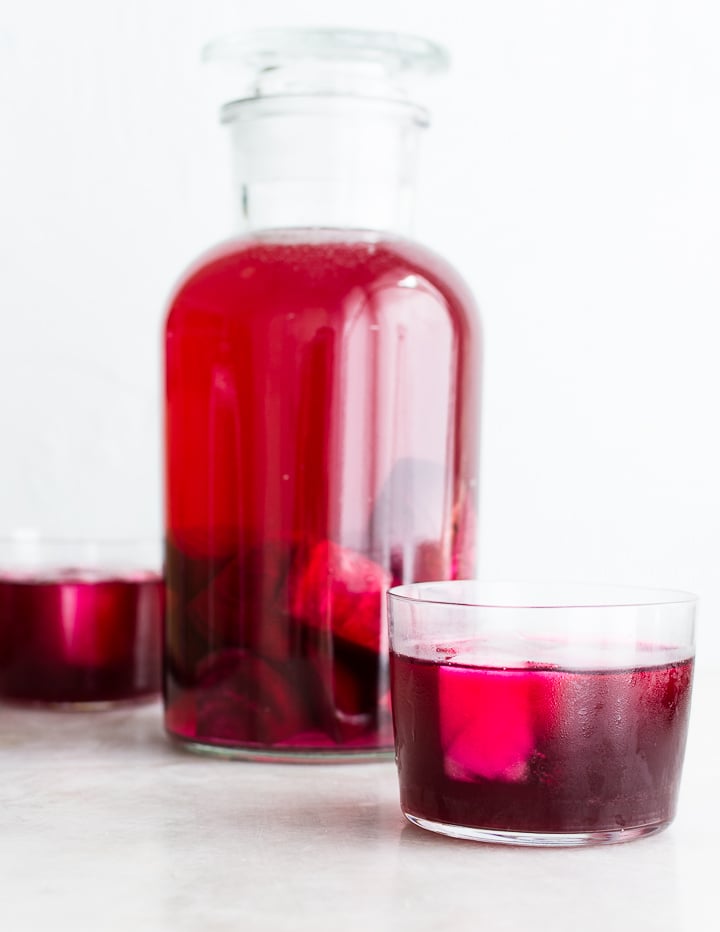
Beet kvass is a fermented drink with roots in Eastern Europe. Its flavor tastes similar to beet juice - earthy, sour, and slightly salty. As beet kvass ferments, the beets release their pigments which gives the kvass a vibrant pink-red color.
Why this recipe works
Beet kvass is easy to make, and you only need a few ingredients.
It's also affordable since beets tend to be a thrifty purchase at the supermarket.
Beet kvass is a powerhouse of antioxidants combined with beneficial bacteria and wild yeast.
You can easily adjust the flavor, adding ginger, dill, or other herbs and spices to make something uniquely your own.
Key Ingredients
Beets are central to this recipe. You can use any kind of beet you like, including red, golden, or candy-striped Chioggia beets.
Salt gives the kvass a little flavor. For the best flavor, look for minimally processed and additive-free salt such as sea salt.
Starter culture is traditionally used to make bread kvass, of which beet kvass is a variation. While it's an optional ingredient, it can speed up fermentation and make a reliable brew.
Filtered water is optimal for fermentation since it will not contain chlorine.
Herbs and spices can add interest and flavor to your beet kvass. Ginger, garlic, dill, black pepper, turmeric, and allspice are all popular additions.
Brewing Tips
Beet kvass is simple to make at home. And you only need a few ingredients: beets, salt, and water. Using a starter culture can be helpful, too, and results in greater palatability and faster fermentation.
When you make this recipe, there are a few things you want to keep in mind.
- Use an airlock lid or a very tight seal. That prevents oxygen from flowing into your kvass. Accordingly, it lowers the chance of mold contamination.
- Use beets with the peel on, but rinse them well. The beet skin can be a good source of lactic acid-producing bacteria. In other words, those are the bacteria you need for proper fermentation.
- Pay attention to your water. Tap water can contain chlorine or chloramine which are antiseptics intended to keep drinking water safe; however, they can inhibit proper fermentation. So, use filtered water or allow your tap water to sit out so the chlorine will evaporate before using it for fermentation.
- Foam and bubbles are a normal part of fermentation. If you see bubbles forming, that's a great sign that fermentation is underway.
- If your beet kvass becomes viscous, start over. Sometimes beets and other high-sugar vegetables like carrots produce a viscous texture when fermented. That just means your beet kvass fermented a little too long.
- Give your kvass more time in the winter, less in the summer. Fermentation speeds up in warm temperatures and slows down in cold temperatures. So it will need less time in summer, and more in winter.
Ways to Use Beet Kvass
At its heart, beet kvass is a fermented, probiotic tonic. So just pour it over ice and drink about ¼ cup at a time. You can also dilute it with sparkling water if the flavor is too intense or earthy for your liking.
Thanks to both its acidity and brininess, it makes an excellent addition to salad dressings. Next time you make a dressing, use it in place of the vinegar.
For similar reasons, it's also delicious swirled into soup - especially borscht and root vegetable soup. The acidity of beet kvass helps to balance the soup's sweet, earthy flavors.
Using a Starter Culture
If you haven't brewed many fermented drinks, you may be unfamiliar with starter cultures. These are sources of beneficial bacteria and yeast. They help speed up fermentation and create an acidic environment.
Fermented drinks with live cultures, such as kombucha, jun tea, and water kefir, work well as starter cultures for drinks. Beneficial bacteria are well-established in these cultures and will kickstart your kvass.
Natural sources of yeast, such as wild yeast or ginger bug work great for beet kvass.
Juice from fermented vegetables is a source of beneficial bacteria and lactic acid. Juice from homemade sauerkraut can be a particularly nice starter for this beet kvass recipe.
Variations + Substitutions
Try golden beets, orange peel, and ginger. Beets are a natural match for citrus and ginger, and the combination is lovely.
Add garlic and dill. If you're a fan of sour pickles or pickle juice, you'll love this combination of garlic, dill, and beets.
Try black pepper, cinnamon sticks, and allspice. They make a nice, spiced brew that's especially good for winter months.
Try these fermented drinks next

Recipe Questions
Beet kvass tastes slightly sweet with earthy undertones, similar to beet juice, only tarter with a salty edge.
I recommend composting them. However, many people will eat the leftover beets or brew a second batch of kvass from them. Keep in mind that if you re-use the beets, your tonic will be progressively weaker.
No, but it's helpful. Traditionally you make kvass with a starter culture similar to sourdough starter or wild yeast. However, if you don't use a starter culture, consider increasing the salt to 1 tablespoon (about 20 grams).
Adding a starter helps it ferment faster and more safely, reducing the risk of harmful bacteria or mold.
No. Traditional Eastern European kvass recipes, including beet kvass, do not call for salt. Rather, they use a hunk of sourdough bread and, often, a starter culture similar sourdough starter to kickstart fermentation. In these recipes, you'll often see honey or sugar added, too.
By contrast, American versions, such as this beet kvass recipe, often include salt (sometimes quite a lot!).

Thomas says
Can I use part of the fermented kvas to make a new batch without adding starter culture?
Jenny McGruther says
Hi Thomas! Yes, you certainly can.
Karen says
I made my kvass on Sunday. It had small bubbles on the surface for a few days but by Friday there were no bubbles. Smells good. But is it kvass? Seems like it did not ferment long enough. FYI I put it in a glass jar but it only filled about 2/3 of the jar (so lots of headspace). I sealed it tightly and have burped it twice a day. I did also add 1/4 cup sauerkraut juice, used spring water and pink Himalayan salt.
Georgie says
Hi Jenny, thanks so much for this great info. I look forward to making kvass!
Thanks!
Marta says
Hi guys! I’m from Poland and I can share with you my great-grandma’s recipe for an excellent and super healthy beetroot kvass ????
1kg of beetroots and two litres of water (boiled and allow it to cool)
1 head of garlic (yes, one full head – it will not only add an amazing flavour but also as we all know – garlic is super healthy)
2/3 whole allspice berries
Around 5 black peppercorns
2/3 bay leaves
1 spoon of marjoram (optionally)
2 spoons of salt (1 spoon per 1 litre)
You can use a big glass jar. Rinse it with hot water before putting any ingredients into it to get rid of some bacteria (prevents the mould to develop). Thinly peel beetroots and cut them into 2/3 pieces (2 pieces for small beets and 3 pieces for bigger beetroots). Place beetroot in the jar, add garlic and all spices in between them, Add cool water and cover with a cheesecloth. Put in a warm place (next to refrigerator or in the kitchen). Leave it for 3-5 days (the longer it stays, the more sour it becomes). Don’t worry if there’s some foam at the top after 1st day or 2nd – this is normal and will disappear, you can always get rid of it if you want. The spoon has to be very clean, though, as we don’t want to add any bacteria to it.
The kvass can make bubbles (like champagne) – it is a very good sign.
If there’s some mould then something must have gone wrong and you need to throw the kvass away and star all over again. Please remember to use clean utensils.
Smacznego ????
Marta
Jill Davis Davis says
Thank you! I’m gonna give this a try!
Cathy says
Jenny! Thank you for letting us know how easy it is to make beet kvass for health!
Anna! Thank you for explaining the white "scum" I would have been afraid of it had you not mentioned it; also for the idea of garlic added-so delicious!! My kvass is tangy and rich today, about a week on the counter top.
Michelle says
Hi! I have a batch fermenting right now. I opted for using more salt instead of whey or starter culture and added garlic as the above poster from Ukraine suggested. But how do I know when it's ready?! It's been on my counter for 5 days. Thanks!
Zarema says
Jenny, I would love to make the beet kvass. however the link to the culture starter does not seem to work. Can you please let me know which one do you use in your recipe?
thank you
Anna says
Hi everyone,
I am from Ukraine – the country were beet kvass comes from and is a base for our traditional national dish – Ukrainian borshch. Borshch is made from beet kvass and beet kvass used to be always at hand in every Ukrainian household. We drank it as a healing medicinal tonic and used it for borshch.
First of all, we NEVER added any whey or kefir starter to beets – this brings in different cultures, like more lactic bacteria rather than wild yeast (and kvass, from its very Ukrainian name means sour – mostly yeast fermented and carbonated, not lactic fermented, like sauerkraut).
Secondly, we never closed the jar tightly, like many new recipes call for – as this will create pressure and may kill off some of the cultures. When this happens, slime may develop (harmless yet disgusting bacterial slime). We only cover the jar with a cheese cloth folded a few times and secured with a rubber band or a string.
Thirdly, keep your beet kvass on the counter for at least five to seven days or longer away from sun light (or covered with a kitchen towel).
Next, you will notice white mold forming on top of your beet kvass. This mold is harmless and is a part of the normal process. You can collect and discard this mold by spooning it from the surface. This mold is like the mold on brie cheese – not necessary the same fungi, but also harmless.
We ALWAYS add a few crashed cloves of garlic. ALWAYS! We do not peel the garlic – just press it (or smash it) as to crack it open a bit for juices and cultures to penetrate it easier.
No wonder many people cannot drink this beet kvass – I would not like it meself without any garlic and with whey added. I grew up drinking this stuff – NO WHEY, friends!
Try the REAL UKRAINIAN beet kvass – you will LOVE it.
PS: If it tastes too strong for you – dilute your beet kvass with water.
Good luck with making this most medicinal tonic of all.
Anna (from Ukraine)
Jeanmarie says
Coincidentally, I just made a fresh batch of kvass! I'm trying beet-carrot this time, using purple carrots that are golden on the inside, plus one gold carrot. The colors are lovely.
I'm going to try with a starter culture next time as you suggest. This time I used whey poured off from Strauss full-fat yogurt, which is pretty darned good.
Heather says
Great recipe. Thanks for the great basic recipes lately. They're very useful and often contain some simple practical/relevant explanations of things I've wondered that I've found missing in Nourishing Traditions, so you sort of fill in the gaps for me. I would love to see more about making whole grain sourdough bread.:) Just thought I'd throw that out there. 🙂
Bonnie says
I am enjoying Beet Kvass. It is so yummy. I used the recipe out of Nourishing Traditions, but yours has an additional flavorful twist to it. Thanks for sharing.
I used a 2 qt Ball mason jar to make my Kvass. The lid was slightly loose for the 2 days it sat on the kitchen counter after which it was placed in the refrigerator.
sue says
Thanks so much for all you do - I love your blog and I use our recipes so often! I've been making beet kvass for a couple years, modified (less salt) from Nourishing Traditions. I've never peeled my beets and I only let it sit for 48 hours as that is what Sally Fallon instructs. I see that your recipe has it ferment for a week and peels the beets. I'm assuming that the longer ferment will enrich the end product? Can you comment on the benefits of letting it sit longer and peeling the beets. Thanks so much.
Krista says
I love beet kvass. I use the recipe from NT so I always only let it ferment a couple of days. I actually just made a batch today so I'll let it go a few extra days to see if I like it better. My little one likes it, too.
Ciganka says
Thanks for the great post. I recently made my own version of a beet kvass using water kefir and the juice from canned beets. I took water kefir after the first ferment and mixed it at a 2:1 ratio (2 parts water kefir, 1 part canned beet juice) and bottled it in groelsh top bottles. I let it second ferment for 24-48 hours and it was delicious and fizzy! I know it's probably not quite as nutritionally dense as doing it all the way from scratch but it was still refreshing and better than drinking pop. I really like the ideas you gave for seasoning it...I will have to try that, too!
Carrie says
Would it work to make this in a gallon glass jar? If so would you put the lid on and just unscrew it to let the CO2 escape once a day or more? I've done some fermenting, but still feel intimidated whenever I see a new recipe. I'd really like to try this one! Thanks!
Suzanne says
Hi Jenny,
I made beet kvass about 6 months ago and it's been sitting in my refridgerator since then. One jar has developed mold on the top. I know with sauerkraut, you can scrape it off and the kraut is fine. Do you know if the kvass is the same? Thanks!
Jenny says
I find that the tonics are better tossed if they develop mold (especially if it's been there for a while). It's hard to get the scent out of the kvass otherwise.
Candice says
Great! Do you cover the beets while on the counter? Tightly or loosely, if so? Do you ever use the veggie starter culture from Body Ecology for your ferments? Thanks, Candice
Jenny says
I culture my kvass in a vegetable fermenter equipped with an airlock (you can find them here: https://nourishedkitchen.com/where-to-buy/#kitchen). The fermenter maintains proper anaerobic conditions while allowing CO2 to escape.
I do use the BED veggie starter culture from time to time. I also like the Caldwell's starter; however, most of my veggie ferments are wild.