

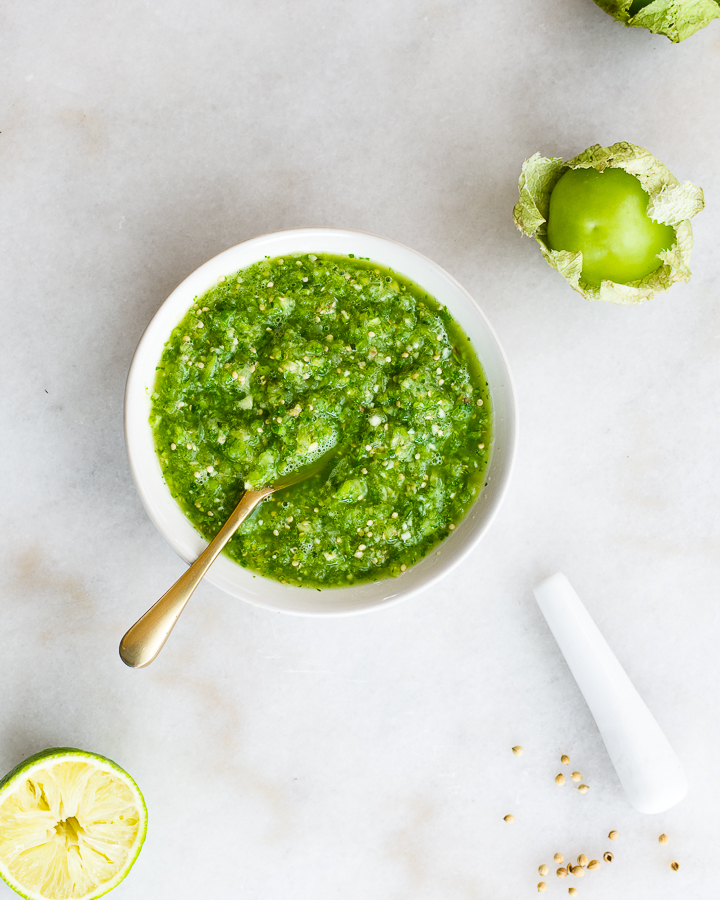
Fermented salsa verde, made with tomatillos, garlic, cilantro, and plenty of jalapeños, has a vibrant, bright flavor marked by notes of citrus and the lightest touch of sea salt. It takes less than 5 minutes of active time in the kitchen, and just a few days to culture on your countertop.
What is it?
Fermented salsa is a salsa that has been allowed to culture for several days to a few weeks. This process imparts a deep, complex flavor with acidic undertones. And, like sauerkraut, sour pickles, and many other fermented foods and drinks, it tends to be a good source of probiotics.
Ingredients typically include tomatoes or tomatillos, as well as onion, garlic, chili peppers, cilantro, citrus juice, salt, and spices. Sometimes, cooks will also add a starter culture, like whey, to speed up fermentation, but you can make it without whey, too. You use this same technique with other spicy ferments, such as fermented pepper mash.
Fermentation Tips
It's really easy to make fermented salsa. You start by blitzing tomatillos, garlic, white onion, jalapeños, and coriander in a food processor. After that, you'll seal it in a jar and let it culture at room temperature for a few days and up to a week.
And while it's easy to make, there are a few tips to keep in mind to ensure your salsa ferments safely and comes out just how you like it.
- Use a fermentation lock. A tight seal that prevents oxygen from getting in while allowing the carbon dioxide that builds up during fermentation will help prevent mold and spoilage.
- Watch for bubbles. Tiny bubbles should appear at the surface of your salsa while it ferments, and they should be visible through your jar. It's a good sign that the beneficial bacteria are doing their work.
- Watch for color changes. As the salsa ferments, it will become more acidic, which may cause it to change color from vivid green to dull green.
- Salt helps keep your ferment safe. Adding salt to the salsa helps keep mold and other microbes that can cause spoilage at bay while beneficial bacteria take root. If you want to minimize salt, consider adding a starter culture instead.
- Separation is normal. Fermentation may cause your ingredients to separate as they culture. Don't worry! It's normal. Just swirl it with a spoon to reincorporate the ingredients.
Katie Bartels says
I turned my very small and precious harvest of tomatillos into this salsa last fall - AMAZING!! I ate it fresh & fermented. Tweaks: I used frozen cilantro and frozen lime juice. I seeded the jalapeños.
Pam says
Hi! Can I use frozen tomatillas & jalapenos from my gardern for this? TIA!
Jenny says
Hi Pam!
You can, but be aware that it may change the texture.
Danielle P says
Love this recipe! Can I preserve this salsa via the water bath method?
Jenny McGruther says
Hi Danielle! You certainly can, but it will lose all of the benefits of being fermented/live cultured. If you're okay with that, then follow safe canning guidelines from the USDA / your local extension office.
Rio Thomas says
I’ve made this recipe in the past with great results.
I have the locks on my jars, but never noticed any bubbling…I’ve had them going for more than the suggested time, maybe a week?, and was about to put them in the fridge, but they have a layer of mold(white). Can I just carefully scrape off that layer?
I followed all measurements, but subbed different pepper variety.
Susan says
I have had my salsa verde on the counter for 3 day so far. I made it exactly as the written recipe (no whey).
Allan says
Hi, I recently found a local farmer who had planted a crop of tomatillos this year and I am now happily in possession of 3 pounds. After having discovered your recipe for fermented salsa verde, one batch has already been started. For the second batch, I would like to use your suggestion of substituting cumin for cilantro.
Thanks
Collybie says
This is awesome! it litteraly took me five minutes... but the result is fantastic! I did the recipe once, then 6-7 days later i made a new pot, so I could compare raw/ fermented... It takes a complex, smokey, deep flavor... I will make this again and share with friends for sure!
Roberta says
can you can this to preserve/
Jenny says
Hi Roberta,
You can can this salsa, but you'll defeat the purpose of fermenting it if you do so as you'll kill all the beneficial bacteria and many of the heat-sensitive vitamins created during the fermentation process if you can it.
Mandy Hodgson says
If yoghurt is a thermophilic culture - how can the whey be used in a room temperature fermenting process?
Jenny says
Hi Mandy,
That's a great question. Yogurt is thermophilic (most yogurts are, anyway), but that doesn't mean that those cultures won't proliferate at room temperature; rather, it just means that they proliferate best at a slightly elevated heat. Remember, yogurt cultures between 6 and 12 hours, typically, which is pretty fast. Heat accelerates fermentation. Ferments using whey as a starter usually ferment over a matter of days, as the cooler temperature promotes slower fermentation.
Thomas says
Can a powdered yougurt starter be used? I have some I bought to make non-dairy yogurt out of cashews (or other nuts). Just wondered if I could use that as a starter for this.
pam says
Would the vegetable culture be the same as what is in sauerkraut?
Paula says
Is substituting with whey ok in this recipe and could I use up some frozen tomatillos for this recipe? Thinking maybe not on the later.
Thanks,
Paula
Emily says
How long will this last in the refrigerator?
tiffany says
How long does this last in cold storage?
Penelope Gonzales says
I love salsa verde. I have made some from a different recipe. I'm intimidated by this one because I don't think I understand the whey thing. I visualize yogurt "juice" but I never seem to get enough from the yogurt that I buy to do any fermenting. Is the whey powder that you can get at the Coop Food store ok to add for the recipe to work? I get the concept, but the practicalities are stopping me from jumping in to the fermentation game.
Liam says
Whey powder will not work it is a powdered protein produced from whey.
Are you straining the yogurt in the fridge overnight? That really should produce enough whey to use as a starter, if not check the ingredients, there maybe added ingredients to prevent the yogurt from separating.
Millard Mathews says
You can get more whey by placing in cheese or nut milk bag or cheese cloth and hanging over a bowl for a day. You end up with more whey and Greek yogurt!
Ken Orabone says
I've just started the fermentation journey beginning with Sandor Katz and The Art of Fermentation. I used this recipe, but halved the jalepenos. I also didn't bother with any starter culture as I figured the ingredients should contribute enough bacteria to let things work out on their own. I did have to ferment longer than the 3-5 days, possibly due to the lack of starter and the cool area of the house that has become our fermentation spot. I probably went in the range of 7-9 days.
You can see them in the foreground here, with my sauerkraut and kimchee in the back.
https://plus.google.com/u/0/116992201578501269585/posts/4SV5AbYHLdz
No issues with mold (none with any of my ferments yet) and it was one of the best things I have made. Absolutely fantastic flavors!
genesis says
Question, I just got a beautiful German made ceramic fermentation pot. It comes with a few traditional kraut recipes, yet they all take well over a month for fermentation to be complete. I just searched for a salsa recipe and came upon this excellent one here. My question is: Am I seeing correctly, does it really only take 3-5 days in a Harsch ferment pot with the starter to have salsa that is ready to consume? Or, do you have to jar it and let it ferment longer in the jars? Thanks!
Andy Tanner says
I've never fermented before, and this looks like a great recipe to give it try with!
Shelly Smith says
I was wondering if I can "sub" green tomatoes for the tomatillos in this recipe?! I have lots of green tomatoes to use up! Thanks 🙂
Rachel says
I was excited to find this recipe (& site) because I'd been looking for a recipe like this. I added the 1/2 pack of culture starter but I made some changes to the recipe to suit my tastes. I decreased the jalapenos (8 way to spicy for me) & garlic to two each & added 1/ 2 cup of chopped cilantro.
mia says
Can the culture be substituted with whey? And if so how much?
Thanks!
Deliciously Organic says
I've been looking for a recipe like this, and can't wait to try it!
christine says
For the fermentation time, does one put a lid on the jar or just cover it with a cloth (like with kombucha)?
Tinjah says
yes, but you should burp it. I always keep all jars of fermenting foods in a dish to catch any overflow that may occur.
AmandaLP says
Wow, that's a spicy salsa! I just did a batch that is fermenting now, and it was 2 lbs tomatillos to 4 jalapeños.
Why is salsa verde more likely to "go awry?". I've had a few mold on me, but I also wasn't measuring my salt correctly. A few times.