Voodoo Stock: Chicken Feet & Chili Peppers

November 30, 2009 · 40 comments - Print This Post - Email This Post

chickenfoot

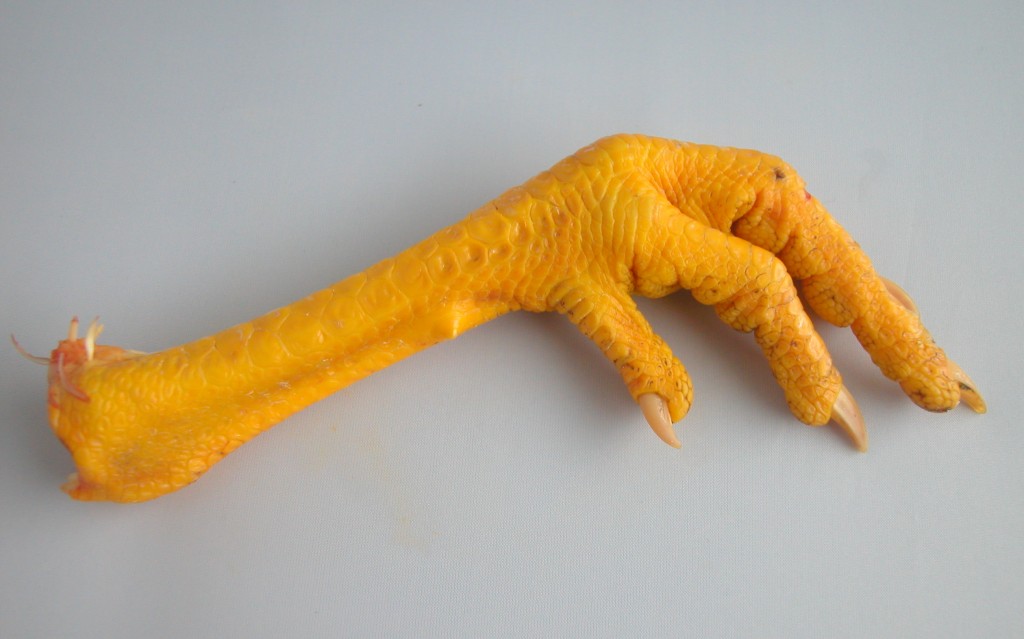
Chicken feet – gnarly, repulsive and disturbing – make for the very best stock. Devoid of little else but tendons, bone and cartilage (sound appetizing yet?), chicken feet produce a fine golden broth that’s rich in all those obscure nutrients that make a good stock so nourishing: glucosamine chondroitin, collagen and trace minerals.   Moreover, a chicken stock is an excellent source of calcium without .   Understandably, a stock made from chicken feet gels beautifully just as a good stock should.

Saturday morning, I pulled out a bag of chicken feet and as I peeled the yellow membrane from the feet and hacked away the talons, I couldn’t help but reflect upon my relationship with food.   Dear God, I thought, I was a vegan once!   I used to gag at opening a package of lunch meat, and now I can peel and hack my way through a bag of chicken feet with nary an ill feeling   That is until my 4-year old tapped me on a shoulder with a disembodied claw.   Eeeew! Then there was that time when I accidentally left a bag full of chicken feet fresh from the farmers market in the fridge at the office.
3chickenfeet

Chicken feet can be difficult to find – that is, until you know where to look.   They don’t come packaged on little Styrofoam trays, wrapped in plastic. Ethnic markets – those last bastions of traditional foods – often carry chicken feet, heads and other miscellaneous parts that are forgotten in conventional cooking.   Farmers markets can be another source.   Most importantly, your local farm offering pastured poultry may also have a stash from the latest harvest.   If purchasing your chicken feet at a market, they will usually run you $1 – $2 per pound; however, if you purchase your whole chickens farmer-direct they will often throw the chicken feet in the bag at your request.   These chicken feet came from a local, family-run farm that also specializes in grass-fed lamb.
Preparing Chicken Feet for the Stock Pot

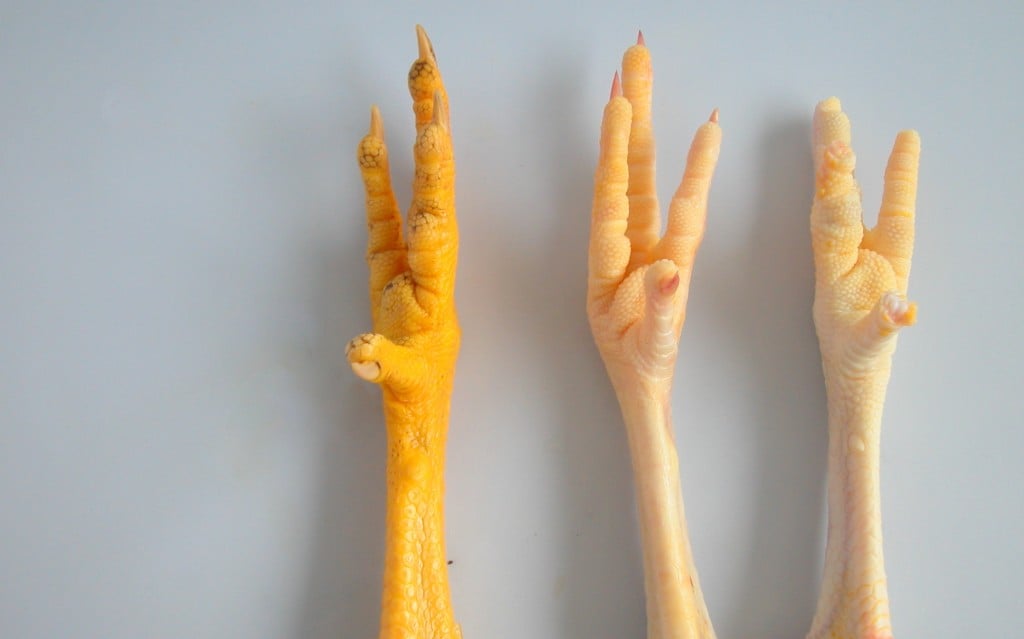
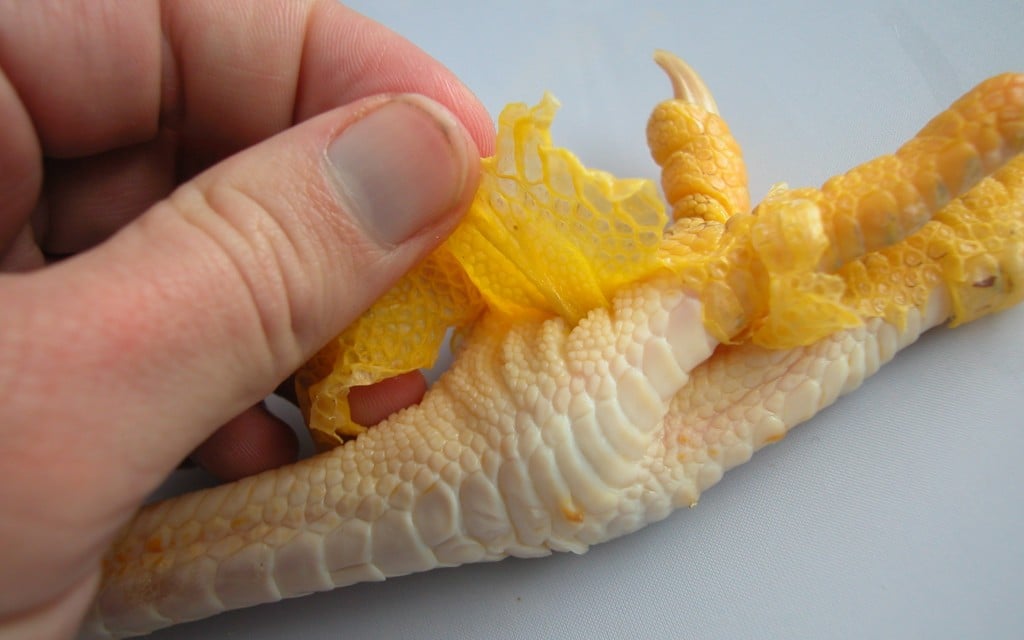
In many cases, the chicken feet will arrive already prepared, more or less; however, if you receive them directly from your local farm you may need to dress the chicken feet yourself.   This is easy.   First, you’ll rub them with salt and scald them briefly in boiling water followed by an icy bath.   This practice enables you to more easily peel the yellow membrane on the foot.   After peeling the yellow membrane from the feet, chop the talons off at the first knuckle.   Some cooks prefer to leave the talon on the foot. In the above picture, you’ll see chicken feet in the three stages of preparation: 1. fresh, 2. peeled and 3. declawed.When blanching the chicken feet, take great care not to blanch the feet too long or you will overcook the feet, fusing the yellow membrane to the foot and activating the gelling process. Moreover, overcooking will also cause the tendons in the feet to contract, making peeling virtually impossible. Be brief.
peeling chicken feet

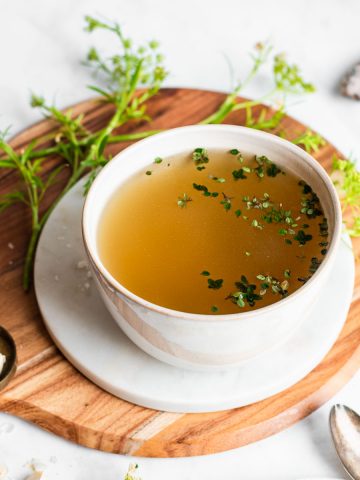
Once the feet are fully prepared by cleaning, blanching, peeling and talon removal, they’re ready for the stock pot.   A stock prepared from chicken feet, like any stock, is widely variable and can be seasoned based on your personal preference.   Preferring a mild-tasting broth in most recipes, I usually season my broth with vegetable scraps including celery leaves, onion and carrot peelings; however, from time to time, I like to change the flavor of the stock a touch and heat it up with chilies, ginger and other spices.   The stock recipe detailed below is very well-suited to Asian-inspired dishes and perfect for cold and flu season when a nourishing, mineral-rich broth infused with chilies and spice can help clear the sinuses.

chickenstock

Asian-inspired Chicken Foot Stock

Prepared from chicken feet and no other bones or meat, this stock produces a solid gel.   One pound of feet will produce approximately ½ gallon of well-gelled stock.   Its aroma is faintly reminiscent of Top Ramen, no joke.   Even if you prefer to season your stock with a mild combination of onion, celery and carrot or herbs of your choice, follow the same method as outlined below.

More on Stock & Broth

Ingredients

  • 1 lb Chicken Feet, Peeled and Talons Removed
  • 1 2-inch Knob of Ginger
  • 1 Star Anise
  • 3 – 4 Fresh Cayenne (or other) Chili Peppers
  • 1 Bulb Garlic, Peeled
  • 1 4-inch Stalk of Lemon Grass (optional)

Instructions

  1. Add all ingredients to your stock pot.
  2. Add water to cover.
  3. Simmer for a minimum of 4 hours and up to 12, adding more water as needed or desired.
  4. Skim any scum that rises to the top.
  5. Strain solids from the broth through a fine mesh sieve or cheesecloth.
  6. Bottle and reserve the stock.
  7. Serve in Asian-inspired soups and dishes.

Shop Real Food

Learn to Cook Traditional Foods.

Learn the basics of maximizing nutrients through traditional, time-honored foods. Posts sent Monday through Friday.

Flickr | Facebook | Twitter

{ 2 trackbacks }

Fresh Chicken Broth | The Nourished Kitchen
February 26, 2010 at 10:38 am
Real Food Challenge, Week 4 | Epic Organic
February 28, 2010 at 6:21 pm

{ 38 comments… read them below or add one }

1 Cara November 30, 2009 at 8:04 am

Thanks for this! I think I can handle it since you take the membrane off first, I didn’t know about that.

2 Donielle @ Naturally Knocked Up November 30, 2009 at 8:08 am

And here I thought I was ready to try the feet in my stock. I had no idea you had to do anything to them to get them ready! Now, I’m not so sure I can go peeling and hacking away….

Great post though! I stumbled it.

3 Kelly November 30, 2009 at 8:19 am

So why cut off the talons? Or do you throw them into the stock too, just separate so the bones have a little exposed marrow? My chicken lady prepared a few for me, scalded and skinned, then froze them for me. I tried adding one to my chicken carcass stock, no gel (cooked for about 30 hrs in crock pot). Does it take a whole pound to get the gel? Thanks!

4 Cathy November 30, 2009 at 8:19 am

I also didn’t know about the peeling part. I don’t consider myself a queasy person normally, but am not sure I can stomach doing that. In part maybe because of our hens in the back yard who are as much pets as they are egg-layers.

5 Local Nourishment November 30, 2009 at 9:18 am

I do remove the membrane, but rarely de-talon. If the talons are clean, why would that be necessary? I was thinking that the claws would probably add keratin to the final product.

6 Katie November 30, 2009 at 10:28 am

I had no idea you were supposed to remove the yellow membrane. Although the time I got chicken feet (attached to the rest of a chicken from a family farm), I don’t remember them being that yellow, so maybe they were already peeled.

The little feet make me feel sad :-( The rest of the chicken doesn’t look so much like a chicken any more, with the feathers gone. But the feet still look like they could be walking around.

I can see why you would remove the talons — I remember finding those little claws floating in my stock, and if I was squeamish I would have been totally grossed out!

7 Jenny November 30, 2009 at 3:54 pm

Katie -

The chicken feet you came across may very well have already had the yellow membrane removed.  In my experience, it’s more common to find them already cleaned and ready to go than to find them with the membrane intact.  It was faintly disturbing to see the chicken feet with all their flexibility ((shudder)), but, man, they made some darn good soup.

- Jenny

8 Jenny November 30, 2009 at 4:01 pm

Kelly -

You really don’t NEED to cut off the talons.  In fact many folks leave them on.  I prefer to cut them off because I find that I have to skim the scum off the surface of the stock considerably more often if I leave them in.  Moreover, they sometimes fall off the rest of the foot and float around the soup pot which isn’t at all appetizing.

While I get a good solid gel from nearly all my stocks, I still can’t figure out what makes the difference between a stock that will gel and one that won’t.  Some folks I’ve come across say it has to do with the amount of water used, but that hasn’t been my experience and I think there may be another factor at play.  Even if you don’t get a solid gel, you still reap the rewards of LOADS of minerals and other goodies.

- Jenny

9 Carolyn Jung November 30, 2009 at 6:58 pm

Chicken feet are also one of my fave dim sum morsels. I know they’re not to everyone’s liking. But what great flavor and texture they have!

10 Rachel November 30, 2009 at 7:41 pm

Thanks for the good info! Maybe I’ll be brave enough to pick up the bag of feet next time I’m at the ethnic market. Interestingly enough, I used to work at an engineering firm that did work at a processing plant for a national brand of chicken. It was rumored the feet were the most profitable part of the bird. Every chicken foot was shipped to China, where I presume home cooks are making stock just like yours!

11 Katie @ Kitchen Stewardship November 30, 2009 at 9:51 pm

Whoa dude. I had no idea I might have to “prepare” the feet from the farm. I’ve been pining for chicken feet to make stock ever since I read about the gelatin factor. I showed my husband these pics and he said, “I’ve think you’ve gone too far.” ;) I’ll have to hide the feet from him if I ever get my hands on some!
:) Katie

12 Julie December 1, 2009 at 1:18 am

Thanks for the post–it was educational and entertaining! When I saw the first photo I realized what you meant when you mentioned that “chicken feet can be a little disturbing”. Yes, they are. But once I got over that I appreciated the tutorial on how to prepare them and make a rich gelatinous stock. I hope I can find some in the area. Nope, I ain’t gonna find these at the local Stop and Shop on a styrofoam tray wrapped in plastic. He He

13 Susan R December 1, 2009 at 7:03 am

My friend gave me some feet from her ‘franken’ chickens. The ones bred to grow fast and meaty. Although they were truly pastured, the feet seemed too deformed to cope with. I used one (did blanch it) then threw the rest…they just grossed me out. Now your pics make me want to find some normal chicken feet and try again. Thanks for the great tutorial!

14 Lisa Imerman December 1, 2009 at 7:30 am

We are lucky as the farm where we get our chickens does have the option of getting the feet with them (for a charge). I forgot to request them this year when I ordered and the owner emailed me and said that she knew I usually got feet with my order and did I want them. What wonderful customer service. I love knowing my farmers!!

We put a few feet in each pot of stock and I think it does help the stock to gel!!

I am glad ours come all cleaned and ready to go, I don’t know if I could do that peeling part of the prep.

Lisa

15 Jenn AKA The Leftover Queen December 1, 2009 at 10:10 am

AHAHAHA! I know what you mean Jenny! I often look back at my long years as a vegetarian and vegan and just marvel at the changes I have made to my diet! I will be sure to ask for the feet the next time I buy my pasture raised chickens!

16 Teresa Ensslin December 1, 2009 at 11:44 am

Is the purpose of peeling the membrane to reduce impurities? Or what?

17 Mary P. December 1, 2009 at 11:56 am

I have heard that feet from factory farmed chickens will not yield much gelatin in a stock – has anyone else heard of this or know if it is true?

18 Jeanmarie December 1, 2009 at 2:09 pm

Great photos! The spice mix looks interesting. I’m not sure I’m brave enough to spice my stock; I just love having lots of plain stock to work with.

Funny how we have very different reactions to chicken feet. I find them to be very sweet looking, and I feel a little sad, though grateful, when I use them.

I have bought chicken feet from Berkeley Bowl, in Berkeley, CA, and a butcher shop in the Ferry Building in San Francisco. Here in Mendocino County I was able to buy some whole chickens from the farmers market (now closed for the winter) that had their feet intact. I just cut them off and popped them into the freezer along with other bones I was saving, and they got used the day after Thanksgiving along with the turkey carcass. Not that much gel, but a rich stock nonetheless.

Never have I every done any preparation of the feet whatsoever. I didn’t know about the yellow membrane; maybe it was already removed for me? And I certainly didn’t declaw them. Everything gets strained out. You’re working too hard!
It’s true there is nothing like the feet to gel things up. I wish I could get a steady supply where I am now. I’ll try a Mexican market, but the problem there is no way to know (given my level of Spanish) how the chickens are treated.
Thanks for another lovely, informative post.

19 Pippi December 1, 2009 at 8:15 pm

I actually do get chicken feet on a styrofoam tray! I wish I didn’t because I’m not fond of styrofoam, but put up with the environmental guilt so I can have the wonderful stock.

As for skimming, it used to be my downfall. I could never get it off, I’d forget, or I’d let it boil back in. Yuck. Then a friend of mine who grew up in rural China taught me her trick: she pours boiling water (or runs hot, hot water from the sink) over the chicken feet before putting them in the stock pot. I don’t need to skim like crazy anymore! I can even do it in my crockpot!

20 Deanne December 2, 2009 at 8:14 am

I ran out of chicken feet last month and asked our local chicken gal if she had any extra feet. She laughed and said few people even want them so they don’t even keep any extra than what she uses(!!!!) She did have a couple extra birds in the freezer I could take, though. It was about a week until I could stop by and get the birds. When I did, she had a HUGE bag (10-12lbs) of turkey feet for me for FREE. They raise pastured turkeys on their organic farm and had just done the last Thanksgiving butcher. I am planning on throwing a couple into every batch of broth. The feet look huge compared to chicken feet, can’t wait to spook the husband with those babies!

In my experience, the quality of ingredients directly affects the gel (including water quality!)

Your broth recipe is very similar to that of a traditional Vietnamese Pho…a culture near and dear to my heart.

21 Molly Chester December 2, 2009 at 5:44 pm

Your posts are so helpful! I have always been a little leary of chicken feet. Haven’t quite dove into them, but your pictures made me wade in the water a bit, and I am much closer to trying!

Thanks for all you do and share!

Warmly,

Molly
Organic Spark

22 Alta December 3, 2009 at 7:22 am

Awesome! I’ve always wondered what to do with chicken feet (I’m strangely obsessed with all things “not normal” in food and cooking). Definitely going to get some!

23 Diana December 3, 2009 at 2:13 pm

Jenny, I love this! I was able to actually visit one of my family farms this year and help them process 100 chickens. I came back with loads of feet! On the farm, I was taught by a fellow Latino to put the feet right into the fire for a few seconds, the outer skin peels right off. If I ever buy them I’ll definitely blanch them. I have a question. I have had no luck at all getting my chicken stock to gel. I did have a lady comment on my stock post that she breaks up the bones before adding them into the pot. Do you have any suggestions?

Thank you!

24 Monica December 3, 2009 at 8:34 pm

I once made chicken *head* stock. When I stirred the pot and had a few heads roll up and “look” at me, I felt like a witch. I was too chicken (ha! pun intended!) to eat the stock after I made it. Which is sad because I went through a lot of trouble to get the heads and it gelled very nicely.

Next time I’ll use one head at a time and add to my regular batch of bones. I’ll definitely try adding some feet too, now that I knwo how to prepare.

Thanks!

25 Alison December 5, 2009 at 7:03 am

Great article. Once I saw a little girl in a Chinese restaurant gnawing on what what was obviously chicken feet. It totally grossed me out. But I have matured and am anxious to try this nutrient dense stock. Thanks for the article. And I have a local farmer who will sell me feet! Here goes.

26 Valerie December 8, 2009 at 9:27 pm

I bought some feet and heads from the Amish at the WAPF conference last month. (I met you there on Saturday and we had a great chat.) I had fun showing them to my kids. I’m not sure if my local source for pastured chicken sells feet & heads. I have an ethnic grocery near me, which I am pretty sure sells chicken feet and other stuff. Is it worth it to buy factory farmed chicken feet?

27 Mary Anderson December 12, 2009 at 12:49 pm

Oh my what a great post. I’m not normal by my own admission and I love chicken feet. When I was a little girl my great grandma would kill chickens and make a stew from the feet and the unborn soft eggs. It was my favorite meal. In the last few years I’ve become reacquainted with the little “feets”. I live on an island in Hawaii so finding them is a chore. We did have a local farm but they closed so now my grocer gets them from another island. I stew them like grandma did or use in broth for pho. I also feed them to our dogs who are “raw fed” and love the crunchy morsels. Much mahalo for the posting. You are a brave and out of the box lady. I enjoy all your writings.

28 Velcromom December 16, 2009 at 9:01 am

I make my bone broth with mostly chicken feet, and I never clip off the claws. No need, I’ve found, and a lot easier too! :)

29 Bernadine December 26, 2009 at 10:14 pm

~LMAO~ Chicken feet have a long history of funnies stories with me and my hubby, started by a chinese acupuncturist and dim sum in Las Vegas – but as it pertains to stock – I so need to find a new sorce! but I do have to say – I feel like I am butchering a childs hand – creeps me out to know end.

30 Lisa P. December 27, 2009 at 1:30 pm

Ah! Why did it take me so long to find you! I ‘ve been looking for a great site like this! I just bought some chicken feet yesterday to add to my pho ga (chicken pho) recipe. I can’t wait to try it and savor the rich broth. Such a comfort food, even for this corn fed white girl.

31 Ieneke van Houten January 10, 2010 at 7:14 pm

My kind of cook! I have raised and butchered my own chickens, and always clean and use the feet. I dip them in hot water, and take off the outer part of the talons. You want to that because a free-range chicken’s feet have walked through a lot of muck that you don’t want in your soup. With luck the rest of the skin peels off easily, like taking off a glove.

32 darlyne January 25, 2010 at 3:15 am

I was able to find chicken feet at my local wholefoods. I think the butcher peeled off the membrane… it didn’t look so yellow. I could barely look at the feet when I put them into the pot though… with the nails all intact. I don’t think I could really touch one, let alone hack the talons. So I put the whole feet in there and used a spoon instead of actually touching them. Maybe in time, I’ll get used to it.

33 Kristin January 29, 2010 at 9:49 am

I received your email with this post back in November shortly after after we processed our first batch of chickens. So when we went to process the second batch I had my husband bring home the feet. Just wrote a post about my experience. Glad I did it, not sure if I would do it again. Thanks for your post- it was what I needed to try it myself. http://sogkonniteliving.blogspot.com/2010/01/chicken-feet-stock.html

34 Mimi February 8, 2010 at 2:19 pm

An excellent tutorial. Thank you! I had no idea I had to skin those feet. I’ve used feet in my stock for quite a while now and it still never gels.

I printed your tutorial back in November and stuck it under the cover of my NT book. I am finally going to make another batch of stock. I usually make a couple of gallons at a time and just use about two pounds of feet along with lots of leftover carcasses and heads. I will peel the feet this time and hope it makes a difference.

Your instructions say “be brief” when blanching the feet. I’m not sure what that means. Do I bring a pot of water to a rolling boil and then dunk them in, wait 10 seconds and take them out? Or do I wait 30 seconds? 1 minute?

I am enjoying your site very much.

35 Shivani February 9, 2010 at 9:07 pm

Why do you peel the feet, remove the talon, etc. ? Why not just wash the feet well and then cook them?

We make broth from the carcasses of the organic chickens we buy locally. No feet. But the broth of bones simmered all day makes a solid gel just like the gel in your photo.

Our chickens don’t come with feet. I’ll ask the farmer what they do with the feet. Bet we can get a bunch.

I know a woman from China who loves chicken and duck feet. She just cooks them a bit and munches away happily.

Hey, I was a vegetarian for 30+ years. Two years ago I learned to hung and shot a doe. Used all but the bones. Made soap with the tallow.

Thanks,
Shivani

36 Jenny February 10, 2010 at 4:00 pm

Shivani -

I peel the feet first and remove the talons because I find that I don’t need to skim the broth as often and it lends itself to a much better flavor.  I’ll bet that if you ask your farmer, they’ll give you the feet.  You might ask about acquiring the heads as well because they lend themselves to a good stock too.


Take Care -

Jenny

37 Leah February 24, 2010 at 4:46 pm

At one lucky, lucky time in my life, I had easy access to chicken feet and they made the BEST stock I’ve ever tasted. I never even put any onions/carrots/celery in it…just pure chicken-y goodness.

I’m working to get in touch with the local growers in my new area, but it’s a slow process. I’m crossing my fingers that someone will have feet for me.

Oh, seeing those pictures of feet sure brought back good memories.

38 JenE March 1, 2010 at 12:33 pm

Kitchen Stewardship referenced this post recently. Thank you so much for posting this info! I didn’t know about the prep work either. Everyone’s comments were helpful as well!
Thanks again!

Leave a Comment

Previous post:

Next post:

Contact | Disclaimer | Privacy Policy | Advertise | Site Map
Copyright © 2007 - 2010 The Nourished Kitchen. All Rights Reserved.