

One of the easiest condiments you can make is beetroot relish. It takes about 5 minutes of active time in the kitchen, and all you need after that is a little bit of patience to let the fermentation process take place. The result is a brilliant red relish, sweetened by a touch of apple, spiked by horseradish, and touched by allspice and cloves.
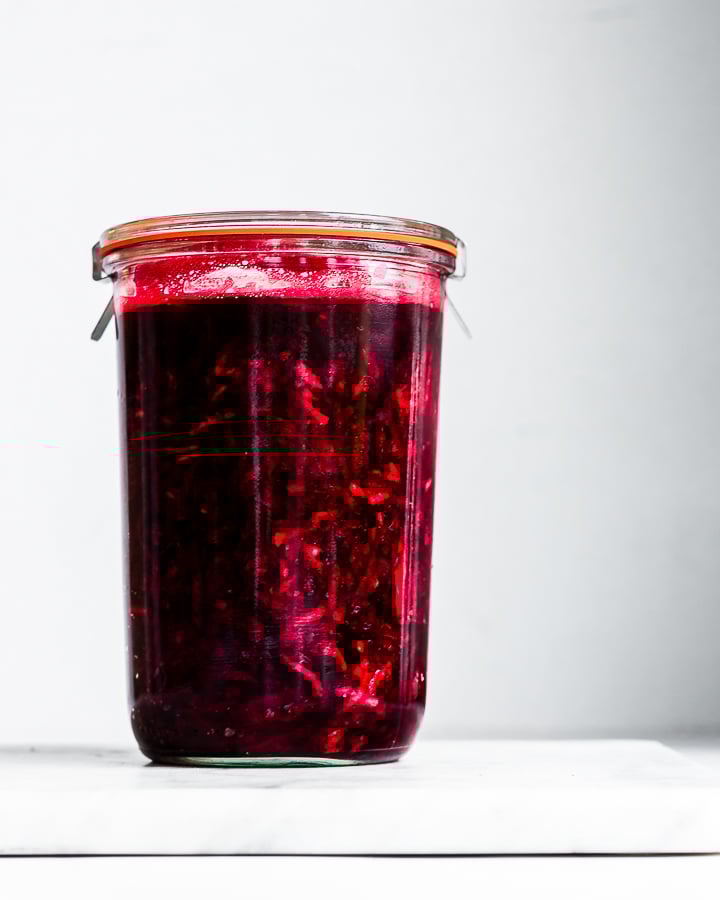
What is beetroot relish?
Beetroot relish is a condiment made by combining shredded beets with other fruits, vegetables, and spices. Traditionally, the relish is pickled with vinegar; however, this recipe calls for fermentation.
Like beetroot relish made with vinegar, fermentation gives the beets a pleasantly tart flavor. Only, that sour flavor comes from the lactic acid naturally released during the fermentation process rather than the acetic acid found in vinegar. As a result, the relish is rich in beneficial bacteria just like kimchi, sauerkraut, and sour pickles.
Tips for making the relish
Like most fermented vegetables, beetroot relish is simple to make. If you can shred vegetables and pack them into a jar, you can make this recipe. But when it comes to fermenting high-sugar vegetables like beets and other root vegetables, you'll want to keep a few tips in mind.
- Use a food processor. Horseradish contains compounds that can irritate your airways, so using a food processor and let it rest about 20 minutes before opening it will dampen the release of those compounds into the air.
- Salt the vegetables and let them rest. Letting vegetables rest after you salt them allows the salt to penetrate cell walls, producing brine which is essential for safe fermentation.
- Pack the jar tightly, so that no air bubbles remain and the brine completely covers the vegetables. This keeps your ferments safe and much less likely to develop mold.
- Use weights and a fermentation seal. Glass weights keep your vegetables safely submerged in brine, while fermentation seals help limit airflow, which prevents mold development.
- The juice may become thick and viscous. High-sugar vegetables like beets can produce a thick and viscous brine the longer they ferment. It's normal.
Love this recipe? There's more.
Join Nourished Kitchen+ for ad-free browsing, nourishing monthly meal plans, live workshops, and access to all our premium downloads.
Billy says
This looks absolutely delicious. I love beetroot, so the fact that you turned it probiotic is fascinating! I definitely want to try this the next time I head to the farmer's market. Thank you for sharing!
Jody says
How do I know when its ready? I have never really tried fermented foods before. I have had this relish on the bench for 4 days it is winter max temps early 20° max. Dont want to refridgerate too soon and miss out on benefitial probiotics.
Jae says
Sounds good. Who do you eat it with ??
Jae says
Not Who but What...lol
kim says
Hello ~ so it says starter if desired... Why? What does that mean? So far I've only done ferments that didn't need starters ~ is there a reason to use a starter sometimes or is it always just a jumpstart kind of a thing? And for the starter, can't it be the juice from another ferment technically?
Any info on this subject would be much appreciated. I've scoured high and low and not found anything to help me.
Thank you! and thanks for the blog and all of your info! It helps (GAPS diet) and it inspires... which helps even more!
Dominika says
Hi, I made this a few days ago. It was working great, but I just opened it this morning and there were black fuzzy bits on the surface. Is it still Ok to eat? it smells like a fermented food (kind of like a pickle), and feels fine, not mushy. What do you think?
Jen says
Hi! Is it ok if I use whey Instead of the starter culture? Thank you!
Jenny says
Absolutely! Use 1/4 cup.
Unity says
I am curious. Would apple cider vinegar be a good kick off to cut back on the salt some and in place of the ferment starter? It crossed my mind since there are apples in the mix, and I always keep a big stash of ACV on hand for when I need vinegar for cooking. It tastes so much better then white vinegar.
lauren says
I just started this yesterday using apple cider vinegar and cut back on salt a bit. My brine is covering the shredded apples and the beets, but I really have no idea what I am looking for when it comes to safety and taste. Not so much concerned with taste as I am with safety. If you did use the ACV for this, can you let me know how is came out??
L
Michele says
How long will this keep once you blend it? Will it still be good for a good long time?
Michele
Janelle says
Yes I will have a surplus of both beets and apples once they are ready. I can't wait to try this out!
Janelle says
My beets and apples are still small - going to hold out on this one.
Jenny says
Oh you should hold out until they're larger. When you do make it, it's phenomenal - especially when paired with sage-rubbed pork chops. WOW.
Cheri says
Hi,
This is all very new to me, but I'm excited to give it a try. Concerning the vegetable starter culture, do you have to use one? If so, do you have a direct link - I could not find it on the "sources" page.
Also, I can just use a mason jar if I don't have access to any fermentation equipment?
Thank you so much!
Cheri
Cheri says
Are you using an adblocker in viewing the site by any chance? A mason jar will definitely work, but a vegetable fermentation master equipped with an airlock produces more reliable results.
Tamara Robson says
I was wondering if I can use my kefir water for this. I have been using it to make pineapple chutney and also cantalope (my daughter is allergic to whey). It's wonderful but wasn't sure if vegetable culture starter is something better than my kefir water. It's all kind of new to me but I can't imagine anything better than my kefir water for fermenting:-)
Jenny says
I wouldn't use water kefir, I'd just go with a wild method but, of course, I prefer wild ferments.
Evelyn says
Jenny,
Is there a reason, other than your preference for wild ferments, that you say not to use water kefir? I'm new to this - but so far water kefir is what I use as an inoculate, so if there is a reason why not, I'm curious to know what it is.
Thanks,
Ev
Lily says
Hi Jenny -
I just thought you might be interested at in an update. I ended up fermenting it about 10 days. After fermenting and blending it wasn't nearly as pink, although it is still lighter in color than yours. I really like it, it's very interesting. I have found that I like it mixed into a little yogurt, which makes a brilliant pink sauce (the yogurt also helps temper the intense flavor of the relish for those of us who are acclimating our taste buds to real fermented foods!).
Thanks for sharing the recipe, I anticipate routinely keeping a jar of this in the 'fridge!
- Lily
monicajane says
I'm so thrilled to have happened upon this site and this post especially (didn't really happen upon...you followed me on twitter!)
I've been wanting to ferment veggies for a while and simply haven't done the necessary homework. This is so easy I now can try my first fermenting project...
and I love beets and apples.
so glad you found me...I will be back!
Jenny says
Lora -
You could definitely use whey in place of vegetable starter or you could omit a starter altogether. I don't personally care for whey ferments, so I never reference them at Nourished Kitchen - that doesn't mean it won't work for you, though.
Take care -
Jenny
Kimberly says
Can I ask why, Jenny, you don't like the whey ferments? What is the quality that you don't like about them? It's all I've ever used, so don't know if there might be something different, lol.
I am looking forward to trying this this week. Just got to try and round up some organic beets, as I haven't got any in my garden this year. I do love Kvass (only one in the family who does!), and I look forward to trying this with our goat, lamb and roast beef this winter!
Kimberly says
Well, I just NOW got to making this (been really busy the past several weeks), and OMG! It's the MOST devine food! I can't stay out of it, lol. It's a good thing there was a couple spoonfuls that wouldn't fit into my jars, so I can munch on it as it is, lol. Even my son, who says, "I don't like beets", says "I LOVE this!" May have found THE way to get my family to not only get more probiotics, but actually enjoy eating their beets! Mom's going to love this! It'll make some very nice Chanukah gifts this winter! It's so pretty! Can you tell I am excited? lol
RPW says
Couldn't you use whey instead of a vegetable starter culture?
Jenny says
Lily -
I bet your use of the chioggia beets was magnificent - it must be such a pretty relish - and I bet the ginger is just amazing in it. I think I'll have to try your variation some time!
- Jenny
Lily says
Mine is fermenting now. I've let it go about a week so far since it's cool. This is my first batch of fermented food, so I'm excited to see what happens! I've tried it a couple times and find it a little salty so far, so I think I'm going to let it get more sour.
I changed quantities just a little, using 2 pounds of apples an 1 pound of beets. Two of my beets were chioggias, so between that and the apple/beet ratio my relish is more vivid pink. I also added a couple tablespoons grated fresh ginger.
Thanks for an easy starter recipe 🙂
April says
This sounds great but is there something I can use instead of the star anise? I can't find that (or any anise AFAIK) in my little backwater town. Thanks!
Ruth says
Beet and apple relish sounds interesting and I'd like to try it, but no one in my family likes anise. Not a big fan of cloves either. Can you suggest alternative spices?
By the way, just made your tomato salsa tonight for the second time. It was a big hit with the kids. Thanks for the recipe and your wonderful blog!
kc says
My favorite vegetables for fermenting are beets and carrots but I have never tried adding apples to the beets. This sounds just delicious. I have never used star anise - I have got to get more adventurous. I've always ruled it out because I'm not a big fan of licorice, but I am learning that the combinations of herbs and vegetables can be so exciting and small variations in ratio can make a huge difference in flavor. It's easy to get stuck in a rut, making ferments the same way every time so I am excited to get new ideas and recipes.
I am looking forward to making my own beet kvass as soon as I can find a corn-free milk source. Have you ever tried it? Got any tips?
Dawn @ Small Footprint Family says
This looks just divine! I just made simple sour beets myself this week, but this relish looks like yet another way to enjoy the bounty of beets this season. Thanks!
Cricket McRae says
I love beet relish, but have never made it with apples. Sound great! Especially since the beets are coming fast and furious in the CSA share. Also, I think I might add a couple tablespoons of whey and reduce the salt a bit (?)
Jenn AKA The Leftover Queen says
Wow, this sounds just lovely, and the color is beautiful!
Chris at Lost Arts Kitchen says
Oh! Oh! I love fermented beets and usually season them with caraway and dill, but this combination sounds divine! Can't wait to try it...that's one of the problems with ferments, tho', isn't it? You gotta wait!
Thanks for the recipe!
Lennie says
My wife and I are hours old in this, your recipe for beets/dill/caraway sounds good. What is your recipe and process?
Julie says
Thank you for this recipe! I like relish and chutney as a meat accompaniment, and this relish has one of the top super foods in it --beetroot. I'll let you know how it turns out.
deana@lostpastremembered says
I have made sauerkraut before... but not beets.. great idea!