
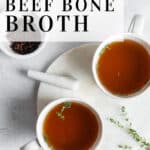
Making homemade beef bone broth will save you a ton, and it's much easier than you think. You can make it on the stove or in a slow cooker.

Homemade bone broth is a staple in our household - something I've made for over a decade. It has nourished my children through cold and flu season each autumn. We sip it in the morning on cold winter days or turn it into wholesome soups and stews.
The trick to making good beef bone broth is quality bones coupled with a slow, gentle simmer. The best bones are grass-fed beef bones with plenty of connective tissue. The connective tissue is rich in collagen, which breaks down when simmered and forms gelatin.
Why This Recipe Works
Adding red wine instead of apple cider vinegar improves the flavor while also helping the broth to gel properly.
Roasting the bones before simmering them adds a delicious richness to the broth and prevents it from tasting greasy.
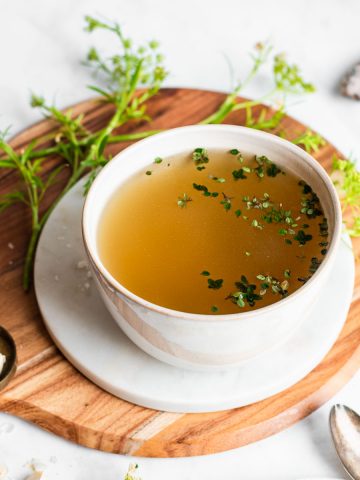
Fresh herbs bring an element of brightness to beef broth, complementing its rich and robust flavor.
Ingredients and Substitutions
Beef bones are the heart of this recipe. Choose cuts with plenty of collagen-rich connective tissue for a silky broth that gels when cool. Beef knuckles, shins, oxtails, and neck bones work well.
Avoid beef marrow bones when making broth. They contain almost no connective tissue and produce a greasy, thin broth with little flavor.
Aromatic vegetables include celery and onion. These add a little brightness and depth to beef bone broth. Many cooks also add carrots to this mix, which lend a sweetness to the broth.
Red wine is our stand-in for the apple cider vinegar that's popular in other broth recipes. Its acidity uplifts the broth's robust flavor and provides balance. It also helps encourage the release of collagen, making for a gelatin-rich broth.
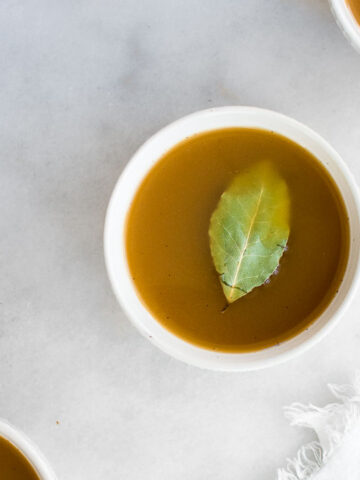
Black Pepper and fresh herbs lend flavor. Bay leaf and thyme well with beef, but you could also swap in some rosemary or parsley, too.
Tips for Making Beef Bone Broth
Choose bones with plenty of connective tissue, and avoid (or limit) marrow bones, which produce a greasy broth that doesn't gel. The best options include knuckle bones, beef shins, and neck bones.
Roast the bones and aromatics before adding them to the pot. Roasting allows some of the fat to render, so you can avoid greasy-tasting broth. Additionally, it improves the flavor of the broth and introduces meaty, savory notes.
Keep the pot at a gentle simmer. Cooking at too high a heat or too vigorous a boil can make cloudy broth. Sometimes it might even prevent your broth from gelling properly
Add the herbs last. Fresh herbs added to the pot during the last 30 minutes of cooking will brighten and intensify the flavor.
Once you have the basics down (roasting bones and simmering them), you can make other micro-adjustments to the flavor profile of the broth.
Add salt when serving. If you salt the broth too early, while it's simmering,
Variations
Rub a little tomato paste on the bones when you roast them. It adds a little more acidity as well as notes of umami.
You can swap the herbs and aromatics for other flavors you prefer. Skip the celery and add ginger and garlic to the roasting pan. Swap the bay leaf and thyme for star anise or cinnamon.
Love this recipe? There's more.
Join Nourished Kitchen+ for ad-free browsing, nourishing monthly meal plans, live workshops, and access to all our premium downloads.
More broth recipes you'll enjoy
Recipe Questions
Beef bone broth will keep in the fridge for about a week.
Yes. You can transfer cooled (room temperature) broth to the freezer-safe containers and freeze for up to 6 months.
If freezing in mason jars, allow two inches of headspace to accommodate the expansion of the broth as it freezes.
If your broth didn't gel, you likely simmered it for too long or at too high a temperature. Additionally, your bones may not have had enough connective tissue, or you may have added too much water.
Check out the article about making gelatinous broth to troubleshoot.
Yes. You can can beef bone broth or any other kind of broth. Because broth is a low-acid food, you should pressure can it. Reach out to your local extension office for best practices for your altitude.

Katie says
Was I supposed to cover the pot at some point? It’s all pretty much evaporated after cooking for 7 hours
Jenny says
Hi Katie,
No, you cook the broth uncovered. It sounds like you cooked it at too high a temperature.
Jim says
This worked really well for me.
David Hill says
Can venison bone be used in place of beef? Also, can the spine be used to make the bone broth?
Jenny says
Hi David,
I haven't used it. In a culinary sense, it should work fine; however, various hunters have expressed concern over using venison spine and the potential of chronic wasting disease.
vb says
I've just heard that beef stock (and broth) made from non organic bones is very likely to be heavily lead loaded
Does anyone know any different ? and also would grass fed beef bones (non organic) be exempt from lead ?
Jenny says
Hi, no, you heard wrong. There was a study on lead in broth and stock made from ORGANIC chicken (not beef, not conventional) that found higher concentrations of lead in broth and stock than in plain tap water. Researchers only tested the broth and stock made from chickens from a single farm, who may have gotten lead in their soil, bedding, feed or water. Source your food well, and don't sweat it.
Wendy says
Can this stock be canned? Or is it too thick?
Deborah says
I didn't know about roasting the bones!! Started my broth already. Please tell me all is not lost!?
cindy says
I followed the directions carefully and simmered it in a crockpot for almost 24 hours. The marrow came out of the bones easily but floats in clumps on top of the broth. When I strain it through cheesecloth, the clumps of marrow will stay in the cheesecloth. I thought the marrow was supposed to contribute to the nutritional value of the stock. Is the marrow supposed to "blend in with the broth?
David Randall says
A tip I got from Julia Child regarding culinary broths: never tightly cover a simmering or cooling broth or stock; they may sour. A gapped lid will keep evaporation to minimum if you barely, barely!- simmer. I've never had a sour broth.
Sue says
How do beef bones work for 'perpetual soup'?
Tamara Mannelly says
Okay, making my first batch of beef stock. I make chicken and veggie stock all the time so just jumped right in with the beef. Had a bag full of beef bones and a couple oxtails. I forgot to roast them first. I put them in my crockpot with some veggie scraps, water, vinegar and am now about 36 hours in. I had to actually move the crockpot outside to my patio this morning because we could not stand the smell. Is this normal? It doesn't smell very good at all. We are not normally picky about this kind of thing but it just smells weird. Is this because I forgot to roast the bones? Thanks for your help!!!
Jenny McGruther says
I find that roasting the bones improves the smell, and it's a vital step for making good bone broth.
Elizabeth says
I've attempted to make beef bone broth two times now, I've simmered it anywhere from 24-72 hours and all I end up with is an un-gelled mason jar full of what I can only relate to a latte. It is so cloudy you cant see through it, milky white with just the palest hint of brown. I cannot figure out what I am doing wrong. Roast bones, add veggie scraps, ACV, kombu strip etc simmer and strain. I dont even know if my finished product is worth eating? Any suggestions would be great!
Jenny McGruther says
Hi Elizabeth -
First, simmering the bones for so long may actually impede gelatin formation - it just sort of breaks it down. Also, it sounds like you're using marrow bones. These produce a greasy, milky broth. Marrow bones also do not have much connective tissue, and so they won't produce a good gel. Use the bones recommended (neck, knuckle, shin, oxtail) and simmer it for less time.
Juanita says
Thanks for the recipe. I omit the cider vinegar but it was great. I just made gluten free gravy with some and way better than any store bought or any that I have ever tried.
Katherine says
I made beef broth and it gelled nicely but the color is weak and it doesn't taste good. I browned the bones first to the point that the marrow was soft and oozing out and then simmered it for 24 hours with carrot peelings and herbs. Do you think that my bones were bad? I was expecting something rich and savory and it came out kind of watery and gamey tasting. I'm new to stock making and haven't had much success so far. I guess I'll try a chicken next and hope that is more foolproof. Any tips would be appreciated.
Sustainable Eats says
I didn't brown my bones last time and it was very sour - no one wants to eat it! Now I know...hopefully I can disguise it with lots of carrots and celery when I make a finished soup with it. Thanks for the tip!
Alyss says
What a great post! I made beef bone broth for the first time last summer and it is fantastic. I also generally use chicken bone broth (or poultry stock - my last batch has pheasant bones and the batch before that had goose and turkey bones from the holidays 🙂 but the beef makes absolutely fantastic soup!
Laryssa @Heaven In The Home says
Lovely! Thanks for this recipe. I didn't brown the beef bones last time and it didn't taste right. I'm glad to know know what to do different next time.
Wardeh says
Definitely going to do this today. Thanks for the great directions! I have so many soup bones in the freezer, it is embarassing. We are getting our 1/2 beef soon so I need to get last year's moved out!
lo says
Oh, fabulous!
You really can't beat homemade bone broth -- and beef bone broth, in particular, is worlds better made at home than purchased in the store. I love the fact that you can control the ingredients -- from the type of beef used to the amount of salt in the final product. And it's oh-so-good for you!
Jenny says
Jessie -
I'm kind of a measure-free cook, so I don't worry about how much it cooks down. I'll add water to the pot a few times. It's really the length of cooking time, not the water evaporation that helps to gel the stock. Generally, though, by the time I strain the solids from the broth it has cooked down by about 1/3 or so.
Christy -
I always use enough water to barely cover the solids, but I don't otherwise measure it.
maybelles mom says
Wow that is some lovely broth...
~M says
Yummm! I loved gelled consomme 🙂
Have you ever experimented with putting tomato paste on the beef bones before roasting?