

On a cold morning, soaked oatmeal porridge provides a hearty, wholesome, and budget-friendly start to the day. It's easy to make, and just takes a little bit of planning to pull it all together. Dress it with your favorite fruit, nut butter, or a little maple syrup for an easy breakfast.
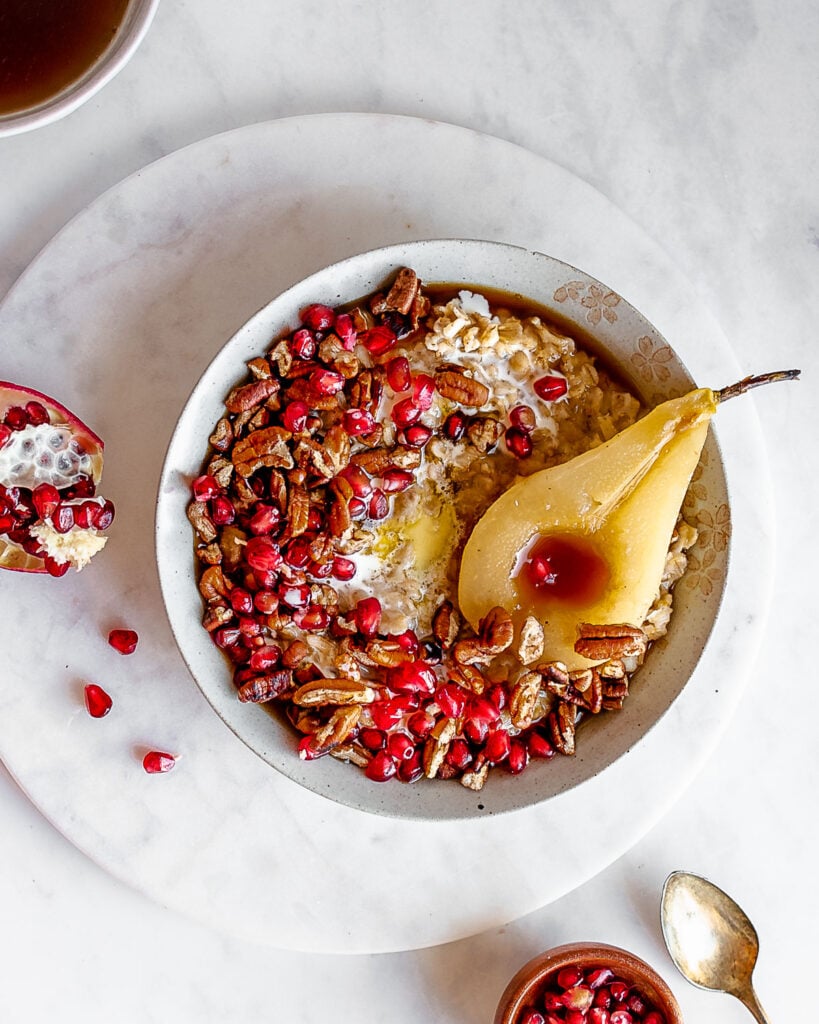
What is it?
Soaked oatmeal porridge was popularized by the cookbook Nourishing Traditions which advocates for soaking grains to improve the bio-availability of minerals such as zinc and iron. It tastes the same as regular oatmeal, with a slightly and barely perceptible acidic undertone owing to the inclusion of lemon juice or apple cider vinegar. Soaked oatmeal is super creamy and quick to cook, too.
Many old-world, historical recipes call for soaking oats overnight and sometimes up to 48 hours for making dishes such as porridge, flummery (a Scottish dessert), and pudding (1). Keep in mind, though, that not all traditional recipes call for soaking oats to make porridge, and quite a few simply call for boiling oats in water or milk.
What's in it?
You need a handful of ingredients to make soaked oatmeal porridge, plus any additional ingredients you'd like for adding flavor once the porridge is finished. In general, you'll need oats, salt, an acidic ingredient, an ingredient that's rich in the enzyme phytase, and liquid.
- Oats are the foundation of good porridge. For this recipe, you should look for old-fashioned thick-cut rolled oats or steel cut oats. Quick oats undergo more processing than thicker cut rolled oats and are more likely to dissolve and lose their form during soaking.
- Flaked rye, buckwheat and whole wheat flour are all rich in the enzyme phytase which helps to breakdown phytic acid. Since most commercial oats are heat-treated through steam (unless you flake the oat groats yourself), they're low in the natural enzyme needed to breakdown phytic acid. So, adding a phytase-rich ingredient helps to support the soaking process.
- An acidic ingredient such as lemon juice or vinegar encourages the break down of phytic acid. This is why sourdough fermentation, which lowers the PH of flour, also decreases phytic acid (2).
- Salt gives the porridge flavor, balancing the natural sweetness of oats.
- Water and milk form the liquid foundation for the porridge. Use hot water for soaking oats since its elevated temperature promotes the breakdown of phytic acid. Whole milk works well for cooking the porridge, and is the primary cooking liquid in many traditional recipes; however, you can use additional water or a non-dairy substitute such as coconut milk if you prefer.
Is soaking oatmeal good for you?
Many people soak their oats because they think it's healthier. And, for some people, it can be; however, not everyone needs to take this extra step in the mornings. Instead, whether or not the soaking process will benefit you is largely bio-individual - meaning that it's dependent on your body's individual needs.
- Oats are generally considered to be a healthy food, and are widely considered to support general health, but specifically heart, digestive, and metabolic health (3).
- Soaking may make oatmeal a little easier to digest. Soaking foods rich in phytic acid in a warm, slightly acidic medium helps to break enzyme inhibitors that can make grains difficult to digest (4).
- Soaking grains may improve the availability of minerals in your oats. That's because soaking grains such as oats kickstarts the enzymatic process that breaks down and phytic acid, thus making zinc and other minerals a little easier for your body to absorb (5).
- Most people probably don't need to soak their grains. Soaking grains to improve the availability of minerals is helpful for people at risk of nutritional deficiency or who are heavily reliant on foods rich in phytic acid for the bulk of their diet (6). If you're eating an otherwise nutritious, mineral-rich diet, the benefit of soaking oats is likely minimal.
- Phytic acid can be beneficial. While it's largely considered an anti-nutrient because it can block the absorption of some minerals in grains and pulses, phytic acid has some benefits, too. It's a strong anti-oxidant (7), and may benefit the kidneys (8) and metabolic health (9).
Tips for soaking oats
Making soaked oatmeal is just as easy, if not easier, than making a regular oat porridge. The soaking process also makes oats faster to cook, and they often taste creamier than regular oatmeal. There are a few tips you'll want to keep in mind before you make your first batch of porridge.
- Rolled oats are steam-treated, so you'll need to add a phytase rich addition if you hope to encourage the breakdown of phytic acid. Rye, buckwheat, and wheat are all rich in phytase, so you might add a spoonful to the oats as they soak.
- Skip the quick oats and use old-fashioned, thick-cut rolled oats or steel cut oats instead. Quick oats are too fine and thin, and will turn to mush with an overnight soak.
- Temperature matters. Soak the oats in hot water and at room temperature. The enzymes responsible for making soaked oats so good need warmth to do their work.
- Keep an eye on the stove. Soaked oats cook lightning fast, and if you leave the stove unattended they might overcook or start to burn.
- Add lots of flavor with chopped fresh fruit such as apples in the fall or berries in the summer, nut butter, coconut flakes, butter, cream, and chopped nuts.
Variations
For a dairy-free option, try making soaked oatmeal with light coconut milk. Full-fat coconut milk and coconut cream tend to be a little heavy and can make the porridge taste oily.
For a gluten-free option, use certified gluten-free oats. Instead of rye flakes, try adding a tablespoon of ground buckwheat flour which is also a rich source of phytase (the enzyme that breaks down food phytate).
Try straight rye flakes instead of oatmeal. Rye has a gorgeous nutty flavor and makes a lovely porridge, and you can prepare flaked rye using the same method as soaked oatmeal.
Use steel cut oats instead of rolled oats. Steel cut oats make a delicious, hearty porridge. You can follow the soaked oatmeal recipe above; however, you may need to increase the cooking time or liquid content.
Consider toasting your oats before soaking them. Toasting your oats in a hot pan or in the oven until slightly browned gives them a naturally sweet, malted flavor. Toasting oats (just like roasting nuts) may also decrease the phytate content
Common questions
You can keep the cooked oatmeal porridge in a container in the fridge for up to 3 days. To reheat, put it in a pan and add a little water or milk and warm it over medium-low heat until warm.
Yes, you can make a big batch and freeze individual portions of oat porridge in muffin tins, transferring the frozen oatmeal to a resealable container. Reheat with a bit of extra water or other liquid.
Try using another acidic ingredient such as apple cider vinegar. Avoid using liquid whey. While whey is a popular ingredient for soaking oats and other grains, there's some evidence that calcium-rich dairy products may actually inhibit the breakdown of food phytate. This is only relevant to the soaking step (when phytate is broken down), not to cooking oats which you can do in milk and other dairy products.
It makes sense that if you're soaking oats to rid them of phytic acid, you would need to discard the soaking water; however, this process is enzymatic. That means the phytic acid is deactivated (to some degree), and you do not need to discard the soaking water.
A serving of oatmeal offers about 6 grams of protein - so not that much. If you're having oats for breakfast, you might consider adding other protein-rich foods, such as breakfast sausage or eggs, to your meal.
If you need a porridge that is more protein- and fat-heavy than carb-heavy, you might try this keto oatmeal, which includes hemp hearts, eggs and cream.
The primary difference between soaked oatmeal and overnight oats is that soaked oatmeal is cooked and then eaten while overnight oats are eaten raw without any additional cooking.
Further, preparing soaked oatmeal requires soaking the oats in water at room temperature (since warm temperatures support the break down of phytic acid) while overnight oat recipes sometimes call for placing the ingredients into the fridge.
Try these breakfast recipes next

References
- Rundell, M.E. A New System of Domestic Cookery. (1807)
- Leenhardt, Fanny et al. "Moderate decrease of pH by sourdough fermentation is sufficient to reduce phytate content of whole wheat flour through endogenous phytase activity." Journal of agricultural and food chemistry vol. 53,1 (2005)
- Paudel, Devendra et al. "A Review of Health-Beneficial Properties of Oats." Foods (Basel, Switzerland) vol. 10,11 2591. 26 Oct. 2021
- Shi, Lan et al. "Changes in levels of enzyme inhibitors during soaking and cooking for pulses available in Canada." Journal of food science and technology vol. 54,4 (2017)
- Gupta, Raj Kishor et al. "Reduction of phytic acid and enhancement of bioavailable micronutrients in food grains." Journal of food science and technology vol. 52,2 (2015)
- Vashishth, Amit et al. "Cereal phytases and their importance in improvement of micronutrients bioavailability." 3 Biotech vol. 7,1 (2017)
- Graf, E et al. "Phytic acid. A natural antioxidant." The Journal of biological chemistry vol. 262,24 (1987)
- Petroski, Weston, and Deanna M Minich. "Is There Such a Thing as "Anti-Nutrients"? A Narrative Review of Perceived Problematic Plant Compounds." Nutrients vol. 12,10 2929. 24 Sep. 2020
- Chatree, Saimai et al. "Role of Inositols and Inositol Phosphates in Energy Metabolism." Molecules (Basel, Switzerland) vol. 25,21 5079. 1 Nov. 2020

Martha says
I enjoy your newsletter very much. Having read this one, I see that the method is to soak oats and then cook them.
Is there any advantage or disadvantage in terms of digestion for those of us who "soak" Oats overnight in the refrigerator and then eat them straight from.the jar?
Jenny McGruther says
Soaking oats overnight in the fridge softens them, but doesn't convey the benefits of soaking them in warm water and cooking them. Warmth and moisture help support the enzymes that are responsible for making oats more nutritious, so soaking in the fridge, where it's cold doesn't do much. Additionally, cooking oats make them easier to digest. The combination is a win for people who want to absorb more minerals or who struggle with digestion.
If you like eating cold-soaked oats raw as many overnight oats call for, then keep it up. As long as you're eating plenty of other nutrient-dense foods and your digestion is good, soaking/cooking won't make too much of a difference for you.
Taylor says
I've done overnight oats before, but that's when you leave them and don't cook them. So I cooked it like you recommended and it was good. I'll add cinnamon and apples next time.
Piper says
I've been trying to soak my grains more, and this really worked. I think I liked it better than regular oatmeal.
Justine says
I did this last night. although I did put it in the fridge (didn't know you were suppose to leave it on the counter) and I used apple cider vinegar. It was just delicious. My two year old son ate the whole bowl. I used sliced frozen strawberries and agave nectar in his and nothing in mine. It was perfect just the way it was!! thankyou so much for posting this.
Two question though. How much apple cider vinegar should you use. I just did a capful for one cup steeled cut oats is that enough? Also, is steeled cut better than rolled or vice versa?
Cathy says
Thanks for the great ideas! I am new to soaking grains and wondering if I can use souring raw milk to soak the oats (to clarify, this is milk that has been opened but in the refrigerator for about 2 weeks and souring). I wasn't sure if this would have the same effect on the grains as the cultured kefir or yogurt. Thanks very much!
Keri says
I soaked this recipe last night with steel cut oats, raw sunflower seeds & pumpkin seeds, flax seeds, and pecans. Unsweetened vanilla almond milk was the only option for a cooking medium but it turned out so creamy and luscious! I put a handful of frozen blackberries at the bottom of each bowl, scooped the porridge on top, added a dollop of yogurt and we were good to go! I haven't had success with using a slow cooker for oatmeal or with an earlier attempt at soaking, but this time it was fabulous. Thank you for this post.
Nicole says
Had this last weekend for the first time, and it was SO YUMMY! I'm not a big oatmeal eater, but this was just wonderful.
Elisabeth says
I'm going to try using coconut milk with my oatmeal next time since I am trying to avoid dairy. I'll probably mix it with water since it is 100% fat - maybe half water and half coconut milk. I will let you know how it turned out 🙂
meaghan says
I'd really like to try this method. I guess that soaking the grain with an acid is similar to treating corn with lime juice (nixtamalization) to make it more digestible, as is done in Mexico.
I'll be trying it this weekend. Thanks for the clear instructions!
Amy Galvan, AP says
For raw milk users who don't want to compromise the milk by boiling it, you can cook the oats in water, and add milk to serve. Personally I prefer a dollop of cream instead of milk, as do the French.
For medicinal porridge recipes, try The Book of Jook.