

Deliciously sour with an earthy edge, these fermented beets get a lift from ginger, coriander, and citrus peel. They're easy to make and taste delicious served on top of a big salad or alongside a bowl of roasted vegetables and grilled chicken.
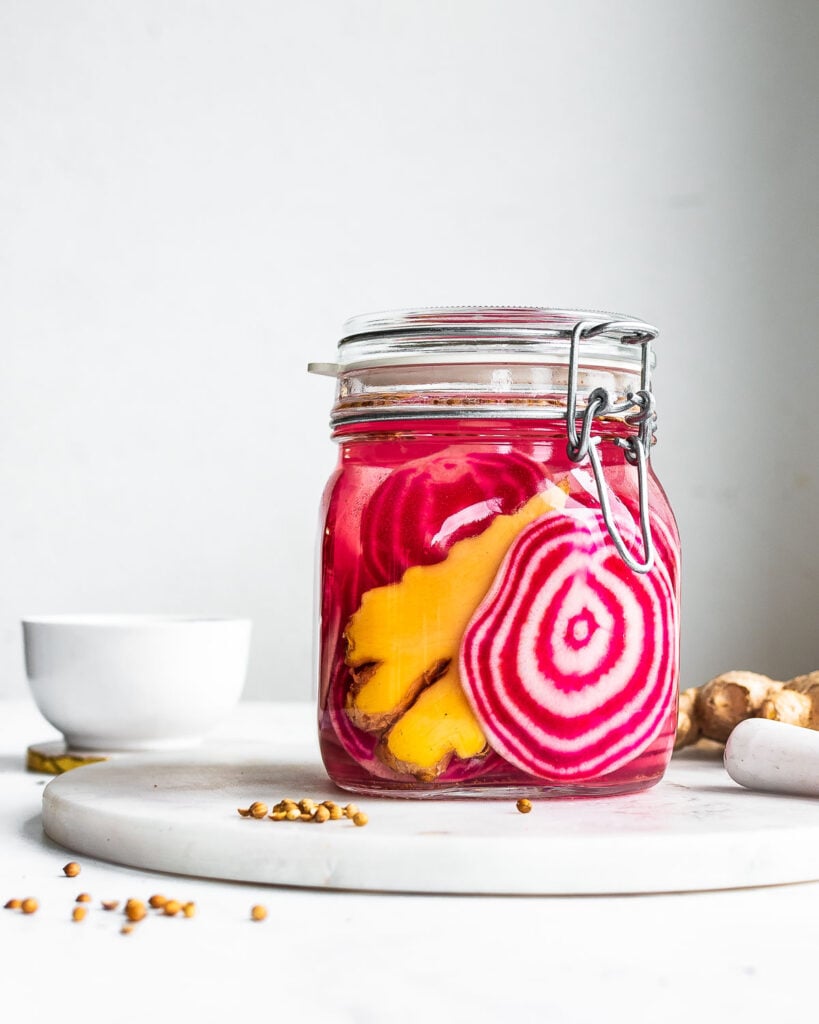
What is it?
Fermented beets are a popular Eastern European fermented vegetable, where they're often combined with dill or juniper berries. In this version, we ferment thin slices of beets with ginger, orange peel, and coriander seed. The result is delicious, combining the earthy sweetness of beets with a punch of citrus and spice.
Unlike beet kvass, in which the intention is to drink the brine, with these fermented beets, you'll use them as you would traditional pickled beets. They're delicious tossed on top of a grain or veggie bowl, or served alongside roasted meat.
Fermentation Tips
As with most fermentation recipes, fermented beets are easy to make. Most of the hard work is done by beneficial microorganisms that convert the sugars in your beets into lactic acid (with a dose of B vitamins). But, there are a few tips to keep in mind.
- Use any beet you happen to like, such as golden beets, red beets, or even candy-striped Chioggia beets.
- Scrub the beets clean and peel them, too. Starting with squeaky clean, peeled beets ensures a cleaner, clearer flavor.
- Use a mandoline to slice your beets. Uniformly sliced beets mean even fermentation, and the thinner you slice the beets, the better the texture. Aim for slicing beets about ⅛-inch thick.
- Mind your temperature. Vegetables ferment faster in a hot kitchen and more slowly in a cool one.
- Use filtered water (or dechlorinated water) as chlorine may inhibit fermentation.
- Keep your beets submerged in brine to help prevent mold (and other nasty microbes) from forming. A weight and fermentation seal help.
- The juice of fermented beets may become viscous and thick. This is common among starchy vegetables.
- Discard ferments that smell or taste putrid or that have thickened spots or caps of mold at the surface of the brine.
- If you're concerned about food safety, test the PH of your brine before eating them. The PH of properly fermented food should be 4.6 or lower.
- Store the beets in the fridge for up to 6 months. Note that the brine may thicken over time because beets have a very high starch content.
Variations
As long as you maintain the same salt ratio for your brine, you can adjust this recipe with any number of additional herbs or spices to suit your preferences. So, you can omit the ginger, coriander, and orange and try any of the spices combinations below.
Dill and garlic give the beets a bright flavor reminiscent of sour pickles.
Juniper berry and lemon zest gives a nice lift to the earthiness of fermented beets.
Cardamom, star anise, and allspice lend a little spiciness to the beets.
A few sprigs of marjoram and thyme will make the beets taste delicious, too.
Common Questions
Fermented beets will taste pleasantly sour with an earthy undertone, and they will take on the flavor of any spices or herbs you add to your jar.
You can use red beets, yellow beets, or Chioggia beets for fermentation.
I highly recommend purchasing a fermentation seal and glass weights for safe fermentation. They're affordable and a must in any kitchen that regularly ferments foods.
If you don't have them (and don't wish to purchase them), make sure to burp your jar every day to release the excess gas that builds up during fermentation. Additionally, shake the jar daily to prevent mold formation.
As beneficial bacteria do their work, your brine will turn cloudy. This is a normal process of fermentation.
Beets are high in starch and may produce a thick brine (especially with long-term fermentation or storage). If your brine is slimy or putrid-smelling, discard the ferment.
Yes. It will taste salty and sour. You may prefer to make beet kvass, however, in which the brine is intended to be drunk.
Fermented beets are finished when they taste pleasantly sour to you. Some people prefer a younger ferment, while others prefer a more complex, older ferment. I recommend trying them after 14 days.
Remember, vegetables will ferment faster in a hot kitchen and more slowly in a cool one. Additionally, small batches will ferment more quickly than large batches.
No. Salt helps keep fermenting vegetables crisp. In addition, it gives them flavor and helps promote ideal conditions for vegetable fermentation.
If you need salt-free options, I recommend trying fermented drinks or fermented dairy products, such as homemade yogurt.
No. A starter culture can speed up fermentation or help culture-specific bacteria; however, it's not necessary for successful fermentation. Read more here: Starter Cultures.

Marie says
If we are making 1 at of beets, why do we need to make 1 qt of brine? I would think half (or maybe even less) would be enoigh to cover the beets.
Jenny says
To make sure you have enough. You only lose out on a little salt and water.
Janet says
Not a comment, rather a question. Can crystallized diced ginger be used in lieu of fresh? I'm new to fermenting and am unsure of the impact of one over the other. Thanks for any input!
Jenny says
Hi Janet,
No, I don’t recommend using candied ginger in this recipe.
Teresa Kelm says
Hi! Would you be able to process these in a canner after fermentation has taken place to preserve? I’ve done that with sauerkraut with great results!
Jenny McGruther says
Hi Teresa,
I don't recommend canning sauerkraut, fermented beets, or other probiotic foods. You'll lose most of what you gain through the fermentation process. Plus they store fine in cold temperatures (such as the fridge) for extended periods of time. If canning really is a must, then I'd recommend a traditional pickled beet made with vinegar, salt, and sugar. It'll be faster than waiting for the beets to ferment.
Annie says
I thought the ginger and coriander in this recipe really made it nice. Without it, I'm not sure it would have been as good.
Wm Jordy says
Love this recipe! Super delicious.