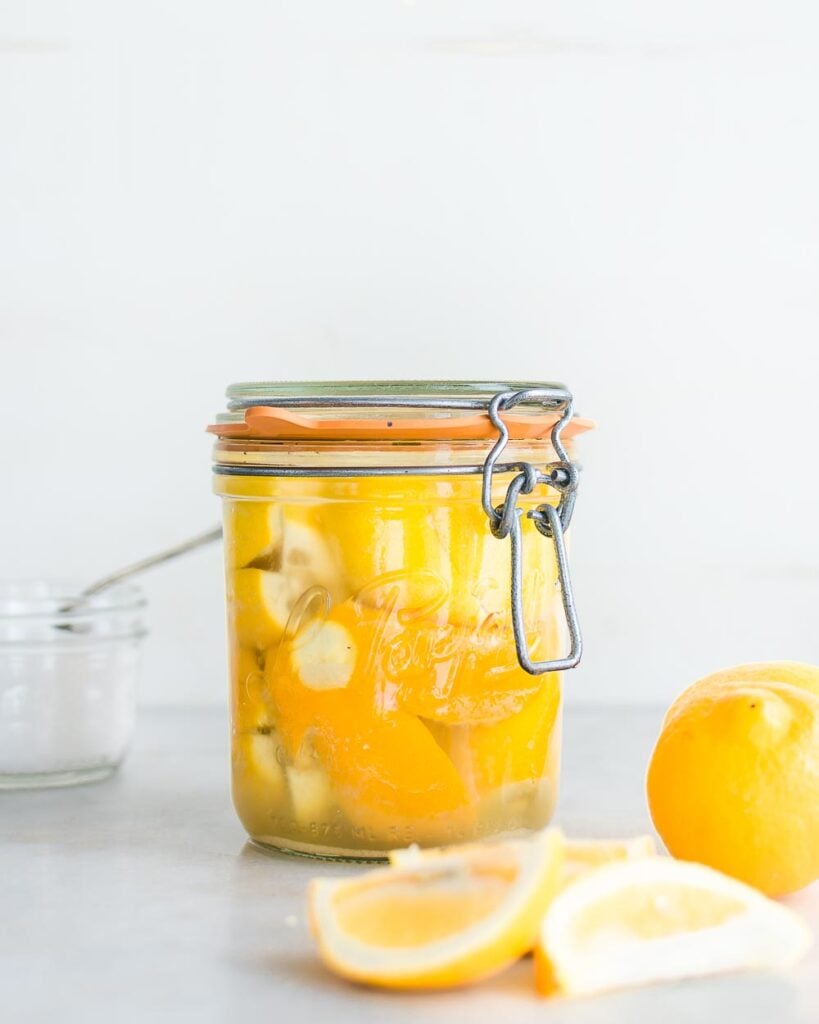

Preserved lemons enhance the cooking of North Africa with their pronounced saltiness and a sourness that is oddly mellowed, rather than enhanced, through fermentation. Even with no other ingredients but salt and lemon, preserved lemons take on other unique and complex flavor profiles that can become even mint-like over time and after proper fermentation.
While you can buy them at specialty stores and online for up to $15 for a jar, you can make them yourself with just a little investment in salt, lemons and time.
dinner in Morocco
I tasted my first preserved lemon in Morocco. It was my junior or senior year in college, and I left for the summer to travel alone throughout Europe and Morocco, where I did volunteer work and hopped from city to city first visiting Tangiers, then Chefchaouen, Al Hoceima, Rabat and Marrakech. I met friends – Italian girls with whom I traveled – and Mustapha, a dear friend who now lives in Los Angeles with his wife.
Mustapha had invited me to stay with his family – mother, father, two sisters (Fatima and Zineb) and what seemed like countless brothers.
My first evening in his family’s home, his mother showed me how they baked bread at home (a luxury, really, as most Moroccan families prepare their bread at home and baked it in huge wood-fired communal bakeries). She also prepared a roast chicken with olives, spices and these preserved lemons.
Not wanting to offend, I dutifully ate every single bite of salad, olives, chicken and bread Mustapha’s mother piled high on my plate. And when she piled more on my plate, I protested, but ate every single bite again. Mustapha’s father urged me to eat the lemons, too, which I thought simply enhanced the flavor of the chicken. When I balked, he chortled, and showed me that when a lemon is fully and properly fermented, the whole thing becomes edible – rind and all.
fermenting lemons in morocco
Later, Mustapha’s mother showed me how to she prepares the lemons (and his father showed me how they cure olives). The technique was simple: slice the lemons as if to quarter them, sprinkle them with salt and press them into a large jar so that the lemon juice and salt create a brine that covers the olives. Let them ferment several weeks and enjoy. They don’t need refrigeration, but their flavor will continue to change over time. So if you wish to preserve that flavor at any single point during fermentation, simply transfer the lemons to cold storage. Properly fermented lemons will last for years – even at room temperature.
special equipment for fermentation
Now, when I make preserved lemons as I do every year, I typically use a closed fermentation system with an airlock (you can find them online), but they’re not at all necessary for proper fermentation, just a personal preference of mine. Remember, Mustapha’s mother and father (who had been fermenting lemons and curing olives since childhood) fermented in large gallon-sized glass jars – no fancy systems, no weights, no airlocks.
Get Cultured! 13-workshop Series on Fermented Foods
If you loved this video and want to learn more about preparing fermented foods at home, check out Get Cultured! – it’s my best-selling 13-workshop online class on fermentation (50+ instructional videos, recipes, tutorials and more) and it’s on sale for $147.
Moroccan Preserved Lemons

By Published: May 15, 2012
- Yield: 1/2 gallon
- Prep: 10 mins
Preserved lemon is a traditional North African condiment where its sour and salty flavor is adds a distinct flavor to classic tagines, roast chickens and other meals.
Ingredients
- 2 1/2 pounds lemons (preferably Meyer lemons)
- 1/4 cup unrefined sea salt
Instructions
- Trim the ends off lemons, taking care not to
cut into the flesh, then slice the lemons as if to quarter them - keeping the base of the lemon intact.
- Sprinkle the interior of the lemons with unrefined sea salt then layer in your mason jar, crock or fermentation device. Sprinkle with unrefined sea salt then mash with a wooden spoon or dowel until the rinds of the lemon begin to soften and the lemons release their juice which should combine with the salt to create a brine conducive to the proliferation of beneficial bacteria.
- Continue mashing, salting and mashing until
your lemons fill the jar and rest below the
level of the brine.
- Ferment at room temperature for three to four weeks. Lemons can be kept for one to two years.


Oh, you are taunting me with these beautiful lemons! I am just dying to make some, but there are NO meyer lemons to be found in this town! The horror, the horror.
Haley W.s last blog post..Garam Masala
It just says “preferably Meyer Lemons”. Doesn’t say it has to be.
These look good, I have been reading your blog for a while, and it is really interesting. However I was wondering if this would work with Limes too?
Rosy! It’s always nice to hear from a reader. I’ve never tried it with limes, or heard of anyone else trying it with limes; nevertheless, there’s absolutely no reason why this technique wouldn’t work with limes. Frankly, I think preserved limes sound fantastic. If you try it out, let me know!
Pickled limes were a treat referred to in Louisa May Alcott’s Little Women. Amy gets in trouble for bringing them to school. I’ve always wondered what they were, and I’m guessing this is it!
I’m dreaming about margarita’s now that you mention salted limes
Hey, how about oranges or grapefruit ? Can get carried away here and have fun .
I love the idea of preserving limes! I just bought a bunch of meyer lemons & did this with them a few weeks back and bought limes at the same time to juice & freeze but that is a great idea! I love your blog.
Annettes last blog post..How Much Does it Cost to Eat Sustainably?
Jenny, how do you use these? Do you substitute them for fresh lemons called for in recipes? I’m just wondering what you do with so many!
Chriss last blog post..Lost Arts Kitchen Hits the Road
Would this work for lemon juice in recipes? And I echo the previous poster. I need to know what to do with a gallon of lemons … but lemon juice I know I can use!
Ashleys last blog post..Pics
Mostly you use these as a condiment – served with roast chicken along with spiced olives. Or chopped up fine and used on top of fish and poultry. Remember, because they’ve been fermented they last FOREVER much like sauerkraut or cucumber pickles so there’s no urgency in using them. Regarding the lemon juice, it makes a really tasty addition to a good bloody mary. Keep in mind that the juice is salty, so it’s not suited to sweet dishes.
I was so excited to see this recipe. I remember my mom bringing home a jar from some Egyptian friends of hers when I was a kid. I would eat them on there own – loved them! A couple of questions: after they are done fermenting do you place in frig? If so do they not last as long once in frig? Do they have to be Meyer lemons? And if so why?
Hi Dawna -
I put them in the fridge to slow down the fermentation process once they’re done to my liking. You could, ostensibly, keep them in a cool dark place in your home with no adverse effects. In the fridge, they keep FOREVER or close to it. I have about 1.5 gallons in there right now that I did in December and they show no signs of spoilage or mold. They should probably last at least a year. Take care though because, as with sour beets, the juice will thicken with age and you always want the fruit to be below the brine so, periodically, you’ll want to mix sea salt and water together to add to the lemons. Also try this recipe: Preserved Lemon & Parsley Tapenade. It’s a GREAT way to use preserved lemon.
You never said if you can use regular organic lemons. Do they have to be Meyer lemons?
If the liquid turns cloudy and looks thicker, instead of becoming clearer and more like water, does that mean it has spoiled, not fermented and is not a viable food product anymore? I was adding brine to cover when the fluid was low. Did not use a sealed jar, but left the ring off, used a glass weight, and put the lid over it. Has been three weeks in moderate, low sixty temp out of direct sunlight.
A little late on replying, but if your lemons are still around, they are probably fine. Another recipe I was reading (for slightly different pickled lemons) says, “When the lemons are done, the water should look, in Kim’s words, like a Margarita.”
If you want to check out a Vietnamese method of pickling lemons:
http://hitchhikingtoheaven.com/2011/02/vietnamese-preserved-lemons-chanh-mu%E1%BB%91i.html
The Indian lime pickles I made a couple years ago got really nice and thick — the liquid turned almost gelatinous. So delicious.
What if you were over generous with the salt. I am 3 days in and got plenty of juice with my lemons, but a whole lot of salt settled at the bottom the jar. Is it complete disaster…ie should I start over?
just keep shaking them!
Mmmmm. These lemons look amazing and I can’t wait to make them! Thanks for the recipe!
If you cannot use up 10lbs of lemons just use a smaller jar.
I just opened my lemons after they had been fermenting about a week. Are they supposed to be fizzy?
They smell wonderful….will be trying them later today!
These sound wonderful!
I love preserved lemons and because we don’t get lemons or Meyer lemons in India, I’ve done a jar with just limes, and another with limes and tangerines both from Ottolenghi: The Cookbook. Their recipe has rosemary sprigs and red chillies added, and a dash of olive oil too. The results are delicious!
i recently tried this with meyer lemons and the flavor just burst in your mouth.
I’ve done this many times and love it. I like to lay slices of lemon on top of a beef roast just a while before it’s done roasting. Adds a fine flavor.
I have to say, though, as much as I like this site I cannot use the sources. I’ve tried to get my computer security to let me open the sources, but in order to do that I have to turn off my entire security program. Not gonna happen, that’s WHY I have security in the first place.
You and Kelly the Kitchen Kop both need to figure out a way to make your resources more accessible. Those are the only two places I ever have any trouble at all. Just post the links instead of setting up hyperlinks, for heavens sakes!
D, try a different browser. I cannot access the sources in Firefox. I can in IE or Chrome.
I use Chrome and haven’t specifically enabled any adblocker or any other blocker, and I still can’t see any of the resources links.
Are you in the US?
i do a similar recipe from one of madhur jaffrey’s old cookbooks… it’s just limes rubbed with a salt-clove-fresh-ginger-cinnamon mixture and stuck in a jar for months. by the end, they were like candy, with an edible rind like you said.
http://friedsig.wordpress.com/2010/10/12/lime-juice-lacto-fermentation/
Hello!
Today I will be making these preserved lemons. I lucked out at the market with finding gorgeous organic Meyer lemons!
My question is about washing them; my water has a little bit of chlorine in it. I’m concerned that the chlorine will damage the naturally present good microbes on the rinds, and inhibit proper fermentation. They look lovely and perfectly clean, but it’s hard to know for sure what’s there that is invisible. Which would be better. I suppose I could rinse them in a bowl of filtered water, but again, I had thought that there were good yeasts hanging out on organic produce skins.
To wash or not to wash… that is the question.
Thanks in advance,
Ananda
I am somewhat new to the fermenting world. I made this recipe in a much smaller batch and after a couple of days mold started forming on the top. There is a layer of mold now. Can I remove the mold and still use the lemons?
Absolutely, I have made and been using my first batch of preserved lemons from a recipe in my middle eastern cookbook, and as it said in the book, some fuzzy white mold can occur, it also says that is fine to just wash it off before using the lemons, if you make sure that the lemons are submerged in brine the mold shouldn’t grow, they are delicious and I use them when making roasted chicken with rosemary yum.
Question about the jar: can a large, regular glass jar be used, or is it necessary to use the food fermenter that you mentioned?
Also, has anyone ever tried this with oranges?
I strongly prefer fermenters, but any jar will work as long as you have a weight to keep the lemons submerged in brine, otherwise they will mold. I haven’t tried it with oranges, but I have tried it with limes and WOW! that is good.
do the fermenters come with weights ? if not….what do you use as a weight ? thank you.
I bought a jar of preserved lemons today at the farmer’s market and made the tapenade to go with the Moroccan-spiced roasted chicken (which I love!). The tapenade is so salty that I couldn’t eat it. Are the preserved lemons supposed to be extremely salty?
Could you post a picture? I can not envision what the almost quartered lemons are supposed to look like. Would slices work as well?
Hi Jasmine,
Hope I’m not too late and you still see this…I thought this video might help, shows how to make preserved lemons, her method is ever so slightly different but you get to see how the lemons should be cut and yes, according to this vid, you can just slice them, with the added bonus that they will be ready sooner.
http://www.youtube.com/watch?v=UiLjhHROnw4
I made these lemons and fermented them for 2 weeks. I am not sure where I went wrong and if I need to ferment them longer. I tried them this morning and they just taste like a salty lemon rind. I used meyer lemons and they just don’t taste like I thought they would. I am wondering what I can do with them at this point. Any suggestions are welcome.
Many traditional preserved lemons are simply salted lemons. The fermentation process isn’t necessary to use them. Try soaking the rinds for about 15-20 minutes in cool water. Slice them up and add them to a salad of tomatoes and cucumbers with lots of herbs, olive oil, a little crushed chile, and fresh lemon juice. Or mash them in a mortar and pestle with olive oil, basil, mint, parsley, and whatever other fresh soft herb you have available to make an embellishment for fresh fish cooked however you like. Something a little different: chop them up really fine and sprinkle them over a watermelon.
I do SO wish you would just list the entire web site of the places where you like to buy things and the things you like to buy. Your “sources” page doesn’t work for me, never has. I’ve unblocked all my pop-up blockers and yada yada yada but nothing seems to work to open them. Can’t you (and all the other nutrient-dense bloggers) please just list the entire web site url??
It would be very helpful. If it’s a long url, shorten it by going to tiny url or snip url.com
Thanks for your kind attention. I would love to use some of the products you talk about, but I have no access to them if I can’t open the link.
If you’re using an adblocker, you will not see anything on the resources page. If you disable your adblocker, it should work.
Here is a great recipe to use your preserved lemons. If you don’t have a tagine just use a dutch oven. I personally would skip the couscous, but a wonderful recipe none the less.
http://globetrotterdiaries.com/recipes/moroccan-chicken-tagine-with-preserved-lemons
Any reason I can’t use regular organic lemons from our co-op?
Of course you can. Meyer lemons are my preference, but certainly not required for the recipe. In fact, when shooting the video – I don’t think I used Meyers.
Jenny, are you supposed to cover with a cloth or cover tight if using a jar? Thank you!
Just a loose lid should work. Good question!
I usually use FIT veggie wash on my store-bought produce. Would it hurt to do so for these lemons? Thanks!
I’m not familiar with the product, but I imagine it would work.
So glad you are covering this today. I’ve made them years ago and loved them as a flavor enhancer for just about everything. Thanks for reminding me. IT’s about time to try again.
Thanks for posting this! It’s been on my list to make a batch of preserved lemons and this is reminding me to do it. I love your blog.
Thora
Sally Fallon says to put a tight lid on your ferments while they are brewing, & Sandor Katz says to only put on a secured cloth. It looks like you are of the lidded approach, but I wanted to find out from you which you think is better.
Also, where did you get your “picklet” (don’t know if my spelling is right)? Thank you, you are a gem!
I put a loose lid on ferments that aren’t in an airlocked device. I don’t think it matters significantly as your ferments will be safe if the solids rest below the level of the brine.
How to know which ferments need an airlock & which need the natural microbes in the air?
No ferment absolutely must have an airlock.
Oh how absolutely divine! It is certainly the right season for lemons, we should all make these and enjoy the increased digestive fire and boosted vitamin content
Thank you! Excited to try this! Can you ferment limes instead? Other citrus fruits…oranges, grapefruits? Thanks.
I am going to try this! Both the limes, and the other citrus fruits. I think if the Lemon ratio is high enough, you can get away with adding in some oranges.
I just started a batch today and I see that I have room for probably four or five more lemons in my jar. I made a brine and used a little whiskey glass to smoosh the lemons below the brine before popping on the “loose” lid. Could I buy more lemons this evening and add them to the jar tomorrow since that would require pouring off brine and any juices that accumulated overnight?
Awesome, unique ferment. Thanks for the tutorial! I’m adding Lemons to my FoodStamp List.
Can’t wait to try these!
When I preserve citrus, I use a 3-1 or 2-1 ratio of salt to sugar. The added sugar doesn’t interfere with the preservative qualities of salt and produces a much less abrasively salty end result. I’ve done lemons, limes, and oranges of all varieties and kumquats too! Currently, I have some other fruit and even vegetables canned in the same salt/sugar mixture, some with aromatics such as herbs, chiles, and spices. Test batches are still in their beginning stages and I expect mixed results but there’s nothing worse than throwing away produce when the east coast season is so short.
Funny, I am reading this as I sip a drink I concocted with a little lemon preserve. I made a jar more than a month ago and am looking for ways to use them. It is a hot day here which means I need salt so I decided to add a little lemon preserve to my coconut water, ginger tea, fizzy water blend. It is really refreshing!
I finally opened my jar of lemons that I started last December. I made roast chicken with one sliced in half amongst the juices. It was heavenly! Next time I will ferment thesm in my fido jars since I did get a mold cap that was pretty funky. I tossed the first two layers of lemons. I used a 2 gallon jar and forgot about it for far too long. Thanks for the idea!
I’ve read that if the lemons are not bone-dry when you pack them, you’ll get mould. It’s something about tap water. As well, you don’t have to worry about oxidation if you keep turning the jar upside down every so often. Needless to say, I use real lids when I make my lemons.
And, to the person who said her lemons were too salty, you need to rinse them off before you use them…depending on your taste and what you’re making, that is.
Hi!
Are you referring to the olives or the lemons in the first paragraph of “fermenting lemons in morocco?
Thanks…
I did the morrocan lemons in a gallon jar about 2 weeks ago.. My jar has a fermenting lid on it and they seem to be
doing well I don’t see any molds but some of the rinds are now above the brine. with this be an issue?
So, then how and with what do you eat these lemons?
This is probably already addressed in the comments, but I didn’t feel like reading every one since it was a long feed.
Just made some in a big half-gallon Ball canning jar.
I’m wondering if they should be in a dark place. Or can I leave the beautiful jar on my kitchen counter while they ferment? TIA!
I’ve seen similar recipes that say to put the fermenting lemons in direct sunlight for a couple months. They should be fine on your counter.
cool ty seen years go but forgot it now i remember it i can do it
I made roasted chicken last night. I used this recipe http://www.foodnetwork.com/recipes/rachael-ray/garlic-roast-chicken-with-rosemary-and-lemon-recipe/index.html
And used my Moroccan preserved lemons and left out the salt. Oh. My. Goodness! It was delish!
Thank you, Jenny, for sharing your wisdom!
I made these about 2 months ago, and despite my love of ferments, I’ve been nervous to try them, wondering how the sourness and saltiness could possibly be mellowed. But for lunch today I had a lemon quarter with some baked wild salmon. I cut a small piece of lemon to have together with each bite of fish and hello! The intensely fresh taste with the citrusy sourness balances the salmon is such a beautiful way. I’m hooked! I also was unable to find organic meyers so I just used regular o. lemons, and even my thick-skinned variety was heavenly. I’m sure the vitamin C and bioflavanoid content of this pickle is through the roof, too!
I tried this and could not get enough juice to cover my lemons; so then they went bad. I think I’m missing one piece of critical common sense information.
In order to get enough juice out of the lemons to cover them, you must have to squish the lemons until they’re a pulpy mess? Help!
It looks like you skipped step #2.
Just reading the questions and issues with washing the lemons in tap water. I have never done any canning or worked with organics, but it seems to me that you would just use a purified drinking water product.
Could you use purified water or some organically safe water?
I had a bunch of lemons in my fridge that I needed to use up, so I followed this recipe using a lock-top Ball jar with the seal. After i finished cutting, salting and packing them, I realized that I forgot to wash them first, and they’re not organic. They’ve been sitting on my counter for 5 days now and I’m petrified to taste them for fear of botulism. Should I dump them out and start over??
Botulism is mainly an issue in low acid canned food. From Colorado State U’s Botulism fact sheet:
“A pH near 7 or neutral favors the growth of Clostridium botulinum, while growth is inhibited at a pH of 4.6 or lower. ”
The pH of lemon juice is about 2. And salt also inhibits bacterial growth. You can test the pH just in case before you eat them.
Aren’t they lovely! I ended up ordering a case from our health foods store. You might still be able to get some from the shopping section of localharvest.org.
I put up a jar of lemons and a jar of limes yesterday. My lemons look great but a few of my limes are now looking brown. Is that normal or did I do something wrong?