
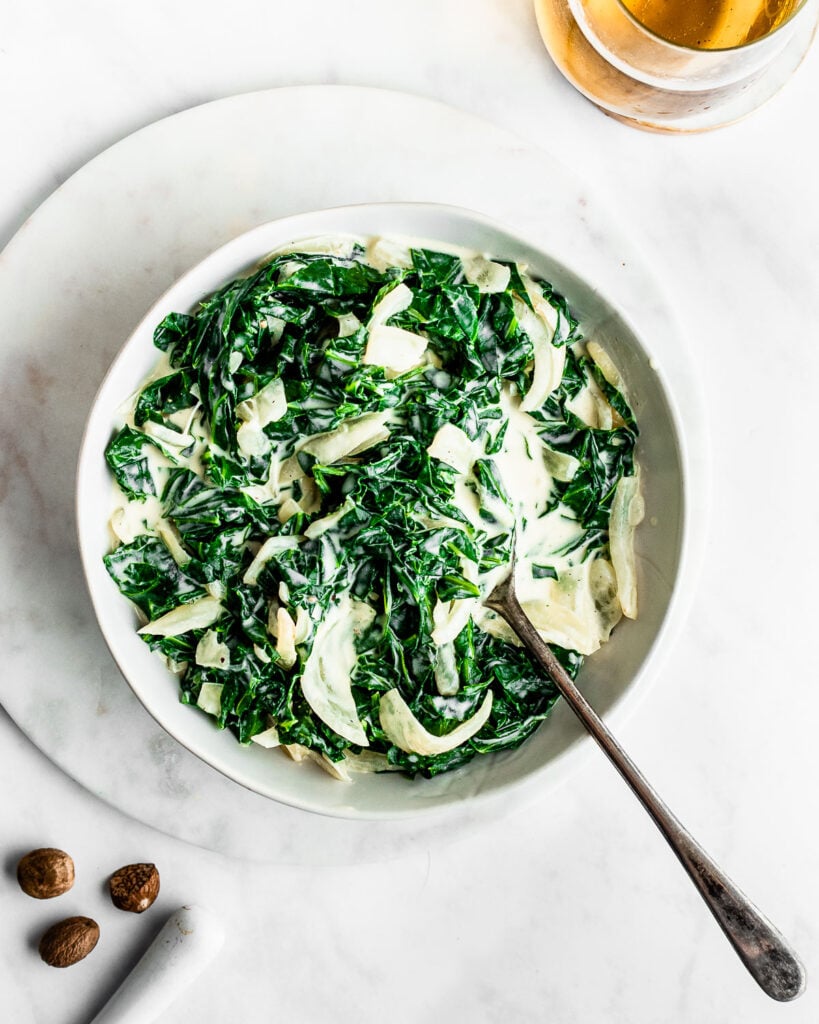
Creamed collard greens have a decadent quality, with slow-cooked onion tempering the collards' mineral-like flavor. When enveloped in nutmeg-spiked cream, you'll find the collards resonantly tender and luscious in their flavor.
What is it?
Collard greens are a leafy green in the brassica family, which also gives us broccoli, mustard (and mustard greens), kale, and cabbage among others. Indigenous to the Eastern Mediterranean, where they remain a popular food. They're also a staple in the traditional cooking of the American South.
The greens are also cultivated throughout the Mediterranean, including Portugal, Spain, and the Balkans, where they feature prominently in regional recipes.
Collards have a slightly briny, mineral-like flavor with a subtle, bitter undertone. They pair well with cured pork, such as bacon and ham, as well as fresh cream, which adds a little sweetness.
What's in it?
In this recipe for creamed collard greens, you start by blanching the collards first, which helps preserve their color and prevents them from overcooking. Next, you warm some butter in a pan. Then toss in the onions which cook down to a beautiful soft texture and sweet flavor. Chicken broth and cream make the sauce that envelops the collards, and a bit of nutmeg and black pepper give it flavor.
Collard greens have a verdant flavor undercut with a slight bitterness. They're rich in many vitamins, but especially vitamin K, folate, beta carotene, and various minerals such as calcium, iron, manganese, and magnesium (1).
Onions give this recipe for creamed collard greens a little sweetness, especially when you cook them until translucent and completely tender. Onions are rich in quercetin, a strong anti-inflammatory compound (2) found in many fruits and vegetables.
Fresh cream and butter bring the whole dish together. When produced from grass-fed cows, cream and butter are also more nutritious and richer in healthy fats (3).
Tips for creaming greens
Making this recipe is fairly straightforward and simple, but you might want to pay attention to a few key points. Namely, how you prepare the collards can make all the difference in the recipe.
- Trim the collards well to remove any tough stems or veins. The veins and stem of the collard green cooks at a different rate than the leaf. So, trimming them will speed the cooking process and ensure a consistently cooked dish.
- Blanch the collards before tossing them in the cream. To blanch greens, you'll boil them very briefly before cooling them quickly either in an ice bath or a stream of cold water from the faucet. This practice improves their color and prevents overcooking.
- Cook the onions to a melting tenderness, because slow cooking gives onions a chance to develop their sweetness. It's that sweetness that combines with the cream to bring balance to the mineral-like and slightly bitter flavor of collard greens.
- Use fresh nutmeg if you can. Fresh nutmeg has a sharper, more vibrant flavor than preground nutmeg, and the fresh variety improves the flavor of the dish.
Variations
Add ham or bacon for smoky depth. Sauté up to 4 ounces in 1 tablespoon butter (instead of 2) before adding the onions, then follow the recipe as written.
For a meatless version, try smoked paprika for a sweet, smoky flavor, or sundried tomatoes for a bright, savory punch.
Swap nutmeg for cayenne if you prefer a little heat.
Common Questions
You can substitute light coconut milk for the heavy cream; however, it will taste slightly of coconut. Olive oil, chicken fat, or coconut oil can be added in place of butter; however, each will influence the flavor of the greens.
Spoon any leftovers into a container with a tight-fitting lid, and store it in the refrigerator for up to 3 days.
No, creamed collards don't freeze well. The greens lose their texture and the cream can become grainy or separated when reheated.
It's to serve creamed collard greens immediately after cooking; however, you can store them in the fridge for up to 3 days and reheat them on the stove over low heat by adding a few tablespoons of water or broth.
Cured pork is a natural match for collards, and they pair well with glazed ham. Slow-roasted turkey is also a good pairing for collards as well.
Try these cold-weather favorites next
References
- Self. Collards Nutritional Information. (2021)
- Chen, Shuang et al. "Therapeutic Effects of Quercetin on Inflammation, Obesity, and Type 2 Diabetes." Mediators of inflammation vol. 2016 (2016)
- Heins, Brad. "Grass-fed cows produce healthier milk." (2021)
Tabriz says
I will add this recipe to my rotation.
Tiffany says
I have never had collards before and saw this recipe in my inbox as I was on the way to the Farmer's Market. I just made it. Wow - it is SO good. This will go into regular rotation. Thank you for the amazing recipe.
Anne says
I tried this for New Year's and we really liked it. I wasn't too sure about the nutmeg, but it actually added a nice flavor. I'm wondering if I can make the same recipe, but use kale instead of collards.
Vangie says
This recipe is absolutely delicious! Even my MIL who thought I took some healthy greens and made them unhealthy by adding the cream, ate two thirds of it! Thank you for the recipe!
Betsy says
Glad to see a recipe that doesn't cook the collards for a long time. I grow my own collards and don't cook them more than 10 minutes after they have wilted in the pan.
Dee Ann H says
I saw the pic yesterday and bought the ingredients today. Trader Joes sells Collard Greens already chopped. I used one bag for the recipe, and I think the amount was pretty good. It piled high when I first put it in the pan but after weighing it down with a lid it wilted down pretty well and even more after I added the heavy cream. Came out great!
CHEF D.W. says
Great simple creamed collared recipe.. All seems great with your instruction other than the timing.. Having sweat down plenty of collard greens, I know that two mins is prob not enough time.. But depending on your desired tenderness and quantity i guess this could work
Shiva-D says
Hello! Just have to say I LOVE LOVE LOVE this recipe. So forgiving - I didn't measure anything! And the taste is amazing. So creamy, comforting, and delicious. I took some in to the office and got rave reviews. Thanks again for posting this awesome receipe!
Lonnie Chu says
How many leaves in "bunch"? Bunches come in all sizes in our market. Thanks for your great recipes!