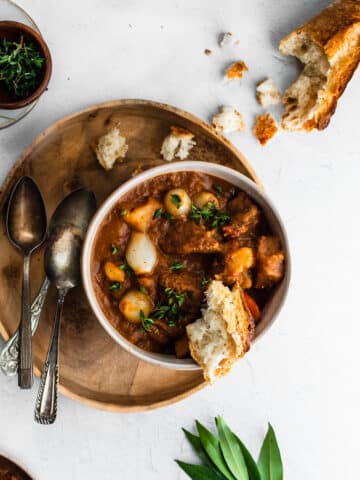
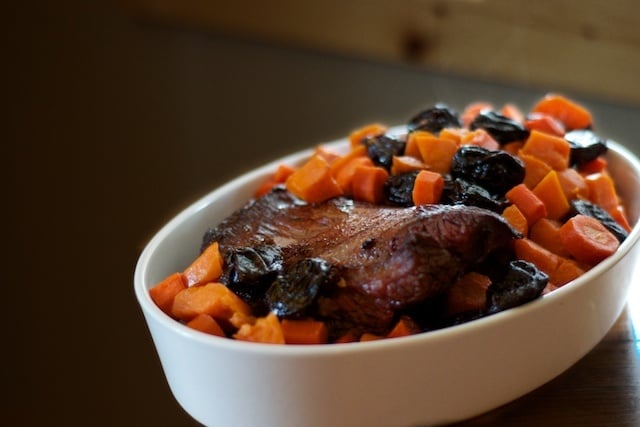
Braised brisket with tzimmes, a classic dish for Rosh Hashanah, takes a new direction with the addition of hard apple cider. Slowly cooked and tenderly watched, grass-fed beef brisket is first seared in tallow then doused in homemade beef stock and hard cider and roasted in a clay baker or Dutch oven for several hours. Sweet potato, carrot and prunes – a traditional combination of fruits and vegetables for the Ashkenazic dish called tzimmes – are added several hours after the meat has begun to roast so that they retain their texture without overcooking. Later, pan juices combine with even more cider for a mildly sweet and decidedly smooth reduction sauce. Sweet dishes, for a sweet year, are typically celebrated during Rosh Hashanah with both apples and honey featuring prominently in traditional menus while the naturally sweet tzimmes is a beautiful accompaniment.
Beef seems to get a bad rap and while conventionally raised, grain-fed beef is certainly deserving of its ill reputation, grass-fed beef offers quite a different story. Grass-fed beef is rich in micronutrients – particularly B vitamins and trace minerals. Just a 100-gram portion contains over half the RDA for zinc, a mineral that is critical for immune function and reproductive health; moreover, brisket is also a good source of niacin and vitamins B6 and B12. Similarly, beef tallow – though much loathed by conventional dietary dogma – is a potently rich source of conjugated linoleic acid, a naturally occurring fatty acid with strongly anti-carcinogenic and antioxidant properties. This beneficial fat decreases significantly with the introduction of grain into cattle’s diet, meaning that grass-fed beef offers the most potent source while grain-fed, conventionally raised beef offers only minimal amounts – underscoring the importance of purchasing beef from farms and ranches following the sustainable model of holistic management in which cattle are rotationally grazed on rapidly growing green grasses, ensuring their meat and fat is of the highest nutritional quality.
In brisket, monounsaturated fat and saturated fat are served up in roughly equal portions with monounsaturated fats (the dominant fat in avocado, olive oil, bacon fat and lard) only very slightly outweighing saturated fats. Brisket also contains a small amount of polyunsaturated fatty acids. In conventionally raised cattle fed on grain, those fragile polyunsaturated fatty acids are primarily composed of omega-6 fatty acids while in grass-fed beef, they are fairly equally composed of both omega-3 fatty acids (also found in ocean-going fish) and omega-6 fatty acids. This improved ratio of omega-3 to omega-6 fatty acids promotes good cardiovascular and metabolic health. This article, published in the journal of the Weston A Price Foundation – Wise Traditions, provides a good case for the value of fat in the human diet.
While this grass-fed beef brisket, slowly simmered with tzimmes certainly derives much of its flavor from the use of a good quality grass-fed beef tallow, that flavor is further complemented by the sweetness of of carrots, prunes and sweet potatoes. Vegetables, like meat, are also good sources of micronutrients, including carotenoids and minerals like manganese. Evidence indicates that the vitamins and antioxidants found in these foods are better absorbed when eaten with fat = making the combination of grass-fed beef and tallow with the tzimmes even more valuable.
Incidentally, as a follow up to their recent giveaway, US Wellness meat is offering a great discount on grass-fed meats to Nourished Kitchen readers.
Braised Brisket with Tzimmes and Hard Cider Reduction Sauce
A special occasion meal, grass-fed beef brisket is slowly roasted in stock and hard cider before sweet potato, prunes and carrots are added to the mix. Once the meat is done and allowed to rest, pan juices combine with more hard cider and a reduced down to a fine, silky sauce. If you’re looking for more menu ideas for Rosh Hashanah, be sure to check out this post by Lisa at Real Food Digest.
For the Brisket
- 2 to 3 tablespoons grass-fed beef tallow (see sources)
- 4 to 5 pound grass-fed beef brisket (see sources)
- 1 quart homemade beef stock
- 1 pint hard cider
For the Tzimmes
- 6 large carrots, peeled and chopped into bite-sized coins
- 3 large sweet potatoes or garnet yams, peeled and chopped into bite-sized pieces
- 2 cups pitted prunes
For the Reduction Sauce
- 2 tablespoons grass-fed beef tallow (see sources)
- 2 shallots, peeled and thinly sliced
- pan juices from the brisket and tzimmes
- 1 additional cup hard cider
Method
- Preheat your oven to 300 degrees Fahrenheit.
- Heat the tallow in a large skillet or griddle until it melts and becomes quite hot.
- Sear the brisket on each side, about three to four minutes, then place it in a clay baker, pouring one quart homemade beef stock and one pint cider over the brisket.
- Braise the brisket, covered, at 300 degrees for three hours before preparing the tzimmes.
- After three hours, or so, add the chopped carrots and sweet potatoes or yams to the brisket. Continue to roast at 300 degrees Fahrenheit for another hour.
- After the brisket has roasted for four hours, and the carrots and sweet potatoes or yams have cooked for one, add the pitted prunes to the clay baker, increase the heat to 375 degrees Fahrenheit and continue to bake for thirty to forty-five minutes.
- Remove the brisket and tzimmes from the oven, placing the brisket on a serving dish to rest and surrounding it by the tzimmes, straining the liquid from the clay baker as you do. Keep the brisket and tzimmes warm by allowing them to rest in your hot oven with the heat turned off while you prepare the reduction sauce.
- Melt two more tablespoons of tallow over a medium flame, adding two thinly sliced shallots to the hot fat.
- When the shallots release their fragrance and begin to caramelize a bit, add the braising liquid and additional cup of hard cider to the saucepan. Simmer slowly until the liquid is reduced by half.
- Slice the brisket, serve with tzimmes and reduction sauce.
YIELD: about 6 to 8 servings.
TIME: 20 minutes (preparation), 5 hours (cook time)
NOTES & SUBSTITUTIONS: If you don’t have access to high quality grass-fed beef tallow (available online or from local ranchers), you can substitute another fat such as unrefined palm oil or, if keeping the dish kosher isn’t necessary in your home, you can also use pastured bacon fat, grass-fed butter or ghee (see sources). I recommend hard cider for this dish, but you can also substitute plain apple cider or juice. Note, however, that the brisket and reduction sauce will be sweeter.


I loved your comments about grass fed beef. I wish they could be put in every conventional food publication and be on the lips of everybody. We would be a much healthier country if we stopped eating conventional food — not just meats but produce, dairy, grains, etc. all need to be organic and/or raw.
Exactly. We try to eat about half of our food raw or fermented, including raw meats, fish and dairy products. I think that if we could just make the switch to caring for our animals properly by keeping them on pasture and grass, we’d see at least some revitalization in the health of our nation.
Wow! This look delicious
I’m so glad I follow you on FB!
Have a Blessed Day!
My son and I are “investigating” culinary traditions and meals from around the world in our first Homeschool Unit of the new school year. Since Rosh Hashana is a Jewish Holiday, may I assume this dish is Israeli in origin? Wherever it’s from, it looks amazing. I can’t wait to try it! Off to call my farmer for a brisket
What a fun project! We’re homeschooling our son too, and it’s such a blessing for our family. The dish isn’t actually of Israeli origin as much as it’s of Eastern European origin (Germany, Hungary, Poland, Belarus) where Ashkenazi Jews migrated and settled.
WHY did I never have this in Germany!? Guess I was just eating in the wrong restaurants or maybe I was to uneducated about food and it’s ties to our health back then and went for the wrong foods (probably both).
Thanks so much for the information. My son gets home this evening from visiting his Grandparents about a thousand miles away (just one more perk of homeschooling – you can set your own schedule). I think we’ll try to make this on Wednesday.
You’ll have to let me know how it turns out for you. I *LOVE* it when people let me know that they actually made a dish from the site.
Im Jewish and Im going to try it. Your biggest fan your mom suggest I make it.
This looks fabulous! Do you keep the brisket covered after adding the veggies?
Can’t wait to try it,
Marleen
Yes, keep it covered for the entire cooking process – it helps to reserve the pan juices for making the reduction sauce.
While the intent of this recipe may be for Rosh Hashanah, certain ingredients used in the recipe aren’t available for the Kosher preparation of this recipe, and those ingredients are: Tallow and Suet. Suet generally is rendered from pigs, and tallow uses non-kosher ingredients in the rendering process. If you keep Kosher you can find bountiful Kosher recipes for brisket by Googling, “recipes for Kosher brisket.”
That’s absolutely incorrect, Arnold. Suet refers to ruminant fat (beef in particular), the terms lard and leaf lard refer to pig fat. I render tallow at home and it requires nothing more than suet (which, like I said above, refers to beef fat not pork fat), there are no extraneous “non-kosher” ingredients used in rendering tallow as all it calls for is suet which, like I mentioned above, comes from steers not hogs. Occasionally you might find a method for rendering tallow that calls for water in addition to suet. You would acquire suet from the same source you purchase kosher beef, render it on the stove and you’d have kosher tallow. This isn’t a difficult task to accomplish.
You may be right, but, the preparation of tallow and suet are totally unnecessary, and beyond the scope and abilities of most people who are just cooking simple meals for their families.
I *am* right.
Further, traditional methods of food preparation are central to the principles behind Nourished Kitchen. This site is about reclaiming the lost art of preparing foods through time-honored tradition, and that’s why we focus on tasks including making raw milk yogurt from scratch, making stock from scratch and, yes, even rendering fat from scratch.
Necessity is not the point. It’s not “necessary” to cook from scratch at all – after all, a family can get a meal at McDonald’s if they want to. What we do here is teach people how to cook using traditional techniques that maximize the nutritive value of their foods. Rendering fat, incidentally, is blessedly easy and even a novice cook can master it provided they have the interest to do so.
I beg to differ. Anybody with a few hours of free time and a pot can render beef fat in their home. My only question would be to a rabbi about the salting process. My *guess* is that you would slice the fat thinly, salt, wait, rinse and begin, but that is NOT from a rabbi. As ALWAYS, CYLOR.
And I wanted to thank the author for this recipe. A non observant friend of mine asked me for a “good tzimmes recipe with brisket” because her csa sold her a grass fed brisket. I didn’t want to send her to the other places, I’m sure I don’t have to explain why
This is perfect for her needs.
Hi. I realize this is late to the party, but not every part of a kosher animal is, in fact, kosher. For instance, the fat surrounding the kidneys is not kosher, and is often used in producing tallow. So while a person could, in theory, procure an amount of kosher beef fat in order to render it herself at home, it is a common misconception that if an animal is kosher, then the whole animal is kosher. Did you know that sirloin steak is not a kosher cut of beef?
I was just going to say that the meal looked delicious, and while I don’t celebrate Rosh Hashanah I would think of making this later this week just as a seasonal meal. The commentary has been quite interesting too. Thanks Jenny. I always learn so much from your posts (and comments).
Oh my goodness. I wish I could make this at college. I need a real foodie mom to make this near me!
I really appreciate the addition of Jewish food to Nourished Kitchen. I’ve all but given up keeping kosher in favor of nutrition. I made this brisket recipe for Rosh Hashanah and it was amazing! It’s a far cry from the dry onion soup mix/ketchup recipe that my MIL makes. I’m making it again tonight to break the fast on Yom Kippur. I was thinking I’d use the leftovers for Kreplach, but there might not be any leftovers! Many, many thanks.
I need to make this dish for 70, and am wondering what to make it in. I have two large oval le creuset baking dishes but I’m not sure everything will fit. I could also do large metal hotel chafer pans with lids or with aluminum foil. Do you think either of these options will work in place of a clay baker?
This looks lovely and I have a grass fed brisket that I’m looking to cook tomorrow. Never prepared one before. So I didn’t know what ‘hard cider’ was compared to just apple cider. Turns out it’s an alcoholic drink? Is that what you used in your recipe? I was excited about this recipe because I have a bottle of apple cider concentrate from William’s Sonoma that I thought I would use for this. How do you think it would effect the recipe if I replaced hard cider with my concentrate?
Never mind. I saw the substitutions paragraph. I’m going to try this today with my cider concentrate.
This is incredible, lovely, and I am roasting my brisket as we speak. I am making it up until the last hour and half for Sunday night’s dinner, when I will finish it with the veg. I am very excited! Thank you for this gorgeous recipe.
Hi Jenny,
This recipe looks wonderful and I am so excited I can all the ingredients from the Traditional Nutrition Guild in NYC. I am wondering if you can use the crock pot for the brisket and how would I do that?
Thanks for everything! I am an avid reader and subscriber of your blog.
Best,
Nikki