
Whole wheat sourdough challah, fragrant with olive oil and honey, is a nourishing bread - rich, flavorful and worth the extra effort it takes to lovingly prepare the dough, roll out the strands and intricately braid the loaves. While typically prepared from refined white flour, vegetable oil or margarine and refined white sugar, challah is, indeed, a loaf for special occasions - but preparing this traditional bread from wholesome ingredients elevates challah beyond the mundane to something that truly nourishes the body and spirit while satisfying the tastebuds.
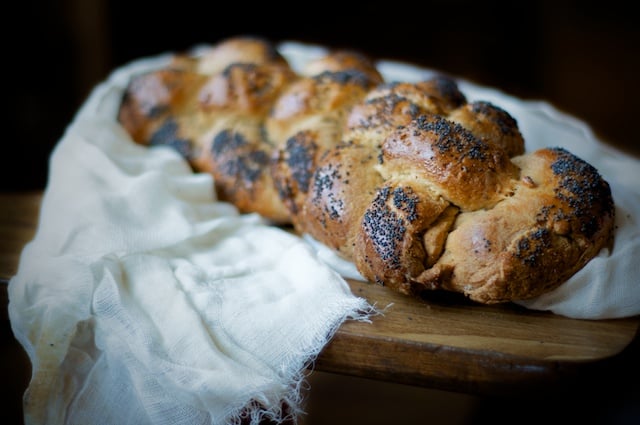
In this version of challah, we use soft white wheat flour. Soft white wheat is a whole grain, differing from hard red wheat which is typically used for bread, in that it is softer, with lower protein content, and is better suited to preparing pastries. When transforming your family's favorite treats and sweets made from refined white flour, to more nutrient-dense whole-grain alternatives, choosing whole soft white wheat flour enables you to maintain the baking qualities of white flour while nourishing your family with the myriad vitamins and minerals typically found in whole grains. Of course, whole grain is rife with antinutrients including enzyme inhibitors which inhibit good digestion as well as food phytates which bind up minerals in the digestive tract inhibiting your body from fully absorbing all the micronutrients whole grain can offer so the proper preparation of flours and bread is essential not only for improving flavor but also in protecting from mineral deficiencies. Fortunately, sourdough fermentation as called for in this recipe for whole wheat challah dramatically improves the nutritive qualities of whole grains by neutralizing enzyme inhibitors and degrading phytic acid.
Using Freshly Ground Flour
If you're serious about bread baking, you might also consider purchasing a grain grinder for your home. After the whole grain is milled, packed, and allowed to sit in bulk bins or on the shelves of your local grocery store, nutrients are lost - vitamin E and other vitamins slowly degrade the longer the flour sits. When you grind grain fresh, not only is the flavor vastly improved, but many of the fragile vitamins and enzymes remain intact. Bread, like this whole wheat challah, becomes a true luxury when prepared from freshly ground flour.


Erin says
My question is can this be made with either white or whole grain einkorn or a combination? We are only using einkorn right now and I know it's fairly different than other wheat flours. Thank you.
Donna Drebenstedt says
Hi Jenny,
I live in Denver and I make yeast Challah every week for the Sabbath using an organic hard red winter wheat that I grind adding some vital wheat gluten to help it rise... I am just beginning to enjoy sour dough baking thanks to your new book and recipes I download from your FB and internet... I love to eat and feed my family healthy food!
I had quite the experience last night and this morning with this recipe... First off after I added 1 quart of my bubbly sour dough starter (seemed like a lot compared to other sour dough recipes) I mixed and mixed the whole wheat pastry flour that I freshly ground and could never get the dough to cling to the dough hook??
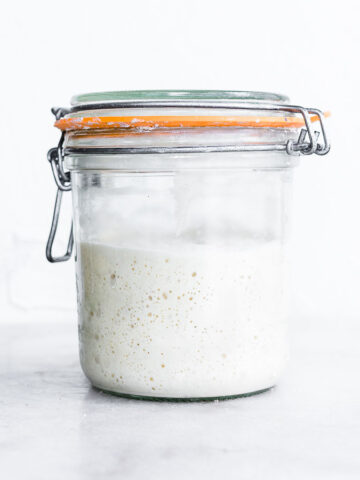
Wondering if my starter was too thin?? It is a starter my sister gave me and I have roughly kept it the same thickness each time I feed it and it has always worked fine... maybe for this bread the starter has to be thicker/less hydrated?? I added almost a cup of extra flour and realized I was in trouble... Put it in the oiled bowl anyway overnight... in the morning it had doubled so I had hope.
Dumped it on a floured surface and was up to my elbows in super sticky dough, what a mess... wondered if I should cry or laugh, did both. I kept kneading flour into it until it finally formed a dough of reasonable firmness. What a mess I made in the kitchen!
I Let it rise again for two hours, it doubled and I shaped it... I have made enough braids to know that this dough was not going to hold a braid very well, too soft but otherwise it felt nice. I made one loaf and the rest into twisted rolls... The braid was not too pretty going into the oven after rising for an hour nor coming out of the oven and the cooked loaf a bit flat. The rolls looked better... We just ate one, they are ok, reminded me of a sour dough biscuit, real butter and honey on it helped... So what was my problem??? I really would like to make sour dough challah each week!
Thanks for your help,
Donna
Terah says
Hello, I am fairly new to sourdough and uncertain how to know whether I have a quart of starter...I usually go by weight, or cups. Does this mean I should use 4 cups of starter? Thank you!!!
Annie Ferrer says
Thank you so much for this recipe. I made it with whole wheat pastry flour (for the first rise) and unbleached white flour (added for the second rise). The texture came out amazing, so nice and soft, no sour flavor at all! I did find the EVOO flavor a bit overpowering so next time I will try a combination of butter and coconut oil. I'll let you know.
Anna says
So much fun to make! I really enjoyed the braiding process. The crust is great and crumb is nice and soft. Like Annie, however, I found the EVOO flavor to be a bit strong and would be interested to hear how the butter/coc oil worked out, as well as potentially more honey! Also, upon first putting ingredients together my dough was stiff and a beautiful ball, but after the first rise it was very wet and sticky. I kneaded it in the stand mixer along with the added ingredients and it came together some, but never fully. After the second rise it was extremely wet and I had to knead it with several cups of extra flour to stiffen it enough to shape. Do you think this could be due to over-oiling my bowls? I generously oiled them for the rises (it overflowed my bowl both times!) or is it something else. Hoping to make these again for Thanksgiving, so any advice would be much appreciated!
Shari says
I also have questions similar to what Annie asked.. I am surprised you were able to get enough gluten development using soft wheat. Your breads look great.
How did you do it? I would also be interested in seeing a foto of the crumb.
joanne says
Hi Jenny,
Can I make this with light spelt, as i cannot have the wheat?
thanks
Jo from canada
jenny says
Yes - it should work very well!
Annie says
I have got my hands (and elbows) into this recipe but now I'm confused about a couple of things.
First, I'm wondering what, exactly, you mean by "soft white wheat flour". "Soft" meaning pastry flour that has low gluten? Or are you talking about flour made from whole white wheat which is still considered a "hard" flour and has a good amount of gluten? Or are you talking about unbleached white bread flour (the refined stuff)?
Secondly, I realized when I started putting this dough together that you didn't mention what the hydration is for the levain. The difference between a thin one and a thick one would change the amount of flour to be added. My starters are pretty thick so i don't have to add so much un-soaked flour to make a dough.
Some more photos of the dough at different stages would help. I don't have a stand mixer (some day maybe) so I'm doing it by hand. Not knowing how thick or thin the levain is I didn't know just how this dough is supposed to look before letting it sit for 12 hours.
I sure hope I hear back from you soon because I really want to make this for Easter. Today's Challah is my first run and truly an experiment in the dark--sort of!
Thanks,
Annie