
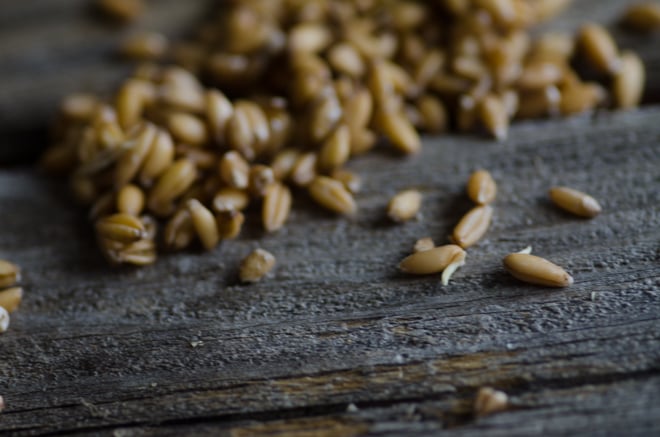
Sprouted grain flour is a staple in my kitchen. I make it from time to time, in bulk, and freeze it for use in sweet things like these sprouted grain cookies, or in this sprouted bread with milk and honey. Sprouting sweetens grains naturally, and the process also helps to mitigate the effects of antinutrients like phytic acid which are found in whole grains. It releases a bit of the plant, one that's imprisoned in the grain's tough layer of bran. When the conditions are right - moist and slightly acidic - the little plant begins to emerge, if only slightly. It's a beautiful transformation, the release of life from something so small and so seemingly inactive.
Why Sprouted Grain Flour
All whole grains (and beans, seeds, and nuts) promise an array of vitamins, minerals, and dietary fiber which is why health authorities (rightly, or wrongly, you might think) emphasize them as a source of good health. And, despite all the emphasis on whole-grain this and whole-grain that, what they fail to emphasize is that these whole grains are also a source of antinutrients -substances that actually prevent you from fully absorbing the nutrients whole grains contain. Listen closely now: you might eat as many whole grains as you like, but without proper preparation to mitigate the effect of these antinutrients, you are not reaping the rewards you should.
Grains want tender, long and thoughtful cooking. This means grains need to be treated first to release their full array of nutrients to your body. Soaking, sprouting and souring accomplish that goal which is also why I emphasize sourdough baking at Nourished Kitchen. Now, sprouting won't remove all of the antinutrients in the grain - but it has some effect. To remove them all, you need to mill the grains and extract all the bran, but sprouting does accomplish quite a bit not only to release the existing minerals from the grain but to improve its complement of vitamins and protein.
Which grains can I sprout?
You can sprout any grain, provided you're working from the whole grain berry, not a rolled, flaked, or otherwise damaged grain. Wheat, spelt, oats, barley, and einkorn all work well for sprouting. Oats are a high-fat grain, and are often treated with steam or heat and dried prior to packing and distribution, so if you wish to sprout oats, take care to purchase untreated oat groats intended specifically for sprouting.
Where to Find Grains for Sprouting
In most cases, you'll be able to purchase whole grain berries at your local health food store in the bulk bins. Common grains like spelt, wheat, and rye are available at even the smallest stores; however, untreated oats for sprouting and einkorn berries are less commonly available. For my family, I purchase both einkorn berries and sprouting oats online.
- Common Grains (Spelt, Rye, Wheat, Rice): Check your local health food store's bulk bins, or inquire at your buying club.
- Untreated Sprouting Oats: Are not widely available yet, as most oats on the market have been heat-treated due to the volatile nature of their oils.
Sprouting Grains for Flour
When sprouting grains to make sprouted grain flour, you must be mindful of the time it takes to sprout while not allowing your sprouts to grow too large. Certainly, once that little speck of a root appears at the end of the grain, it's tempting to let it continue growing. Yet, by allowing the sprout to continue to grow, you run the risk of malting the grains. Malt, in small amounts, adds great depth of flavor to baked goods; however, when used exclusively or in large amounts it will produce an overly sweet, gooey bread that never cooks through. In using sprouted grains for flour, be mindful to begin dehydrating the grains shortly after the root tip appears.
Sprouted grains should also be dried at a relatively low temperature in a dehydrator; just as allowing the sprout to grow too long can fundamentally change the way the flour performs, so too can drying it at a high temperature. An oven doesn't work well as a substitute for a dehydrator in this instance.
Equipment You'll Need for Making Sprouted Grain Flour
I live in a very small, modest home with a surprisingly tiny, equally modest kitchen - about 40 square feet. I do not like to clutter what little space I enjoy with too many appliances and kitchen gadgets; however, there are a few items I find to be absolute necessities for sprouted flour making. Fortunately, they all serve multiple purposes.
- The Insert of My Slowcooker: I soak my grains in the insert of my slow cooker, though any large mixing bowl will work well.
- Fine-mesh Sieve: I use a fine-mesh sieve that fits over the sink for rinsing and aerating the grains as they sprout. Fitting it over the sink saves much-needed counter space, and also allows the water to run cleanly through the grains, minimizing clean-up.
- Dehydrator: To prevent sprouted grains from roasting in the oven at too high a temperature, I dry them in a food dehydrator.
- Grain Grinder: When I first began grinding my own grains for flour, I used a Nutrimill; however, early this year it stopped working, and I purchased a Komo Grain Grinder and Grain Flaker which is blessedly quiet and doesn't heat the flour during grinding. There are many grain grinders, electric and manual, in a variety of price ranges.



Lisa VanValkenburgh says
Can you use flax seeds to sprout and flour?
Katie says
Could you use a freeze drier instead of dehydrator?
Jenny says
You can try and let us know how it goes.
Arlene Kufchock says
Hello, can I use sprouted green/brown lentils directly in my bread recipe, without dehydrating it first? This would be very helpful, because I rarely bake, so I plan when I bake, so I can wait 3 days to bake while my grains sprout. Thank you!
Jenny says
You can try and let us know how it goes.
Kristi says
Which dehydrator specifically do you use? The link takes me to all dehydrators on that website not one specific one.
Jenny says
Hi Kristi,
I use a 9-tray excalibur.
pat says
where can I find the recipe for ezekiel bread
Jenny says
By googling "recipe for ezekial bread."
Anna says
I am confused as to instruction #2 where you say to rinse and stir the grains 2-3 times a day till you see the spout emerge. After each rinsing do you put the grains back in the soaking liquid? Or make a "new" liquid after each time?
Jenny says
You don't put the grains in a soak liquid while they sprout.
Deanna Sheckler says
What if I don't have a dehydrator?
Jenny says
I recommend using a dehydrator if you're planning to make sprouted flour. Even the lowest temperature on an oven is too high for making sprouted flour without malting it. And if you just leave sprouts on a counter or to dry in the sun or a sunny window, the temperature is likely too low and the ambient moisture too high - promoting mold growth.
Clara Sulpice says
If I am going to use the flour to bake bread, would there be any advantage to using a dehydrator to dry the spouted wheat rather than the oven?
Jenny says
Yes, you can control the heat better in a dehydrator. Sprouted grain needs to dry at very low temperatures, otherwise the sugars in the grain will change and form malt. A little bit of malt can improve your bread, but using flour that's been malted will deliver sticky, gummy results that are unpalatable.
Christa says
Thank you for the steps to make homemade sprouted wheat - what temperature do you dry your grains at?
Bernard says
One question to ask and one question only. I have had a visit to my naturopathic/holistic Dr. and I have had a very detailed conversation on nutrition as he was schooled in a very progressive medical university here in the PNW so he does know what he's talking vs the stupid brain dead know all and be all allopathic Dr's whoring with Big Pharma. Why is sprouting grains so focal in ones eating regimen as from my own personal research that grains are negative to our physiological DNA? Can you clarify on this grey are for me?
Maurie says
After I grind my sprouted wheat, I sift out some of the hard flecks. What are these and what can I use them for? (obviously a newbie)
Jenny says
That's just pieces of bran, and it was traditionally used to feed animals.
chelsea says
love this site! I sprout my einkorn and dehydrate it to make my own flour for bread making. I have only been making sourdough, but got to thinking...
If I am sprouting my grain, then do I really have to make sourdough? or maybe I can use yeast? Is it extra healthier to do both, sprout and sourdough? Or is is healthy to sprout my grain and then use a bit of yeast?
thanks for the help!
Jenny says
You can do whichever you choose, sprout and sour, or just sprout and use bakers yeast. Typically, I use sprouted flour for quick breads and pastries and use regular flour for sourdough breads.
chelsea smith says
thank you for they reply! I'm new to this baking. Is bakers yeast bad for you? seems like im always hearing of the dangers of commercial yeast. or is it using yeast AND not sprouting the grain that gets you into trouble. I would just hate to be going thru the process of sprouting only to add yeast thats not good for you. thanks so much for the help! also do you ever use bakers yeast and if so what brand do you use?
Jenny says
I don't take issue with commercial yeast.
chelsea says
do you use bakers yeast? recommendations?
Jenny says
Generally I use sourdough for yeast-leavened breads and baking soda or baking powder for quick rise breads.
Lea says
Hi jenny. Lovely article. My health improved after giving up whole grains and soaking my flour. So, can you mill sprouted berries before grinding them? Thank you
Jenny says
Grinding and milling when it comes to flour are more or less synonymous.
cab says
I was wondering if you have any advice for me. I have 2000 pounds of some kind of nasty spelt wheat. I bought it over the telephone from an organic farm place about 60 miles away, and was charged about $1 a pound. I didn't go to pick it up and other people did that for me. Turns out the stuff was probably some old unused spelt that was probably in the bottom of the grain silo sitting there for years. Only a few seeds would even sprout. Plus, some of the spelt has husks and some not. We didn't realize it was no good and we stored it all up in big barrels so we'd be set for the future days and have food. But turns out this stuff is not edible and won't grow and doesn't sprout either. The chickens won't eat it either, even if I soak it.
I paid about $2000 for this and it's all stored up in my basement. Do you think there's anything I can do with it? I've tried soaking and boiling it and it doesn't digest very well, if you get my drift. I'm trying now to do a soak and mill experiment, and I'm waiting to see if it will ferment a bit and maybe that will fix it. I'm afraid to eat it, seems to give me a lot of gas, and I don't want to poison myself with phytic acid. But since it doesn't want to sprout ... I'm not sure what to do. The people who sold it won't tell me anything about the stuff they sold me, which they told me was 'seeds.' Seeds that don't sprout are not exactly seeds. If they told me they were old seeds that wouldn't spout anymore, I would not have bought them. I did get taken for a big ride, but I'm just wondering if there's any way at all I can use this stuff, that is taking up my whole basement as stored 'food.' Maybe if I was starving then it would be a wonderful thing to have? Do you have any suggestions at all?
Allyson Jacobs says
One more question...doesn't all the rinsing wash away water soluble vitamins like the vitamin B family?
Jenny says
Hi Allyson,
No, rinsing will not wash away water-soluble vitamins.
Allyson says
I sprouted a bread size portion of grain and then instead of drying the grain I used my food processor to basically make the dough. It tasted great. Am I missing anything nutritionally by doing it this way?
Jenny says
Nope! What you've done is called "wet milling."
Joe villegas says
What would happen if I allowed my grain to sprout for a full week. At that time dehydrated then then,grind to a flour. Would it taste ok?would it have a better health value?And kuldip it yield more flour? Thank you for your time and input.
Jenny says
Hi Joe,
If you would sprout it for a week, it would be sprouts. Almost all of the grain's energy would be used in the sprouting process and you will have effectively grown a vegetable. It would not yield good flour, if any flour.
Janice Sloan says
If I put my flour through the sifter is it fine enough for flour? It isore grainy than regular flour.
Abigail says
Do you have to dehydrate sprouted grains and grind them before making bread? Can you just use the wet sprouted grain and process it to make bread?
C Morris says
What is the vinegar in the soaking water for?
Kathy says
Hi Jenny, thank you so much for this article. Please can you help me, I don't have a flour mill so I used a coffee grinder but I wasn't sure how much I needed to sieve the flour? How much if the bran can you leave in? Thanks
Jenny says
Hi Kathy,
You don't need to sieve the flour at all if you don't want to.
michel mathison says
When in the sieve do you cover the grains? If so, with what?
Bec says
Hi Jenny
I'm starting to make my own sprouted flour and i have a few questions that i was hoping you could help me with.
- what does the vinegar do in the process?
- if i'm using a dehydrator what temperature should i dry the grains on?
Thanks in advance 🙂
Joyce says
Yes I had the exact same questions Bec!
Jenny, are you using the vinegar to sterilise the grains from mould? Do you have specific proportions that are effective, if that's the case? Also, you say 12-18 hr until the grains are dry and hard, but is that at 40 degrees?
Hannah Hall says
I have spelt or farro berries but I'm not sure if they will sprout. I soaked them overnight and I don't have a dehydrator and just want to make flour. What do I do? Does it have to sprout? They are pretty old berries. But not rancid.
Jenny says
Hi Hannah,
I recommend following the instructions listed above with fresh berries and the equipment recommended.
Kim hollingsworth says
I'm just getting into grinding sprouted grains and I can't find an answer to my question. What is the reason for dehydrating the grains after sprouting. If I'm going to make the bread immediately after sprouting, can I not just grind them while still wet in my vitamix and make my dough, figuring out how much water to add at this step (if any?) if there is a nutritional value in dehydrating then grinding and baking I prefer to follow steps. I'm just wondering if I can omit this part. PS I do have a dehydrator and just now ground my grains to flour. I am about to bake my bread and wondered about this for next time. Thanks, Kim
Rachel says
I just soaked some spelt grains in the vinegar, however when I rinsed them there was lots of white glue like substance throughout all of them. Any idea what that is? Do I need to start again? Thanks
Jenny says
It's difficult for me to troubleshoot without a photo. Broken grains, and roughed up grains, will look gluey.
Roberta Devers-Scott says
Jenny,
Question: I order einkorn berries (for example). I then sprout them and dehydrate them and store in the freeze. I have A Kormo grain mill too (love it). I then grind them into flour each time I bake. I hate to have to grind each time so my question is what constitutes "freshly groun?" Can you grind once a week and use that flour and still consider it freshly ground?
Thank you
Erin Mullins says
I have been soaking steel cut oats for a night or two before cooking them as oatmeal. After reading this, Im wondering if its a damaged grain or if there is any benefit to soaking a steel cut oat? Also, I havent been rinsing or draining, but using the liquid I soaked them in to cook with. Thank you for all the helpful information.
Jenny says
Hi Erin,
If you're using steel cut oats, I'd suggest adding a bit of rye flour or buckwheat flour (both high in phytase which facilitates the breakdown of phytate). There's no need to rinse the grains, other than personal preference, as the phytate is broken down not dissolved in the soaking liquid. I rinse, because I think the flavor is better, but that doesn't mean you need to.
Madeline says
May I mill my sprouted grain in a blendtec blender?
Jenny says
Hi Madeline,
I'd reach out to Blendtec and ask directly.
Madeline says
Thank you.
How much milled flour does this recipe using 1lb of grain make?
Jenny says
Hi Madeline, I'm not certain as I've never measured.
Mel says
Do you have pictures of the different steps of making your sprouted grain flours? Specifically what they look like when you harvest them after sprouting and what they look like after dehydrating before grinding them and what the flour looks like. Thank you.
Jenny says
Hi Mel,
No I don't, but that's a great idea.
Susan says
Very interesting information. I'm wondering if you use sprouted grains solely for flour or if you ever sprout them and then cook them to eat? I soak mine for 24 hours with a little whey or vinegar before cooking. Is that enough, or is sprouting prior to cooking a better choice? Thank you.
Lisa says
Once you rinse them in the sieve, where do you put them to sprout for the 2 -3 days, or do you just leave them out in the sieve?
Thanks
Jenny says
You leave them in the sieve.
Karen Mashak Kmash11@yahoo.com says
I've sprouted spelt grain twice. The first time I didn't know that you have to stop the sprouting immediately when the little bud (of the sprout) shows and to my surprise when I tried to make bread it didn't work like my normal spelt flour! It did turn out yummy but no sandwiches.
The second time I somehow over sprouted again 🙁
I've kinda given up on the process
I soak everything i.e. rice, beans, garbanzo, everything
waltenguse says
hello I have question that what is the amount orpercent of sprouted seeds in wheat that used for normal flour?
Jenny says
None.
Ann-Marie Hunter says
I make sprouted grain bread all the time. I sprout the organic grain, but don't dry and grind it to turn it into flour. I make the bread directly from a mash made from the moist sprouted grains. It makes beautiful loaves!
Bess says
Ann-Marie Hunter,
Do you mind sharing the recipe you use to make bread from moist sprouted grains? Thanks!
pam says
Once you bake the bread at 350 degrees, the nutritional value in the sprouted grains is killed, so why does it matter if it's dried in an oven that might be too hot?
Jenny says
That is absolutely untrue, and, frankly, foolish to boot. The nutritional value of sprouted grains is not "killed"at 350F; rather it remains very much intact. If you had read, you would know that drying the sprouted grains malts them, which negatively impacts the texture of baked goods.
Barb W. says
I misread information to sprout wheat berries in a glass bowl. I put 2 pounds wheat to soak and left them in the water overnight as directed. Next morning I rinsed them and put fresh water over them to soak, rinsing and changing water 3X a day. However, they didn't really sprout so I reread the directions and discovered I should have drained off the water after rinsing. That was 5 days ago and now I'm wondering if the wheat berries are safe to dehydrate and grind for flour to use in baking muffins, etc. Or should I throw out the wheat and allow the birds to enjoy my error? Please reply before I spend anymore time worrying about trying to salvage my product. Thanks!
Rachel Edwards says
Hi, I am a health nut wanna be, I have gathered lots of tid bits, some I believe, and some I don't, from all over. I have great intentions and when I don't mis manage my time too badly, I really get on a roll, health wise. Unfortunately, I fall completely off track quite often. 🙁
However, I have a question and hopefully you can enlighten me. I have read that sprouted wheat and other grains are much healthier, and I believe that. However I'd like to know is there any change in the gluten in a grain once it has sprouted?
Nicole Handfield says
I tried the sprouted recipe as described above and it worked beautifully. However, when I put the dried sprouted grains in my Nutrimill, I was not able to mill at the finest setting like I normally do with non-sprouted grains. I just bought a Komo Classic grain mill today and when I was talking with the sales rep at Pleasant Hill, she said that neither the Nutrimill or the Komo are supposed to mill sprouted grains because they will "gum them up." I am wondering if the Komo Classic is able to mill sprouted grain at the finest setting, or if you have to make it coarser than non-sprouted grains so that it will work? I was thinking about getting the Komo XL because it has the larger motor if the classic can't do it.
Allen says
You can grind sprouted grains also in the Komo. Here is what it says at the Breadtopia website. "Sprouted grains can also be milled provided they are thoroughly dried first."
Heidi says
I have struggled with being able to sift out the bran. What is the most effective way to get as much bran out as possible?
Stephanie says
Hi! I experienced as you mentioned, the gooey bread that never cooked through from sprouting the grain too long. Just wondering, if you do it correctly, can you substitute wheat flour for sprouted wheat flour in bread recipe ?
Tony says
I have same setting on my oven. I dehydrated at 100* for 11hrs they were dry & ground in grain mill NG. What i found out through online research is that if you wait to long the sprouting proess flour becomes a malt . When i baked bread with normal recipe wheat flour i used many times in the past the bread was good. When i used this sprouted grain it was gummy and sunken on top. So next time will dehydrate at 135*-140* so sprouting tails will not grow during the process. When i sprout wheat berries i started to Dehydrated (dried ) when sprout just cracked the grain do not wait to long or it will be Malt. I am trying again to sprout Spelt will let you know what happens when i dehydrate at 135* and mill to flour then make my bread?
June says
Hi Jenny,
Do you have any advise to dehydrate sprouted grains in an oven? I have a Kitchen Aid wall oven that has a dehydrating mode. The temperature range can be set between 100-200 F with a total time of 12 hours of dehydrating before it turns itself of. ( I can reset after that time period.) I can use up to 3 racks in the oven with this mode. I am most likely going to soak, sprout and dehydrate wheat for flour. What would you recommend I place the wheat on to place on the oven racks? Thank you for your time and advise!
Tony says
I have same setting on my oven. I dehydrated at 100* for 11hrs they were dry & ground in grain mill NG. What i found out through online research is that if you wait to long the sprouting proess flour becomes a malt . When i baked bread with normal recipe wheat flour i used many times in the past the bread was good. When i used this sprouted grain it was gummy and sunken on top. So next time will dehydrate at 135*-140* so sprouting tails will not grow during the process. When i sprout wheat berries i started to Dehydrated (dried ) when sprout just cracked the grain do not wait to long or it will be Malt.
Sina says
okay so I think I may have accidentally malted my wheat...it has a very strong nutty smell that overpowered when I tried to bake with it. I was going to throw it out but it sounds like I can keep it and just use it mixed with some non malted flour for a deeper flavor right? I hate to waste all that time and effort LOL.
kira says
Hi, I tried to make sprouted wheat bread. But the crust turn into some sort of black candy like the one in the flan and the inside stayed moist or raw... It also got too sweet. What did I do wrong?
Cricket says
Many people have asked what temperature to dehydrate at but I haven't seen an answer yet. Can you please forward me this information. I see the time in the instructions but not the temperature.
Thanks,
Cricket
Allen says
I have read some books on dehydrating other items like flax seed crackers. They say do it at 105 degrees F. Anything above that temperature, you will kill the nutrients. I would dehydrate my berries at this temperature.
Mary McCreadie says
Someone said 105
Wes says
Hey Jenny,
Loved the article- so informative. I'm wondering if there's a simple alternative to using vinegar during the sprouting process that will similarly facilitate phytase release and will not otherwise impede the germination process. Maybe something like lemon juice?
Thanks!
Karen says
Hi Jenny, thanks for this page and for all your site! Once the grains are sprouted, could one whiz them then, then dry them, then grind them? Or would this interfere with their nutritional value somehow?
Morgan says
After dehydrating how long are the grains good for in the refrigerator un milled?
Lindsay says
What temperature do you set your dehydrator to when you dry the sprouted wheat?
Allen says
Do it at 105 degrees F. I have read other vegan books on dehydrating and they say use 105 degrees F. Anything above that and you kill the nutrients in the food your dehydrating. I use this temperature when making flax crackers.
rice cooker says
I just could not go away your website before suggesting that I actually loved the usual information a person provide to your guests?
Is going to be back continuously in order to check up on new posts
amna says
can be sprouting done by spreading the 24 hour soaked grains on filter paper
Rosita Fernandes says
Can I sun dry the wheat sprouts as I do not have a dehydrator but plenty of sunshine.
Nena Knox says
Your links for buying organic sprouted flour dont work for me. 🙁
Lee says
My wife has been using 100 percent spelt flower for years we do not grind it any more it was very time consuming, now i soak 2 cups of grain for 24 hr put it in a cuisiart food processor add it to 10 cups of spelt flower along with yest and salt 1 cup apple juce and water then put it in the refer for24 hr, we think it makes the best bread
Think you for your words of support for our way of eating bread
Helanie Tresidder says
Can you share the exact measurements?
Monica says
Please share exact ingredients. sound wonderful
Heather says
Jenny,
I found this Q&A on the everythingkitchens.com website, which may be helpful to those grinding sprouted grains. I almost ruined my Nutrimill and now I know why:
I saw the listing that said not to grind sprouted grains in the Nutrimill. Does this include grains that have been sprouted and then dried in a dehydrator? If the answer to the previous question is still no, what brand do you recommend for grinding sprouted, then dried, grains? Thanks.
Unfortunately the Nutrimill is unable to mill sprouted grains even if the have been dehydrated. The reason for this is that sprouted grains contain so little moisture that they explode into such a fine powder that not all of the flour is ejected from the mulling chamber. The flower that is not ejected from the milling chamber just impacts the milling chamber causing the motor to seize. The Wonder Junior Hand Mill model 70-WJBASIC and the Wonder Junior Hand Grain Mill Deluxe model 70-WJDELUXE can be used for grinding sprouted/dehydrated grains.
Claire says
I sprout grain on a fairly large scale, to feed my cow and chickens. I use a paint strainer, a fine mesh bag available at the hardware store. I learned that pressure and dark help the sprouting process, and tying the bags provides the pressure. The shower in my half-bathroom is dedicated to sprouting, and I have attached a hose that can go in and water the whole mess in just a few minutes. I've tried several techniques and find these bags give me the best results. I will be adding a bag of my good human grade grains to the process to give this a try! Thanks for the instructions, and I hope someone finds my tip helpful.
katherine says
I was wondering if i can bake bread with the wheat grains left over from making rejuvilac?
Rose A says
According to culturesforhealth.com, the grains left over from making rejuvilac are spent. It is recommended that they be composted or disposed of.
Chaya says
Where can I buy food dehydrator in India (Banglore) ?
khidaribarksdale says
Seems legit. I have to try this. Thank you!
morganelizabeth says
I am so excited to try this now! I just received my first grain mill as a hand me down from an aunt. Giant, heavy, hand crank...pretty rustic looking but FREE. Along with my dehydrator, I am ready! The journey begins!
Jenn says
I regularly make flour from my soaked dehydrated grains, but can anyone tell me if they have success flaking the soaked dehydrated grains?
Cara says
can you use 2%milk or does it need to be whole milk?
Leah says
Ahhh, now I understand why my bread was always gummy when I let my wheat sprouts get longer. I started dehydrating them as soon as tiny sprouts appeared because the longer "tails" hung up in my grinder, and voila! No more gummy bread.
Amelia Hohl says
I'm sprouting some wheat right now, but many of them don't seem to be sprouting. A very small percentage are. Should I be concerned. Do you think I did something wrong?
Amelia Hohl says
Also, what temp do I dehydrate them at in the dehydrator, or do I just let them sit and dry without turning it on?
S Hancock says
Must not have any oxygen packets to sprout better
Ana says
So I'm new to all of this and a bit confused. Is it better to sprout regular wheat or the Einkorn? Does freshly milled four have to be baked right away? i heard that somewhere.
Isabel says
Thank you for sharing your thoughts/advice/tips. I had no idea that grains need to be soaked & cooked for optimal nutrition. I usually eat raw muesli -- rolled oats, barley etc, straight from the box, uncooked, with milk or yogurt. Do you advise against this?
Todd says
Does sprouting eliminate all or most of the antinutrients? I'm just wondering about sprouting in addition to other methods like soaking, souring, or sifting out bran.
Joli says
I've been milling my own wheat for 5 years now...but just recently became aware/convinced that I need to soak/sprout/sour my grains for optimal nutrition. Just sprouted my first batch of einkorn wheat last week - turned out great in our favorite muffin recipe! One of the reasons I began milling my own wheat was because of the rather rapid loss of nutritional value after milling - 95% loss after 2-3 days, if I remember correctly. (something along those lines) My question: The way you mention milling the sprouted wheat and storing it in the freezer, is that purely a convenience thing? (I definitely see the benefit there!) Wouldn't the loss of nutritional value be the same with sprouted wheat as it would with regular wheat? Would it not be optimal, nutritionally speaking, to still mill this sprouted wheat right before using it in a recipe?
sarah says
Thanks! Do you worry that the store bought sprouted flour has already gone rancid? I have heard that if it is not frozen it goes bad within a week. Do you think this is true?
Sarah Krzymowski says
Hello! I have wanted to sprout grains for awhile but have wondered about the price comparison. How much flour does one pound of wheat berries yield? Also, I have a friend who grains her sprouted grains in a small coffee grinder. It's obviously labor and time intensive, but tight budgets make for creative solutions!
Sarah Acosta says
Sarah, I initially started buying my sprouted grains from To Your Health Sprouted Flour Company in 2 lb bags. I found that the 2 lbs of wheat berries was approx. 4 1/2 c. of whole berries, which ended up being approx 7 1/4 c. of flour using my friend's NutriMill. I still buy all my sprouted grains from them (last order was a 25 lb bag) but they also have the option of buying it pre-ground for you. They grind to order so you know it will be as fresh as possible w/o doing it yourself. (info for your friend, in case she wants/needs it).
Nichole says
I ruined my grain mill grinding home made sprouted flour. Now I will only hand mill it or grind it in the Vitamix. Expensive lesson.
Lisa says
Great! This has been on my 'gonna get to it one day' list for a while now and this is just the encouragement I needed to get on with it. THANKS!!
Jennifer says
Can you grind the flour in a Vitamix?
Christine says
Vitamix makes a special "Dry Blade Container" for grinding dry things like whole grains and, in this case, dried sprouted grains.
Debbie says
I don't have a dehydrator or the means to purchase one. What's the best alternative to drying them? I tried this once before and lost my sprouted grains because I couldn't get them dry enough to grind before they started going bad.
Jenny says
I would recommend waiting on making sprouted grain flour until you can afford a dehydrator.
Linda Pearson says
I purchased my dehydrator at a Goodwill Thrift Store. It works great. If you have thrift stores near you, look there.
Christine says
Check on Craigslist or ebay for a 2nd hand dehydrator. Like many kitchen gadgets, some people don't end up using them and some people like the gadget so much they end up buying a higher-end model to keep up with their needs.
Nikki says
How do you use the flour? Do you use it in a 1:1 ratio? or do you have to mix it in with other flour?
Jenny says
Sprouted grain flour is rich in nutrients, particularly B vitamins like folate. You can substitute it at 1:1 ratio for any whole grain flour, and is particularly good in baked goods, cookies and breads.
George says
You said to use a low temperature in the dehydrator, but you didn't give a temperature or a range. Do you mean 100 - 110 degrees or more?
Cindy Hailey says
Oops, forgot to ask...can I use parchment paper cut to fit on my dehydrator to keep the grains from falling through the plastic screen?
Jenny says
That should work. I haven't tried it, but I see no reason why it would be a problem.
Jessica says
I've used the parchment paper before and it works great 🙂
Cindy Hailey says
Thank you! I've finally 'mastered' soaked grain bread and sourdough, but have been wanting to dive into sprouted grain...but felt a little timid about it. Your post helps take the fear out! Looking forward to yet another kitchen adventure!
Becky Howard says
Really looking forward to trying this. I have some sprouted grain on my counter top, ready to be dehydrated.
Do you have bread recipes where you do not dehydrate the grain first. Instead just whiz it in the food processor. Do you think the nutrient content would be better not dehydrating it? Is it mainly dehydrated to make it easier to work with.
Your website is very inspirational! I have had great success with your recipes and procedures! Thank you.
Cindy, we need to bake together! 😉
Margaret says
What temperature do you set your dehydrator? And how long does it usually take you?
Kerstin says
What about buckwheat? We sprout that for cereal..but I don't know about using it in the whispermill.
Betsy says
Where do you keep the grains for the 2-3 days they're in the process of sprouting? In the sieve? In the bowl?
Alliyanna says
DO NOT SPROUT SORGHUM!! OR MILO.....TOXIC!!!!
Hulles oats are what are needed for sprouting. Sproutpeople.com also carry hulless oats along with a lot of other neat things to sprout.
Sprouting and soaking also remove phytates and lectins, which is really good for some of us!
Amy says
What do you do with the grains/ put them/ store them/ cover them for the 2-3 days? Do they just sit out in the strainer? Do you cover with a towel? Obviously they aren't in your sink that whole time!
Jenny says
No. I really do keep them in a sieve over my sink all that time. I remove the sieve and set it on the counter if I need to do dishes or something like that. I will sometimes cover them with a damp towel, but not always.
Braden says
I brew beer from malted barley, as such I have a lot of malted barley and it would be easy to use it instead of sprouting the wheat that we grow. I know you said that malt isn't good for certain things, like bread. Is there a way to use it that does work and which could give me the same nutrient benefits? Or is malt just bad news altogether?
Jenny says
Use about 1-2 tablespoons mixed in with whatever flour your using (not sprouted/malted) and it will create a beautiful rich flavor and color.
Stephanie says
What Is the purpose of the vinegar? Thank you'!
Jenny says
It creates a slightly acidic environment which aids the release of phytase, and enzyme that helps to deactivate antinutrients and promote germination.
Linda says
Could one use water Kefir once the sugar is gone and you have water kefir. Works much like vinegar since if left too long it indeed turns to vinegar
Johanna says
Don't forget that you can also make rejuvalac to make some "alt" cheeses with the grains (or quinoa).
alma says
Hello
Any ideas on how long corn's germ is supposed to be before dehydrating? I can't find that info, but would live to make my own sprouted corn flour.