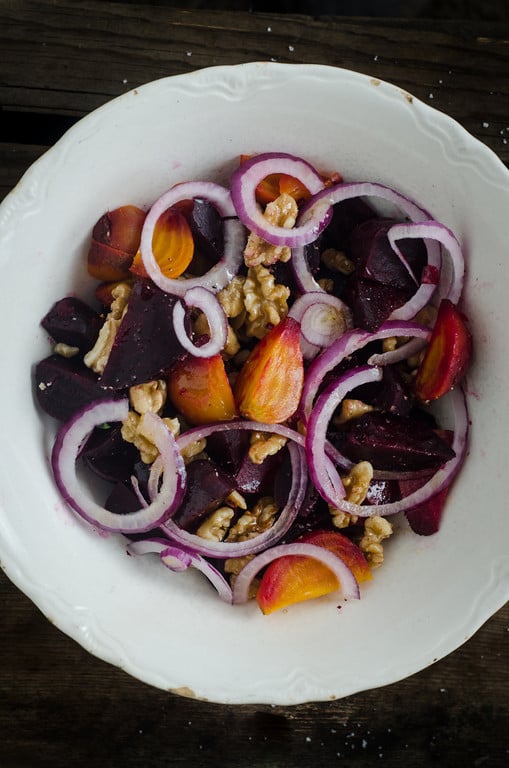
Kombucha vinaigrette, may seem like an unusual take on the classic combination of olive oil and balsamic or red wine vinegar, but, when complemented by the unique flavors of clove and allspice it can become a nourishing, if unique, dressing for any salad. I find it pairs particularly well with the sweetness of beets, apples, pears and nuts. Reminiscent of apple cider vinegar in combination with club soda, kombucha offers a unique flavor that is growing in popularity as more and more natural foods enthusiasts learn to cherish the beverage – a sweetened tea that undergoes a unique fermentation process through the use of a mother or symbiotic colony of bacteria and yeast.
Brewing kombucha is easy and, in many ways, effortless as it requires little else but a brewing container, tea, sugar and a mother which you can find affordably online (see sources). Though its origins are largely clouded in mystery, kombucha, like many of our favorite fermented foods, enjoys a rich heritage in Russia and central Asia where it’s hailed as a health tonic. Simply combine three quarts brewed tea with one cup sugar until the sugar is fully dissolved and the sweetened tea has cooled to room temperature. Mix the sweetened tea with about one-quarter cup brewed kombucha tea and a kombucha mother in a clean container, cover and allow it to ferment for about a week when the kombucha mother splits and produces a second, thinner scoby. Bottle the kombucha and ferment it again, if desired. Ensure that the tea, mother and baby are free from mold and other signs of potential contamination.
Kombucha tea and kombucha tea vinegar, like all fermented foods, are rich sources of B vitamins as well as beneficial bacteria. For this reason it is an excellent dairy-free probiotic. It is also a potent source of glucuronic acid, a substance which is thought to aid in detoxing1. Indeed, research on rats indicates that kombucha’s detoxing effects may help to mitigate the effects of environmental pollutants2 is a strong anti-oxidant with immune-modulating effects3 and may support the liver4; however, it’s important to note that comprehensive analysis of kombucha’s effects on human health are largely unstudied and most of the evidence linked to kombucha as a health food is based on traditional wisdom and anecdote.
Kombucha is widely available in health food stores, both those that are locally owned and those that are part of national chains; moreover, kombucha brewing is popping up as a sort of cottage industry and you might find a local brewer through your farmers market, newspaper or CSA. Customarily large bottles, approximately 12- to 16-ounces, of kombucha are available in the coolers at health food stores, but kombucha is a beverage with potently medicinal qualities and strict care should be taken to ensure it’s not consumed in excess – particularly when first beginning to drink it as kombucha has been linked to toxicity in some individuals5,6. If you wish to add kombucha to your kitchen, start with 2 to 4 ounces instead of 16-ounce bottles, or use it sparingly as in this recipe for kombucha vinaigrette.
Kombucha Vinaigrette
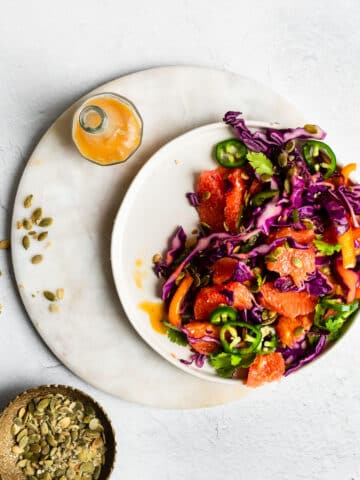
Consider serving kombucha vinaigrette, with its sweet and sour flavors enhanced by a touch of clove and allspice over fresh, richly flavored greens; alternatively, it pairs well with nuts, steamed beets, apples and pears. One of my favorite ways to serve this unique vinaigrette is over a composed salad of arugula, apples and toasted walnuts. For a variation of this recipe, consider substituting part or all of the unrefined extra virgin olive oil with walnut or hazelnut oil.
Kombucha Vinaigrette: Ingredients
- ¼ cup kombucha tea or kombucha tea vinegar
- 1 shallot, minced
- pinch ground cloves
- pinch ground allspice
- dash unrefined sea salt
- ¾ cup unrefined extra virgin olive oil
Kombucha Vinaigrette: Method
- Steam the beets until tender, about 20 minutes. Set aside to cool.
- Combine kombucha tea or kombucha tea vinegar, minced shallot, allspice, clove, unrefined sea salt in the basin of a food processor or blender.
- Blend to combine while slowly drizzling unrefined extra virgin olive oil into the mixture until the dressing is well-emulsified and uniform.
- Serve over the fruit, vegetable or greens of your choice.
YIELD: About 1 cup
TIME: about five minutes
1. Fallon. Kvass and Kombucha: Gifts from Russia. Weston A Price Foundation. 2. Gharib. Effects of Kombucha oxidative stress induced nephrotoxicity in rats. Chinese Medicine. November, 2009. 3. Dipti, et al. Lead induced oxidative stress: beneficial effects of Kombucha tea. Biomedical and Environmental Sciences. September, 2003. 4.Murugesan, et al. Hepatoprotective and curative properties of Kombucha tea against carbon tetrachloride-induced toxicity. Journal of Microbiology and Biotechnology. April, 2009. 5. SungHee, et al. A case of kombucha tea toxicity. Journal of Intensive Care Medicine. May, 2009. 6. Srinivasen, et al. Probable gastrointestinal toxicity of Kombucha tea: is this beverage healthy or harmful? Journal of General Internal Medicine. October, 1997.


I love kombucha, yet I NEVER though to add it to food or dressings. Fabulous idea!
I started brewing kombucha last year. After several brews I realized I didn’t care for it and let the batch just sit. I finally changed it and found that it had made a strong vinegar! Since then I’ve been using it for all kinds of things – as an acid for soaking grains, salad dressings, even in the shower as a rinse! So now I do a half gallon at a time and just change the brew as I run out of vinegar which is ever couple of months.
Love this idea, thank you so much for sharing.
Lovely. I think this same recipe would be wonderful replacing the clove/allspice with tarragon! Especially on the beets. Wouldn’t this be great on a cobb salad too!
My daughter saw the picture at the top of this post (she’s 2) and said “I eat?” She was very insistent about wanting to eat it, and when I scrolled down she signed “more” because she wanted to see the picture again! Not sure what she’d do if I really made it for her, but cute that she’s so intrigued by it.
Sounds fabulous and the picture looks so appetizing! I love beets.
Never thought about cooking with kombucha. What a great idea!
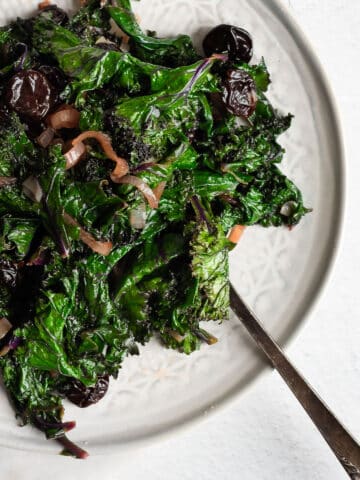
This looks great. I started making my own kombucha last spring, and all through summer and fall I sauteed chard and kale in kombucha. As it reduced, it became super flavorful. Even my friends who balked at my kombucha culture sitting on the counter commented on how good it was, and asked what the secret ingredient was!
This is a great idea! One day I forgot to bring salad dressing to work to have with my salad…but I happened to have some kombucha. I used it to moisten my salad enough to eat. Funny that I did this, but I never thought to actually make a dressing out of it! Thanks for the wonderful recipe!
So what would you do if you wanted to cut out the oils? I have been staying away from Meat, Dairy Products and Oil. I love Kombucha and am making my first one now. I also never thought of cooking with it though.
What do I replace the oil with? Any thoughts.
I don’t recommend a low-fat diet at all, and encourage the consumption of meat (from grass-fed/pasture-raised animals), raw dairy from grass-fed animals and healthy unrefined oils like coconut and olive.
As of today’s date, the link above to Sally Fallon’s article “Kvass and Kombucha: Gifts From Russia” is broken. Here is the correct one:
http://www.westonaprice.org/food-features/502-kvass-and-kombucha
Great article, btw, and thank you for the recipe!
~Leola