
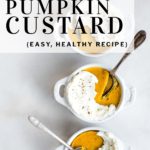
Pumpkin custard, like Maple Pecan Pie and Slow-Roasted Turkey, finds a place on my Thanksgiving table every November, and often throughout the winter too. Its luscious, velvety smooth texture and lovely pumpkin flavor that's laced with aromatic spices make the custard a perfect dessert for cold winter nights.
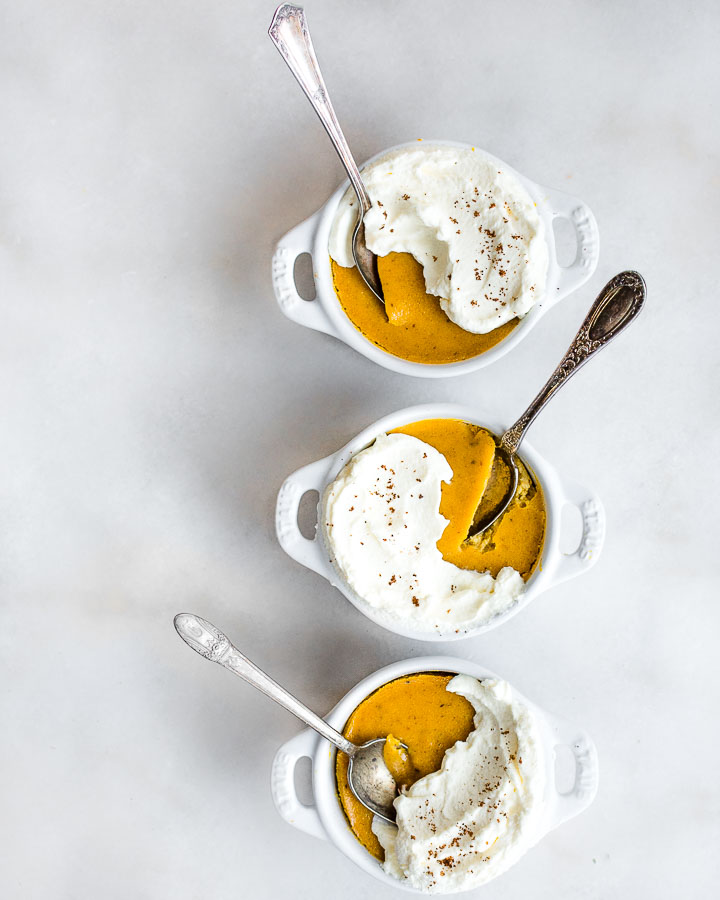
Unlike many pumpkin custard recipes, this one skips all the cans and uses only wholesome, fresh ingredients like roasted pumpkin purée, real cream, egg yolks, spices, and the lightest touch of maple for sweetness.
What is it?
Pumpkin custards, like homemade root beer, are a quintessentially American dessert. And, if you have an interest, you can find references and recipes for them in just about every early American cookbook.
Pumpkins are indigenous to North America, and colonists quickly adopted traditional European recipes to their use - among them custards. Early recipes often call for sweetening pumpkin purée with molasses, flavoring it with aromatic spices, and baking the custard in the shell of a pumpkin.
More often than not, modern recipes rely on canned pumpkin purée, ample brown sugar, sweetened condensed milk, and premixed spices. But, you'll find your results are better when you use fresh pumpkin purée rather than canned and enrich it with egg yolks, cream, and just the lightest touch of maple sugar.
Tips for making a good custard
Pumpkin custard is a super flexible dessert, and fairly easy to make. The key is to use a very smooth purée and plenty of fat for a luscious, smooth custard.
Use freshly roasted pumpkin purée rather than canned for better flavor. You can make pumpkin purée by splitting a pumpkin, removing the seeds, and roasting it at 400 F on a rimmed baking sheet until soft. Scoop out the flesh and whir it in a food processor or blender until smooth.
Use any winter squash you like, kabocha, red kuri, butternut squash and pie pumpkins all work fine.
Strain the custard base before baking. That way, you'll remove any stringy bits of pumpkin or unblended egg for a smoother texture.
Bake the custards in a water bath which keeps an even temperature. That means better, smoother texture.
Variations
While the basic recipe for pumpkin custard includes many of the same spices you'd find in pumpkin pie, you can easily adjust the recipe on the fly with whatever you happen to find in your kitchen.
Make it dairy-free by swapping full-fat coconut milk for the heavy cream.
Make it a little lighter by swapping half-and-half for the heavy cream.
If you don't care for maple, try using whole, unrefined cane sugar or even honey, but if you use a liquid sweetener, you may need to adjust the amount of cream you add.
Try vanilla in place of stronger spices. Vanilla bean powder or extract can give this custard a delicious sweet, musky floral aroma that blends beautifully with pumpkin.
Try adding ginger or star anise, for lovely, subtle heat and nice anise-like flavor.
If you really want pie, try baking this custard in a crust and you can skip all the junk that usually goes into pumpkin pies - like sweetened condensed milk.
Make pumpkin custards in the sous vide by filling mason jars, sealing them finger-tight and then cooking them at 176 F for 1 hour.
Naomi Minahan says
Healthy and tasty! I’ve made this recipe numerous times! It’s always a crowd pleaser!
Shannon Valle says
I love this recipe. It’s full of flavor and so light. Quick and easy to make too. This will definitely be at our holiday table!
C says
I’ve made this custard for several years now. I cook it in one large glass dish instead of in ramekins though. I also like lots of nutmeg in it and use about a half of a tablespoon of it freshly grated. It’s an easy recipe to play around with since custards are pretty forgiving, unlike cakes. I definitely recommend using the maple sugar and not substituting it with something else. It’s harder to source, but it is so worth it. It’s subtle real maple flavor perfectly complements all the others.
Kimberly says
I started at 4:30 in the morning to cook Thanksgiving dinner this year, & was determined to try this recipe. It was fantastic! I had to sub ginger for the cardamom, & my ramekins were larger than 6 oz., but it was so delicious! What is your recommendation for the best and fastest way to cook the pumpkin?
Jenny McGruther says
Hi Kimberly,
I'm glad you liked this custard! I usually cook the pumpkin a few days in advance by roasting it (400 F) until tender and then I puree it in a food processor. That way I don't have to do all the work the morning I plan to make the custards.
Aubrey says
This made an amazing pumpkin pie. It felt light and fluffy compared to other recipes, and was very tasty!
Colleen says
This was the most delicious, buttery custard! I used just 4Tb sugar and it was plenty sweet. May try 3 next time. I would also at least double the spices and add ginger because I love a spicy pumpkin custard. I used a full pie plate and put a dish of water in the oven to add humidity. Forgot to strain but it didn't matter. This is a keeper!
Elizabeth Lang says
I made this today for thanksgiving, and it exceeded expectations! I used butternut squash, and loaded the whole thing into a deep baking dish rather than mess around with individual ones and heated water and all that. I just used a bit of maple syrup and could’ve used even less. Just great, thank you so much!
Theresa says
Was looking for a pumpkin custard and this one stood out, because of the waterbath and because of the use of just egg yolks (no whites). I am here to say, the texture of this comes out creamy and light. I did taste the filling before cooking it, and ended up doubling the sugar (I used mostly brown and some white), and even quadrupling the spices. The freshly ground cardamom, I mixed with a little clove in the spice grinder added nice warmth! I also added about 1/4 tsp coriander and about 1/2 tsp salt (soo needed). So other than the spices, salt and sugar being quite short, as long as you taste the filling and adjust to what you like before baking, this ends up being super tasty. A trick I learned is to cook the filling till it reaches 175....this gives it a chance to form a bit of a skin on the top, but is still moist and creamy inside (DONT OVERCOOK)(. Also, I used half soy milk, half cream to cut back on calories, with no flavor loss. I suspect this could easily be made non-MILK by just using diary free creamer. THIS IS GOING IN MY HOLIDAY FAV's :).
Erin says
I made this custard with raw milk and my own pastured eggs. I thought the texture turned out beautifully, but it needed more sweetener, salt and spice! I'm hoping to try it again with better flavor next time.
Angela says
Tasty custard! I subbed canned coconut milk (just the solid part) for the heavy cream to make it dairy free. I also skipped the thickening step and just put it in the oven with a pan of hot water beside it. Turned out very good!
Paul says
Made this for the local WAPF meeting....it was FANTASTIC!