
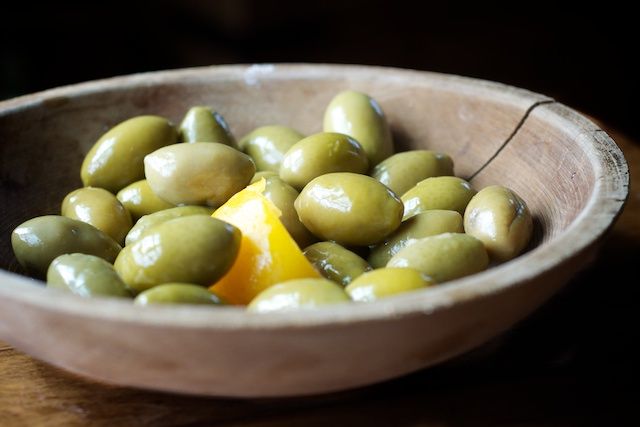
Home-cured olives - seasoned with chilies, lemon and North African spices - have finally made their way into our kitchen, and happily so. Not too long ago, we received a beautiful box of freshly harvested, green-ripe barouni olives from Chaffin Family Orchards out of California. Since then we've patiently waited and waited for our olives to lose their soapy bitterness and gain a saltiness spiked by hot peppers, lemon and garlic.
Olives are among our favorite foods. They enjoy a rich heritage having been cultivated across the middle east and Mediterranean region for thousands of years. Though olive oil has always been prized both for grooming and culinary uses, my love rests with the well-spiced and wonderfully salty fruit. Olives are rich in mono-unsaturated fat, vitamin E and polyphenols which account for the fruit's strong, bitter flavor. A good soaking in brine and spices tempers the olive's natural bitterness.
In preparing my batch of olives at home, I chose to water cure them - as it's a relatively faster approach to olive curing and, as you can imagine, I was eager to see the results of my first adventures in olive curing. Other methods of curing olives at home include treating the fruit with lye, brining them whole and curing them in salt. I imagine, next season, we'll try a different method of curing olives. Water curing is simple and remarkably easy; just clean the olives, discarding any marred fruit, and pound them with a mallet or rolling pin until the fruit is slightly bruised. Over a period of days or even weeks, depending on how much bitterness you prefer, soak them in clean water, changing it frequently. You'll notice that the olives will release some of their oils and that oil will rise to the top of the water every day. Follow this by a heavily spiced brine, and you have home-cured olives.
We're looking forward to serving our olives at the Thanksgiving table and throughout the year as appetizers or in lovely, rustic tapenades. Some we seasoned with provincial herbs, others with Greek oregano and garlic, but these olives we seasoned with a savory array of North African spices. I can't wait to pair them with a Moroccan-spiced Roast Chicken or on fresh bread smeared with authentic labneh and a slice of preserved lemon.
Angela says
This sounds delicious! When fermentation is complete, should the olive mixture be refrigerated?
Cindy Murillo says
I have a question about fermenting lemons. When using mason jars, would you prcess the in a hot water bath to seal the jars? Also, can the same be done with Valencia Oranges?
Dale Siar says
It is that time of year where the Chaffin Farms have the olives. But you are changing the water twice a day for a week, is that due to the raw lemons? As the spices would not seem to ferment that much? The University of California, puts the olives in the same brine for two months, then a final change for 2-4 months. Due to foaming and evaporation, the solution is checked every 6-7 days.
Why so different?
Diane says
In the recipe you say to place a 1/2 gallon of olives into a 1/2 gallon container with spices than mix a 1/2 gallon of brine and pour it over the olives. Did you mean 2 half-gallon containers? I have a feeling I'm being dense and missing something? Thanks for this recipe! I am through the soaking and my taste buds are watering for the final delights!
Aria says
During the time the olives are soaking in filtered water and during the time they are left to ferment, are they to be left out at room temperature or refrigerated?
Jenny says
Always room temperature.
Bobbi says
Hi Jenny,
A quick question about the final brining process--do you keep the jar sealed while they ferment or leave the lid on loosely to allow the gasses to escape? Also, how do you store them once they are done?
Bobbi
joette says
Hi, I have a question! I'm seeing your blog for the first time and I started water-curing a little over 6 weeks ago. I don't know what kind of olives they are -- they're from my neighbor's tree and they have no idea what they are. They're tiny and brown to black. I didn't crush them because someone else told me I didn't need to. However, 6+ weeks later and some are getting a little soft and coming apart and the olives still have bitterness. Not unpleasant really, but there is a bitterness. I noticed you say they will retain a bitterness and I'm so happy to see this!!! So, perhaps they're ready to go into salt water now? I would like to ultimately just put them in olive oil. Thanks and looking forward to your reply! 🙂
Brian says
Some Olive growers told me to only dry cure ripe olives and use brines for green. I don't know if that's a "rule" or just a tradition. Good luck!
Tessa says
I ordered olives from Chaffin Family Orchards and followed the recipe. I rinsed them for 2 weeks and were less bitter when I tasted them. Now, after almost 2 weeks in the brine, they are very bitter. Are they going to get better with time? They are not edible at this point. Please help!
Wendy Waldron says
Seriously you'd send olives to marly? I would love to have you send some to me! Wendy Waldron 741 E. Dolphin Ave. Ridgecrest, ca 93555
Meryl Dunton-Rose says
So glad to find your site with the luscious Moroccan recipe! We are in the process of curing some small olives we picked in Northern Spain. Not sure how they will turn out! The brine didn't seem to release bitterness but we did forget to cut or pound the olives! Ah well, will try again with the water method after cutting them.
Patti Johnson says
Hi, Jenny! First, I love your blog. I just discovered it last week. Wow! I have learned A LOT! I also took your recent webinar. AWESOME! Second, in the recipe for your home-cured cracked olives, can I use 1/4 C of Raw Apple Cider Vinegar or is that not good? I have Raw ACV but no other type of raw vinegar in the house right now. I could go out a buy some but was wondering if the Raw ACV would work just as well. Oh, I would love to taste these olives! Sounds delicious! Third (and last), if you ever send out samples, let me know. I'd be interested in getting a sample! Thank you so much! Blessings to you and your family. 🙂
Maggie says
Hi Patti J, I just discover this amazing site,I have the same question about tha Raw ACV,so can you tell me if is ok to use it because that's is what I have Braggs ACV(Raw ) also when you let it ferment you have to tight the cap of the Jar or just leave it loose,thanks for your response
Brilana says
Jenny, I just ordered my olives from Chaffin Orchards and have the same questions as Patti and Maggie. First time curing olives and am pretty excited to add this to my repertoire.
Amy says
I just picked about 10 pounds of small black olives, I have no idea what kind they are. I'd like to cure them, but am not sure if water curing is appropriate for black-ripe olives.
Thanks for any advice!
Brian says
I've had luck dry curing them! I got two 5 gallon buckets, drilled holes in the bottom of one and nested it inside the the other. I got a lot of salt (form cotsco) and filled the upper bucket with it. I put my ripe olives in and mixed them into the salt. Every day I mixed them by hand, but it would probably not matter if you missed a few days. The salt draws out the bitterness over time. The salt will get damp like snow and the excess will drip to the bottom bucket. This process take a while but it yields some really strong tasting olives that are shelf stable, although I keep mine in the fridge so they'll last for a really long time! I also just leave them in the salt until I need them. When I do, I just fish them out and rinse them and throw them in whatever I'm cooking. I find them a bit too strong to eat out-of -hand but my wife loves them. I'm going to try them again this year, but maybe try putting a small slit in the side of a few to see if that speeds the process or leaches out more of the bitterness.
Kirsten says
I was wondering how these turned out?
Cherie Harper says
I'm trying to get to that yummy looking recipe for Red Chili Pork with the Pineapple Salsa, and I keep getting kicked into this olive recipe....not that the olives don't look amazing too! 🙂
Linda says
I cure olives every year, and it's one of the simplest and most rewarding of the 'projects' I have on the go.
I'm so glad you had a great experience. It's simple, like you say, anyone can do it!
Cheers, and thank you for sharing great food!
Tina~ says
Jenny,
Yummy! These look incredible. I remember reading a post about the organically grown olives last fall, but when we tried to order them they were out of stock.
When is olive season? I'd love to order some.
Do you know how commercial olives fall on the food safety issue? I don't really trust the curing process...sound of lye in my food concerns me. I wouldn't mind paying for safe cured olives if I knew which ones were actually safe to feed my family. Perhaps a topic for discussion?
Thanks, I love your blog 🙂
Nancy says
So... how did the olvies turn out? I have a Barouni olive tree and would like to cure the olives this year. My tree has given a good yield of fruit the last two years and I've had to throw them out due to lack of finding anyone to cure them. I don't a cook so this will be a chanllenge for me, i.e. kitchen terminology. Where in California are you located? Thanks for listenting.
Sustainable Eats says
so I am curing mine according to the sicilian method - in vinegar brine and they were looking great but when I went to check on them today they are getting black in spots! Did that happen to yours? I have some in the harsch so no air at all and some are in a stone crock submerged but not as effectively. Derp!
Jenn AKA The Leftover Queen says
YAY! I was so looking forward to this post, Jenny! Your olives look fabulous! I love all the flavors you used.
On another note, I had a good time, reading your blog as one of the Nominees in the Foodbuzz Food Blogger Awards this past weekend! 🙂
Jenny says
Marly -
I'll be happy to send you a batch - we have several gallons of the Moroccan style olives. Just be aware that my kitchen is NOT a commercial kitchen. Email me your address, and I'll send some off if you're really interested!
Take Care -
Jenny
Cheryl says
I'm so happy I ran across your olive receipe! The ones I've read use lye! so it's nice to see one that's natural and not so difficult. Thanks! Oh and if you happen to have any olives left, I loved to try them. 🙂
Cheers
Marly says
Jenny,
I'm so envious. I love olives, too! Any chance of sending me a taste? 🙂 You must be proud of all your hard work to be finally eating your rewards. Congratulations!
Melissa @CelluliteInvestigation says
I grew addicted to olives when I studied abroad in Tunisia, but the good ones at the grocery store are so expensive. I never would have thought of curing my own. Thank you for the inspiration!
Anna says
I was SO glad to see this post! About a year ago we planted an olive tree in our front garden. Not only is it a lovely landscape tree in our Southern California garden, but I hope to eventually harvest olives for my family's use. Right now the tree is young and getting established in it's new site, so it's putting out new growth, not fruit.