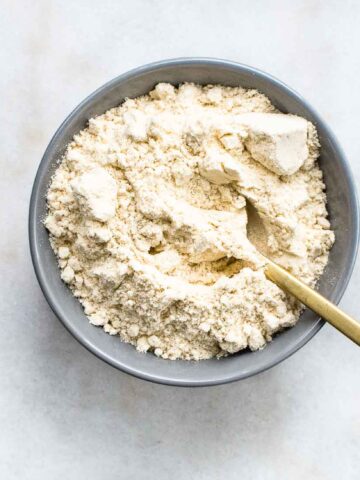

Grass-fed ghee is one of our favorite cooking fats and something we always keep in the cupboard. Its rich flavor profile and stability at high temperatures make it something we reach for again and again.

Why we love ghee
It's vitamin-rich. It's packed with vitamins A, D, E and K.
Because it's pure butterfat, ghee is naturally free from lactose and casein. So, it's suitable for people with dairy sensitivities.
Its rich, buttery flavor makes it an excellent companion for spices and root vegetables.
Thanks to its high smoke point, it can handle high-heat cooking.
What is ghee?
Ghee is a type of clarified butter used in South Asian cooking. It plays a staple role in Indian cookery and Ayurvedic medicine. It has a buttery, nutty flavor and a deep yellow-gold color.
Traditionally, it has been revered not only for its culinary applications but also for its role in religious rituals and traditional medicine. In India, it is often used in sacred offerings and is considered a symbol of auspiciousness and nourishment.
All ghee starts with butter. Then, it's slowly simmered over low heat until it melts and the milk solids separate from the pure, golden butterfat. Then, the milk solids are removed, leaving only pure fat.
Removing the milk solids and clarifying butter does two things. First, it lengthens ghee's shelf life. Second, it increases its smoke point.
So, while butter has a relatively short shelf life, it can be safely stored for up to a year at room temperature. Similarly, while butter has a smoke point of 302 ℉ (150 ℃), ghee's smoke point is 482 ℉ (194 ℃).
Is it good for you?
When made with the butter of grass-fed cows, ghee is a rich source of fat-soluble micronutrients. Those include vitamins A, D, E, and K as well as beta-carotene.
It's also rich in healthy fats. These nourishing fats include conjugated linoleic acid, which may support metabolic health (1). It is also a good source of butyric acid. Some research links butyric acid to better digestive health (2).
Ghee is pure butterfat and doesn't contain the milk solids you find in butter. The milk solids contain casein (milk protein) and lactose (milk sugar), the two components of dairy products that can trigger sensitivities. Since these components are absent in ghee, many dairy-sensitive people discover they tolerate it well.
What to Look For
The most nutritious (and flavorful ghee) is made from grass-fed, cultured butter. That means the butter comes from cows raised on pasture where they can graze freely. As a result, it's richer in fat-soluble vitamins and healthy fats.
Look for ghee that has a rich golden-yellow color with no separation. Its only ingredient should be butter, except for herb-infused varieties, which also includes herbs and spices.
Avoid purchasing vanaspati or vegan ghee. These "plant-based" options lack the nutrient value of true, grass-fed varieties. Moreover, they're often made with questionable ingredients. Some higher-quality options include coconut and avocado oil, but others use hydrogenated palm oil and food dyes.
Where to Find IT
You can find ghee in most grocery stores, natural foods markets, and online. Stores specializing in Indian and other South Asian cuisine will also stock it.
Our Favorite Recommendation
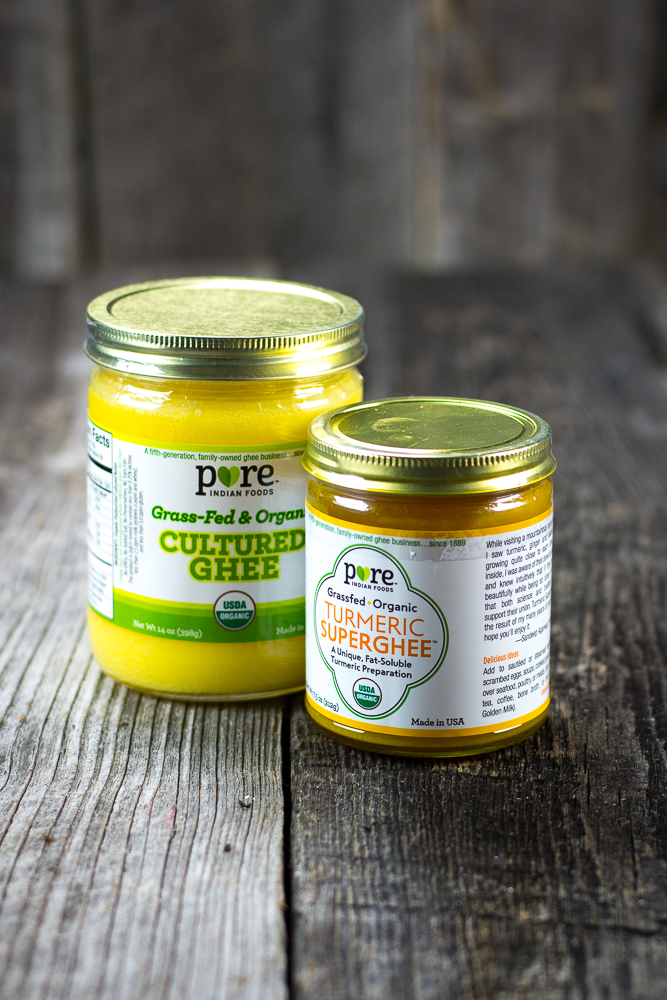
We love Pure Indian Foods organic grass-fed ghee. It's a small, family-run business by a 5th-generation ghee maker.
How do you use it?
While ghee is made from butter, it cooks much more like olive, coconut, or avocado oil. That's because it's pure fat.
Thanks to its high smoke point, it's perfect for high-heat applications. Use it to sauté aromatics such as ginger, garlic and shallots. Or dot a little ghee over root vegetables and set them on a sheet pan to roast. Melt some and pour it over popcorn instead of butter.
Recipes that use Ghee
Sole Meunière is a pan-fried fish dish touched with lemon and parsley.
Garam Masala Chicken Curry is a simple weeknight dish that starts with sautéing aromatics in ghee. Then, you add chicken and simmer it all together in coconut milk and sweet, warming spices.
Root Vegetable Soup is an easy recipe for cold weather.
References
- Badawy, Sara et al. "Conjugated linoleic acid (CLA) as a functional food: Is it beneficial or not?." Food research international (Ottawa, Ont.) vol. 172 (2023): 113158.
- Banasiewicz, T et al. "Microencapsulated sodium butyrate reduces the frequency of abdominal pain in patients with irritable bowel syndrome." Colorectal disease : the official journal of the Association of Coloproctology of Great Britain and Ireland vol. 15,2 (2013): 204-9.